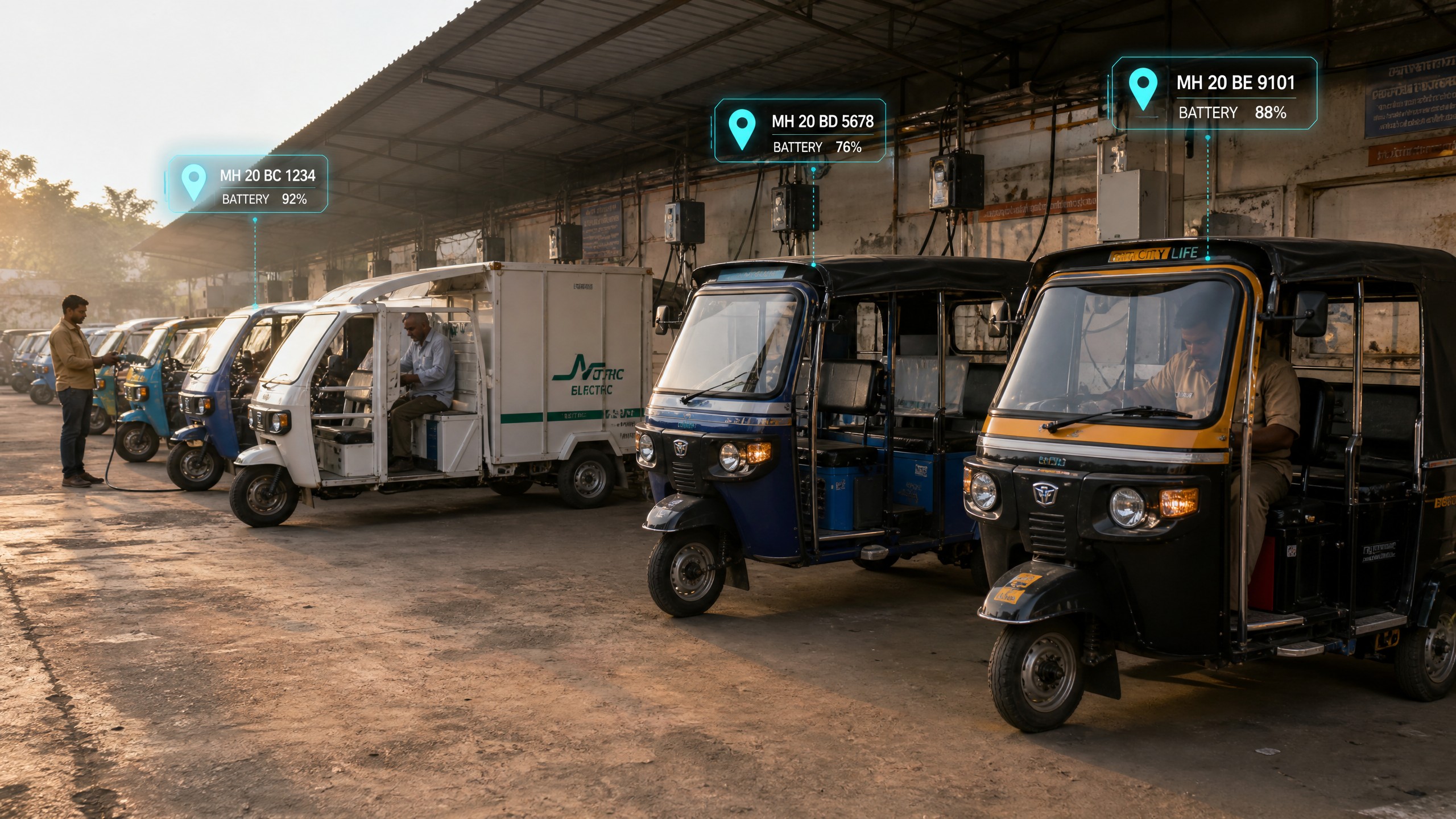
Electric Three Wheeler Telematics Platform Built for Indian Fleets
Location, battery health, charging behaviour and compliance data from L3 e rickshaws and L5 passenger and cargo three wheelers, in one platform that fleet operators, OEMs and lenders can each use.
More than three out of every five new three wheelers sold in India are now electric, and almost none of them run on software designed for this vehicle class.
An L3 e rickshaw and an L5 cargo three wheeler expose completely different data, and a platform that treats them as one thing fails on both.
Navionyx reads what each vehicle can actually give, tells you honestly what it cannot, and serves the operator, the lender and the OEM from the same stream.
Segment Scale
India now sells more electric three wheelers than any other commercial EV category
830,819Electric three wheelers retailed in FY2026, up 19 percent year on year
Vahan registration data
60.9%Of all three wheeler retail in India is now electric
FADA retail reporting, FY2026
101,905 / 89,604Units from the two largest sellers in FY2026, a gap of just over 12,000 units
Vahan data, FY2026
~84%Of the L5 passenger category sits with the three largest manufacturers
JMK Research
The electrification of India's three wheeler is not a forecast anymore. It has largely happened. More than three out of every five new auto rickshaws and cargo three wheelers sold in the country are electric, and FY2026 retail crossed 830,000 units for the first time.
What matters operationally is the shape of that market, not the headline. The segment splits into two very different halves, and a telematics platform that treats them as one thing will fail on both.
The L5 half is consolidated. The three largest manufacturers hold roughly 84 percent of the L5 passenger category, and L5 cargo shows similar concentration. These are proper automotive products with CAN networks, structured battery management, and in many cases a factory fitted telematics unit already transmitting to the manufacturer.
The L3 half is the opposite. E rickshaws and e carts come from a long tail of small assemblers, in a field so fragmented that the three largest players together hold only about 13 percent of the passenger segment. Many of these vehicles are assembled from imported kits. Some expose no diagnostic interface at all.
Both halves are financed. Both halves are commercial assets earning daily income. Both need visibility. They just cannot be instrumented the same way, and any vendor who tells you otherwise has not fitted enough of these vehicles.
Design Constraints
Four reasons truck telematics does not transfer to an e rickshaw fleet
1
The revenue per vehicle will not support the cost model.
A tracking platform priced for a container truck, where a single vehicle carries lakhs of rupees of cargo, cannot be sold at the same per vehicle rate to an operator whose asset earns a few hundred rupees a day. The economics force a different architecture, cheaper hardware, leaner data plans and higher device density per server, and those constraints have to be designed in from the start rather than discounted in later.
2
There is usually no fleet manager.
The typical electric three wheeler owner in India holds between one and five vehicles. There is no operations centre and no one paid to watch a dashboard. Alerts that assume a person is monitoring a screen simply do not get seen. Intelligence has to reach the owner and the driver on a phone, in a language they use, with a single clear next action.
3
The driver is often not the owner.
A large share of e rickshaws run on a daily rental model where the driver pays a fixed amount and keeps the balance. That changes what the data means. Idle time is not laziness, it is queue time at a stand. Night movement on a rented vehicle is a different signal from night movement on an owner driven one. Utilisation without the ownership context is misleading.
4
The vehicle may not have a port to plug into.
OBD based telematics assumes a standardised diagnostic interface. Most L3 e rickshaws do not have one. What exists instead is a battery pack, a controller and a wiring loom, and the honest answer is that the depth of data available varies vehicle by vehicle. The integration tier table below sets out exactly what we can read from each tier.
To that add the network reality. The largest concentrations of electric three wheelers sit in Uttar Pradesh, Bihar and West Bengal, where 2G coverage still carries a meaningful share of traffic and where dead zones are routine. A platform that drops data when the network drops is not fit for this segment.
Data Streams
What the platform reads from the vehicle, and what each signal is actually for
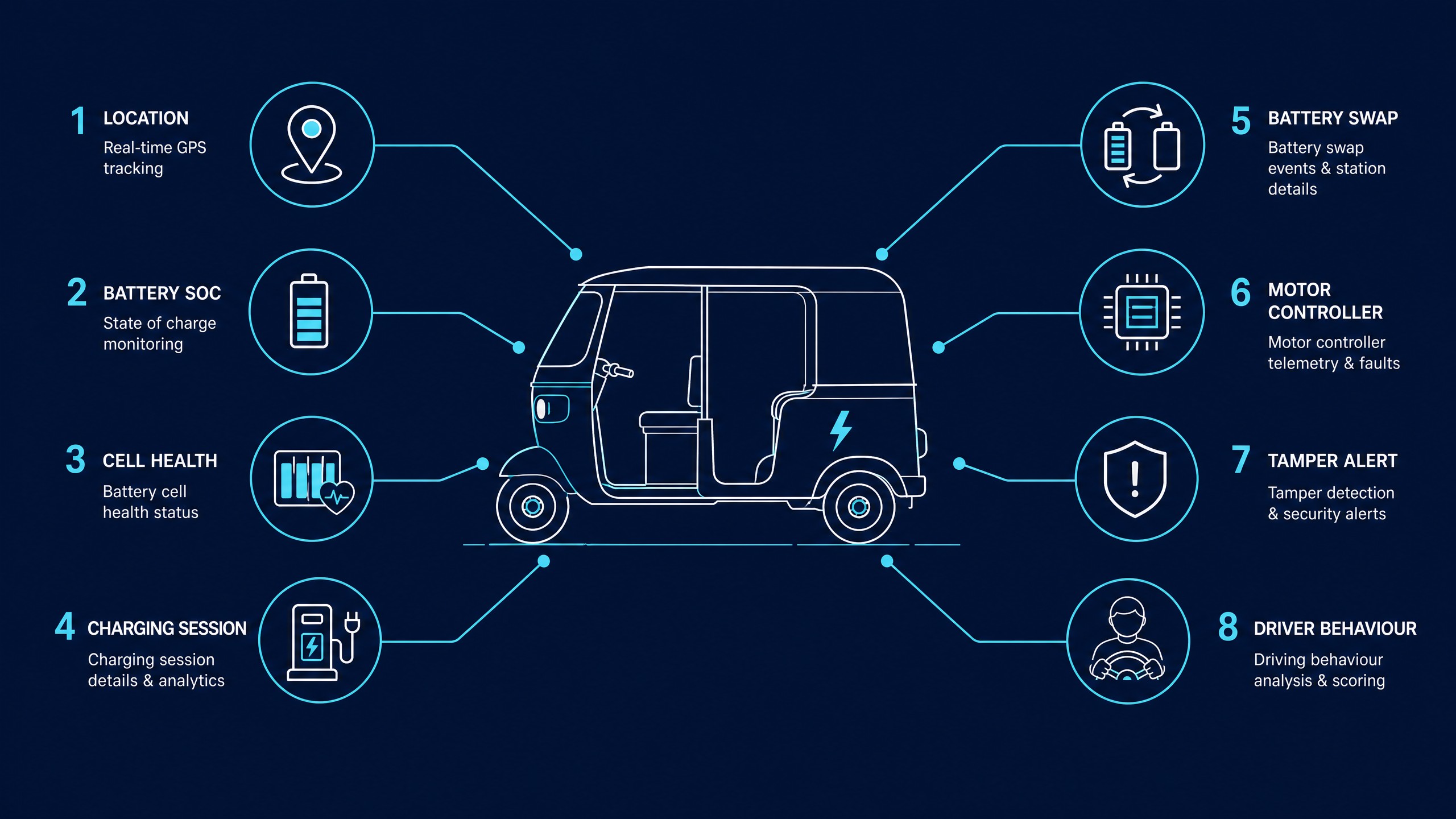
A feature list is not useful unless each item connects to something a person does differently as a result. These are the eight streams that change decisions on this vehicle class.
Location and ignition state
Position, speed and whether the vehicle is powered.
Decision it drives: Recovery of a stolen or absconded vehicle, verification that a rented vehicle is working the shift it was rented for, and the base layer for every compliance requirement.
State of charge and its rate of change
Not just the current percentage, but how fast it is falling under load.
Decision it drives: Whether this vehicle can complete another trip before it needs to charge. Percentage alone is close to useless on a vehicle whose consumption doubles with a full passenger load and a gradient.
State of health and cell voltage spread
Capacity retention against the original pack, and the delta between the strongest and weakest cell.
Decision it drives: Whether to plan a pack replacement, defer one, or flag a warranty claim. On a financed vehicle this is also the residual value of the collateral.
Decision it drives: Whether a session that was reported as complete actually completed. A charger delivering 60 percent of its rated output still ends the session, and the driver leaves with less range than assumed.
Swap events, where the vehicle uses a swap network
Which pack left, which pack arrived, at which station, at what state of charge.
Decision it drives: Reconciliation of energy cost, and correct attribution of degradation to a pack rather than to a chassis. Without this the battery history of the vehicle is fiction.
Motor controller faults and derate events
Fault codes and any state where the controller is limiting available power.
Decision it drives: Whether a driver complaint about a slow vehicle is a real fault or a battery issue, before the vehicle is sent to a workshop.
Tamper, panic and unauthorised access events
Device removal, power disconnection, panic button press, and any attempt to write to the vehicle from an unauthorised source.
Decision it drives: Immediate escalation. On this vehicle class the device itself is a theft target.
Driver behaviour, redefined for a 25 kmph vehicle
Harsh acceleration and braking, cornering load, and overloading indicators.
Decision it drives: Coaching and insurance conversations. Speeding alerts calibrated for highway vehicles are noise here. What matters is the stop start pattern that drains a pack and wears a controller.
Compatibility
Four integration tiers, and an honest statement of what each one gives you
The single most useful thing a telematics vendor can tell you before you buy is what they cannot measure on your specific vehicles. Depth of data on an electric three wheeler depends entirely on what the vehicle exposes. There are four tiers.
Electric three wheeler telematics integration tiers, showing what data is available and unavailable at each tier
Tier
Typical vehicles
What is available
What is not
Tier 1: Manufacturer telematics API
Factory connected L5 passenger and cargo models from the larger three wheeler manufacturers
Location, true state of charge, pack level health, charging events and fault codes, at intervals the manufacturer defines
Cell level detail is rarely exposed. Data frequency is set by the manufacturer, not by you. Nothing flows until a data access agreement is in place
Tier 2: CAN with a vehicle specific decode
Most L5 passenger and cargo three wheelers with a proper CAN network
State of charge, state of health, cell voltages and temperatures, current, controller faults, at the frequency you choose
Requires a decode profile per vehicle model. A new model needs profiling before deployment, typically one to three weeks
Tier 3: Direct battery management link
Lithium packs on mid tier L3 and lower cost L5 vehicles with a serial interface on the pack
Pack voltage, current, temperature, cell balance and state of charge from the pack itself, independent of the vehicle
No vehicle side data such as controller faults. Pack must be accessible and the interface documented or reverse engineered
Tier 4: No clean battery interface
Older lead acid e rickshaws, unbranded assembled vehicles, kit built units
Location, ignition, movement, tamper, voltage at the terminals, and usage derived estimates of energy consumption
True state of health. Cell level anything. Any number presented as SoH on these vehicles is an estimate and we label it as one
One point on Tier 1 that vendors tend to leave vague. Where a vehicle is factory connected, the data right usually sits with you as the registered owner and operator, not with us. What we do is help you exercise it, by handling the technical integration once your manufacturer grants access. We do not claim standing access to any manufacturer's telematics feed, and any vendor who does is worth a follow up question.
The design principle that follows from this table is degradation, not pretence. When a vehicle sits in Tier 4, the platform shows fewer fields rather than showing confident numbers it cannot support. A fabricated state of health figure is worse than a blank, because someone will price a loan or defer a replacement against it.
Before any deployment we run a compatibility assessment across a sample of your fleet and return a tier map: how many of your vehicles land in each tier, and exactly which fields you will see for each. That document is the honest version of a feature list.
Charging and Swapping
Why charging data on a three wheeler has to come from the battery, not the charger
The running cost argument for electric three wheelers is well established. Around 40 paise per kilometre against roughly 4 rupees per kilometre for an ICE three wheeler is what put 830,000 of these vehicles on the road last year. The problem is that almost none of that energy passes through infrastructure that produces a usable record.
An e rickshaw charges at the driver's home, in an informal garage, off a domestic connection, or at a swap cabinet run by a shopkeeper. Charger side telemetry does not exist for the majority of this fleet, and network level logs cover only the organised swap networks. If you want to know how a vehicle is being charged, the only reliable vantage point is the battery itself.
That is the design decision behind our EV charging analytics built to read the session from the battery side. The device on the vehicle records pack temperature, current, charge rate and state of charge through every session, regardless of charger brand, network or location. Session history, slow charging alerts, deep discharge detection and a charging behaviour score all derive from the vehicle, not from the infrastructure.
3.0%Annual battery degradation for fleets relying on high power DC fast charging for more than 12 percent of sessions, per a 2026 fleet analysis of over 22,700 electric vehicles.
1.5%Annual degradation for comparable vehicles charging primarily on AC or lower power. The gap is a behaviour outcome, not a design flaw, which means it is measurable and correctable.
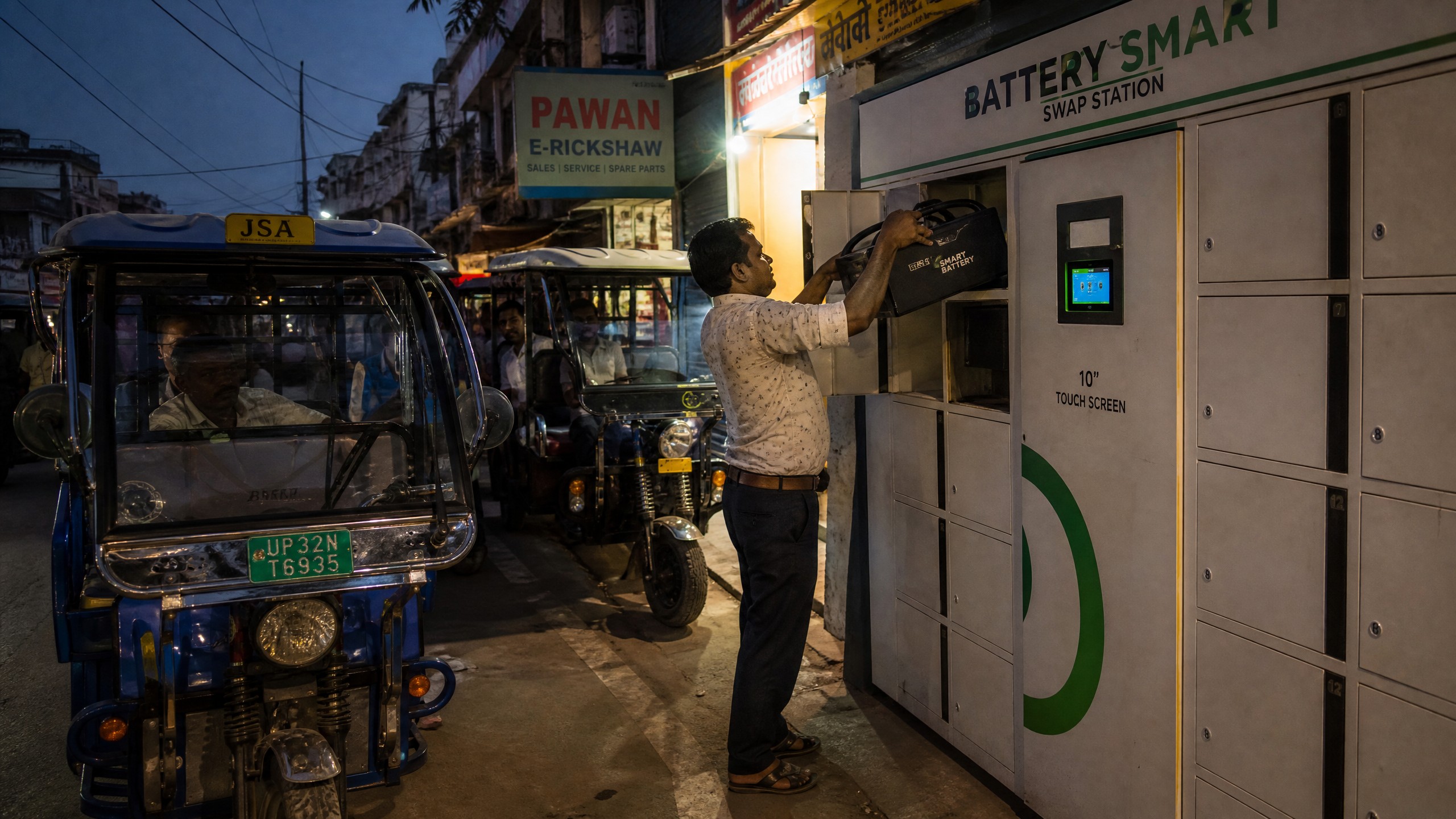
Swapping changes the data model rather than just the workflow. India's three largest swap networks together operate several thousand stations across the major metros and a growing set of tier two cities. The largest of them has crossed 100 million cumulative swaps with more than 281,000 batteries in circulation, according to company disclosures reported in mid 2026. Roughly 80 percent of installed swap infrastructure in the country serves two and three wheelers.
On a swapping fleet, the battery does not belong to the vehicle. Pack identity has to be tracked separately from chassis identity, and every degradation signal has to be attributed to the pack that was actually installed at the time. Platforms that key battery history to a vehicle registration number produce nonsense on swap fleets, and the error compounds silently over months.
Uptime
On a three wheeler, two days of downtime is a missed loan payment
For a logistics company, a vehicle off road is a scheduling problem. For an electric three wheeler owner, it is a direct hit to household income in the same week. That asymmetry is the reason maintenance strategy on this vehicle class has to be different, not just better.
Scheduled servicing fails on electric vehicles because the dominant failure mode is not mechanical. Batteries degrade electrochemically, and the first visible symptom is usually a vehicle that stops earning. Gradual capacity fade, silent cell imbalance, and thermal stress that accumulates in sustained ambient heat above 40 degrees Celsius do not announce themselves on a service calendar. An operator following the OEM schedule and nothing else has no view of that curve until the vehicle drops out of service, or until the warranty window has already closed.
Our predictive maintenance for EV fleets workflow converts those signals into a planning window. State of health trend against the expected curve for that duty cycle, cell temperature and voltage outliers, usage based service timing that counts charge cycles and route severity rather than calendar days, and a per vehicle breakdown risk score.
What a 60 to 90 day early warning is actually worth to a small operator is specific and unglamorous: time to arrange a replacement pack at a negotiated price rather than an emergency one, time to book a rental vehicle for the driver so income does not stop, and time to file a warranty claim while the vehicle is still inside its coverage window rather than three weeks after.
60 to 90 daysEarly warning window ahead of a battery related fault, against reactive failure responseUp to 30%Pack life extension observed where thermal stress and degradation patterns are corrected early18 to 24 monthsTypical replacement deferral when fleets act on live battery health signals rather than calendar programmes
For Lenders
Telematics as underwriting infrastructure for electric three wheeler lending
Electric two and three wheeler loans in India price roughly 5 to 14 percent costlier than their petrol and diesel equivalents, according to RMI's work with Indian NBFCs, in a segment projected to reach around 3.7 lakh crore rupees by 2030. That premium is not primarily a credit story. Most borrowers are new to credit with thin files, and lenders report that they rarely default deliberately. The premium is an information story. The lender cannot see the asset, cannot value the collateral, and cannot tell early distress from a bad week.
Telematics closes each of those gaps in a way that is specific and auditable.
Utilisation as repayment capacity
Trips and kilometres per day are the closest available proxy for the borrower's earning, and a sustained drop is visible weeks before an EMI is missed.
Battery state of health as collateral value
The pack is 30 to 50 percent of the vehicle's cost. A loan secured against a vehicle with an unknown pack is secured against an unknown number.
Early distress signals
A vehicle that stops moving, moves outside its normal operating geography, or goes offline is a case for a phone call, not a field visit.
Recovery
Where recovery becomes necessary, location and asset condition data shorten a process that is otherwise expensive and adversarial.
Where we draw the line
Remote immobilisation of a financed vehicle carries real regulatory and reputational exposure, and fair practice expectations around recovery conduct apply to digital methods as much as physical ones. Disabling a vehicle is disabling a person's livelihood, and it should never be the first tool a platform reaches for. Our default posture is to alert early and often, so that the situation is resolved by a conversation while it is still small. Any command capability is permissioned, logged, and auditable, and we will not deploy it for a lender who wants it as a routine collections instrument. That position is built into how our EV loan asset protection workflow is designed.
Permissioned Sharing
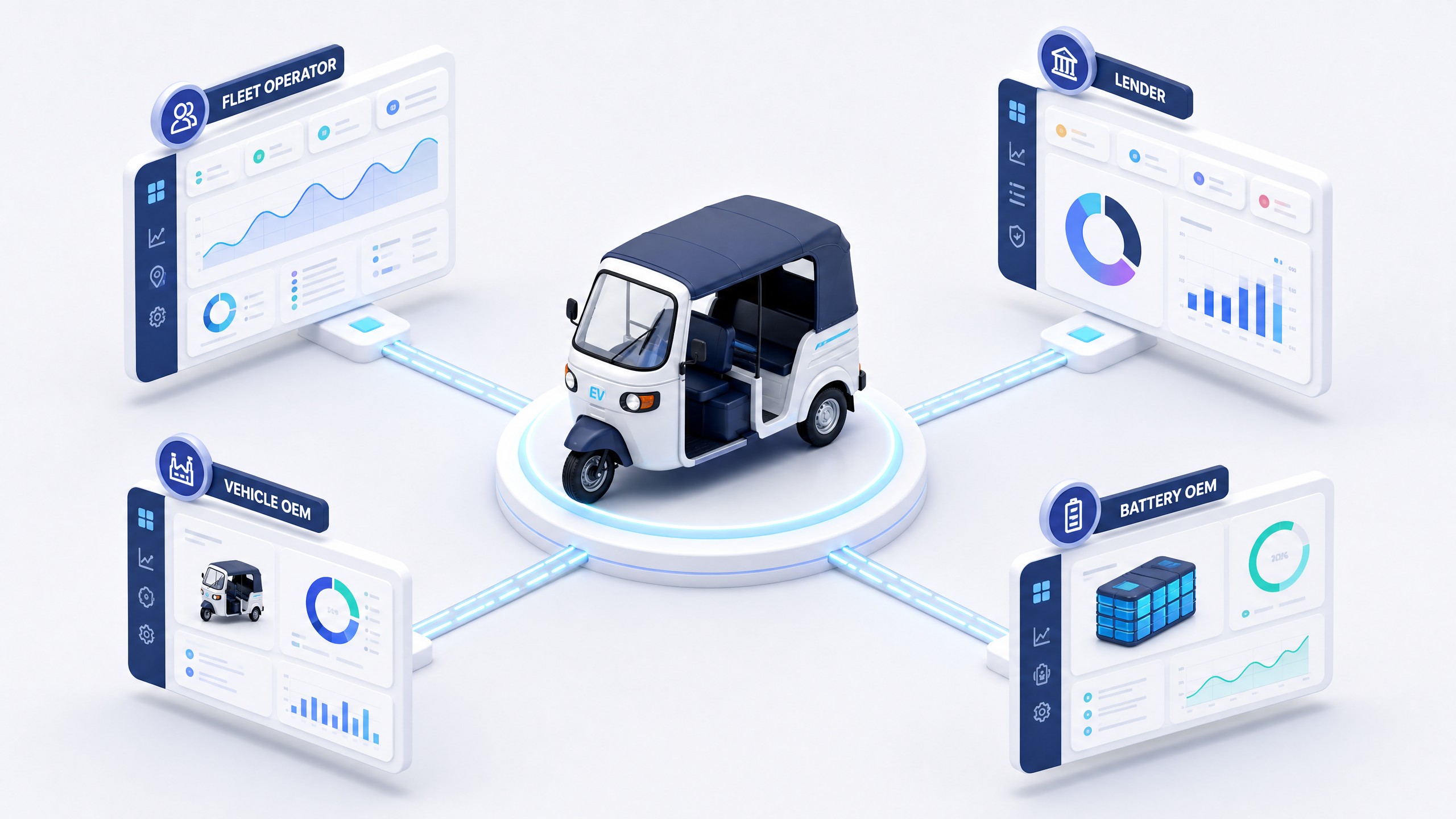
One vehicle, four parties, four different questions
Something unusual happens on an electric three wheeler. The same telemetry stream has four legitimate buyers at once, and each of them is asking a different question of the same data. Very few vehicle categories work this way, and it is the reason a platform for this segment has to be built around permissioned sharing from day one rather than adding it later.
The operator asks
Will this vehicle earn today?
Charge state, fault status, driver location, and whether the vehicle can complete the shift.
The lender asks
Is this asset still worth what I lent against it?
Utilisation trend, battery health, location, and early distress signals.
The vehicle OEM asks
How is my product actually holding up?
Field performance against specification, failure clustering by model and batch, and real duty cycles rather than assumed ones.
The battery OEM asks
Was this pack abused before the claim arrived?
Cell history, charge cycle records, thermal events and deep discharge frequency, captured from the day the pack entered service rather than reconstructed after the claim.
The battery OEM question matters more here than in any other segment. Packs represent 30 to 50 percent of vehicle cost, and the L3 tier runs on the most cost constrained cells in the market. Every warranty contract excludes deep discharge, over temperature operation, unapproved charging and tampering, and almost none of those exclusions are enforceable in practice, because the OEM has no record of how the pack was treated. Without a deployment record the OEM pays every claim or contests every claim, and both are expensive. Our battery warranty validation with cell level evidence turns that from an argument into a document: cell history, charge cycle records, thermal events and deep discharge frequency, captured from the day the pack entered service rather than reconstructed after the claim.
Platform Architecture
What has to be true of the platform underneath
The four party requirement in the previous section is not a commercial nicety. It is the hardest architectural constraint in this segment, and it determines most of what follows.
Multi tenancy with separate branding, permissions and data scope
One vehicle, four parties, and each of them needs their own view under their own brand with their own users and their own scope. An OEM offering connected services to its dealers, a dealer serving fleet customers, and a financier monitoring a book across many operators are three different tenancy shapes on the same fleet. This is why our white label fleet platform exists as a first class capability rather than a rebranding option.
Protocol adapters rather than a single device assumption
This market has dozens of device vendors and several de facto protocols. A platform that only ingests its own hardware locks the customer in and cannot absorb the vehicles they already own. Ours ingests from multiple device families and from OEM APIs.
Ingestion sized for high packet volume from cheap devices
Hundreds of thousands of low cost units reporting frequently is a different scaling problem from a few thousand trucks. Backpressure handling and idempotent ingestion matter more than raw throughput benchmarks.
Time series storage with tiered retention
Full resolution telemetry recently, downsampled aggregates for the long tail. Battery health analysis and warranty evidence both need years of history, and storing every packet at full resolution for years is neither affordable nor necessary.
Store and forward on the device
In the corridors where this segment concentrates, network gaps are routine. The device must buffer locally and reconcile on reconnect, with server side deduplication. A platform that loses the trip because the network dropped is not usable here.
Device and SIM lifecycle management with signed over the air updates
At this fleet scale, physically touching devices to update them is not an option. Firmware, configuration and connectivity have to be manageable remotely, and every update has to be signed.
Open APIs and webhooks
Every serious partner in this segment eventually wants the data inside their own systems, whether that is an OEM warranty workflow, a loan management system or a dealer CRM. Our REST APIs and webhook alerts are documented at docs.navionyx.io.
Security
What the July 2026 e rickshaw shutdowns should change about how you evaluate connected systems
Incident, July 2026
In early July 2026, videos circulated showing people connecting to e rickshaws over Bluetooth on a public street and cutting power to the motor mid ride using consumer battery management applications. Indian authorities removed two apps, Delhi police opened an investigation and made an arrest, and the transport department was directed to examine the claims. The vehicles affected used low cost, Bluetooth enabled battery management units that shipped without password protection, encryption or device verification, which meant any device within roughly ten to fifteen metres could connect.
The lesson is not that connectivity is dangerous on this vehicle class. It is that unauthenticated connectivity is, and that cost pressure in the L3 supply chain has been producing exactly that. The same commercial logic that makes an e rickshaw affordable also produced a battery management board with an open radio and no access control.
Anyone evaluating a telematics platform for this segment should treat the following as minimum requirements, and should ask for evidence of each rather than accepting a yes.
Device identity and mutual authentication, so the platform and the device each prove who they are before any data or command passes
Encrypted transport for all telemetry and all commands, with no fallback to plaintext
Signed firmware, so a device will not accept an update that did not come from us
Role based access control, so a dealer, a financier and an operator each hold only the permissions their role requires
An immutable audit trail on every command, recording who issued it, when, and against which vehicle
No local command path that a nearby unauthenticated device can reach. Proximity should never be a credential
The last point is the one the July incident turned into a public safety matter, and it is the question worth asking every vendor.
Scorecard
Eleven metrics that tell you whether an electric three wheeler fleet is healthy
Dashboards show everything. Operating a fleet well means watching a short list. These are the eleven we build the default view around, with the thresholds that should trigger a look.
Eleven operating metrics for an electric three wheeler fleet, with the threshold that should trigger a review
Metric
Why it matters on this vehicle class
Watch when
Vehicle uptime
The single number that determines whether the asset services its loan
Below 90 percent over a rolling week
Trips per vehicle per day
Closest proxy for operator earning
Drops more than 20 percent against the vehicle's own 30 day baseline
Energy cost per kilometre
Detects both degradation and energy pilferage
Rises more than 15 percent with no change in duty cycle
Kilometres per full charge
The range number the driver actually experiences
Declines steadily over three consecutive weeks
State of health decline per quarter
Residual value of the collateral and the pack
Faster than 1.5 percent per quarter on a lithium pack
Cell voltage spread
Earliest available warning of pack failure
Delta widening month over month, regardless of absolute value
Charging or swap downtime
Time the vehicle is present but not earning
More than 15 percent of the working day
Deep discharge frequency
The habit that shortens pack life fastest
More than two sessions per week starting below 10 percent
Unauthorised night movement
Theft, unapproved rental, or moonlighting on a financed asset
Any movement outside declared operating hours
Panic and tamper events
Safety and asset security
Any event, always
Composite risk score
Combines utilisation, battery health and payment behaviour for lenders
Any vehicle moving two bands in a month
Buyer Guide
Twelve questions to ask any vendor, including us
Which of my specific vehicle models can you read battery data from, and what exactly do you show when you cannot?
Is your device AIS 140 certified, and is your backend empanelled in the states where I operate?
Do you handle swap events, and do you track battery identity separately from vehicle identity?
What is your data retention policy, and at what resolution for how long?
Can I export my raw telemetry, and in what format?
Who owns the data if I move to another vendor, and what does an exit look like in practice?
What was your platform uptime over the last twelve months, and can you show a status page?
Do your devices buffer and forward when the network drops, and for how long?
What happens to my fleet if a firmware update fails, and can it be rolled back remotely?
Can I give a financier a scoped, read only view without giving them my operational dashboard?
Is every remote command logged with the user who issued it, and can I export that log?
What is the per vehicle monthly cost at 500 vehicles and at 5,000 vehicles, including connectivity?
If a vendor cannot answer question one with specifics about your models, the rest of the conversation is premature.
FAQ
Frequently Asked Questions
It depends on your state. AIS 140 is set nationally but enforced by each State Transport Authority, and several states and union territories currently exempt e rickshaws and three wheelers. Auto rickshaws on contract carriage permits are covered in some states. Enforcement approaches continue to evolve, so confirm the current position with your RTO before assuming exemption.
Not reliably, and we do not claim to. Lead acid packs on unbranded e rickshaws usually expose no digital interface, so what we capture is terminal voltage, movement, ignition and usage derived energy estimates. Any figure presented as state of health on such a vehicle is an estimate, and our platform labels it as one rather than showing it as a measured value. On lithium packs with an accessible battery management interface, we read genuine cell level data.
Cost has two parts, a one time device and fitment charge and a recurring per vehicle software and connectivity fee, and the recurring figure falls significantly with fleet size. The variable that moves the number most is integration tier: a vehicle with a factory telematics API or a CAN network costs less to instrument than one needing a direct battery management link. We quote after a compatibility assessment on a sample of your fleet, because quoting before that means guessing.
We track battery identity separately from vehicle identity, so every charge cycle, thermal event and degradation signal is attributed to the pack that was actually installed at the time rather than to the chassis. Swap events are recorded with station, timestamp and state of charge at both ends. Platforms that key battery history to a registration number produce misleading history on swap fleets, and the error accumulates quietly over months.
If your fleet is single brand and the OEM gives you the data depth and API access you need, you may not need to. Most operators we work with run mixed fleets across two or more OEMs plus older vehicles, and want one view rather than three portals. The other common driver is that OEM telematics is built for the OEM's purposes, so data frequency, retention and the ability to share a scoped view with a financier are set by them rather than by you.
Sources
Market figures from Vahan registration data as reported by industry trade publications and JMK Research for FY2026, FADA retail data, RMI research on electric two and three wheeler financing, and a 2026 industry fleet degradation analysis. Figures current as of the publication date shown.
Next Step
See exactly what we can read from your electric three wheelers
Send us your vehicle models and we will return a tier map showing which battery and vehicle fields are available on each, before you commit to anything.