Know Which EV Can Complete Which Delivery Route Today
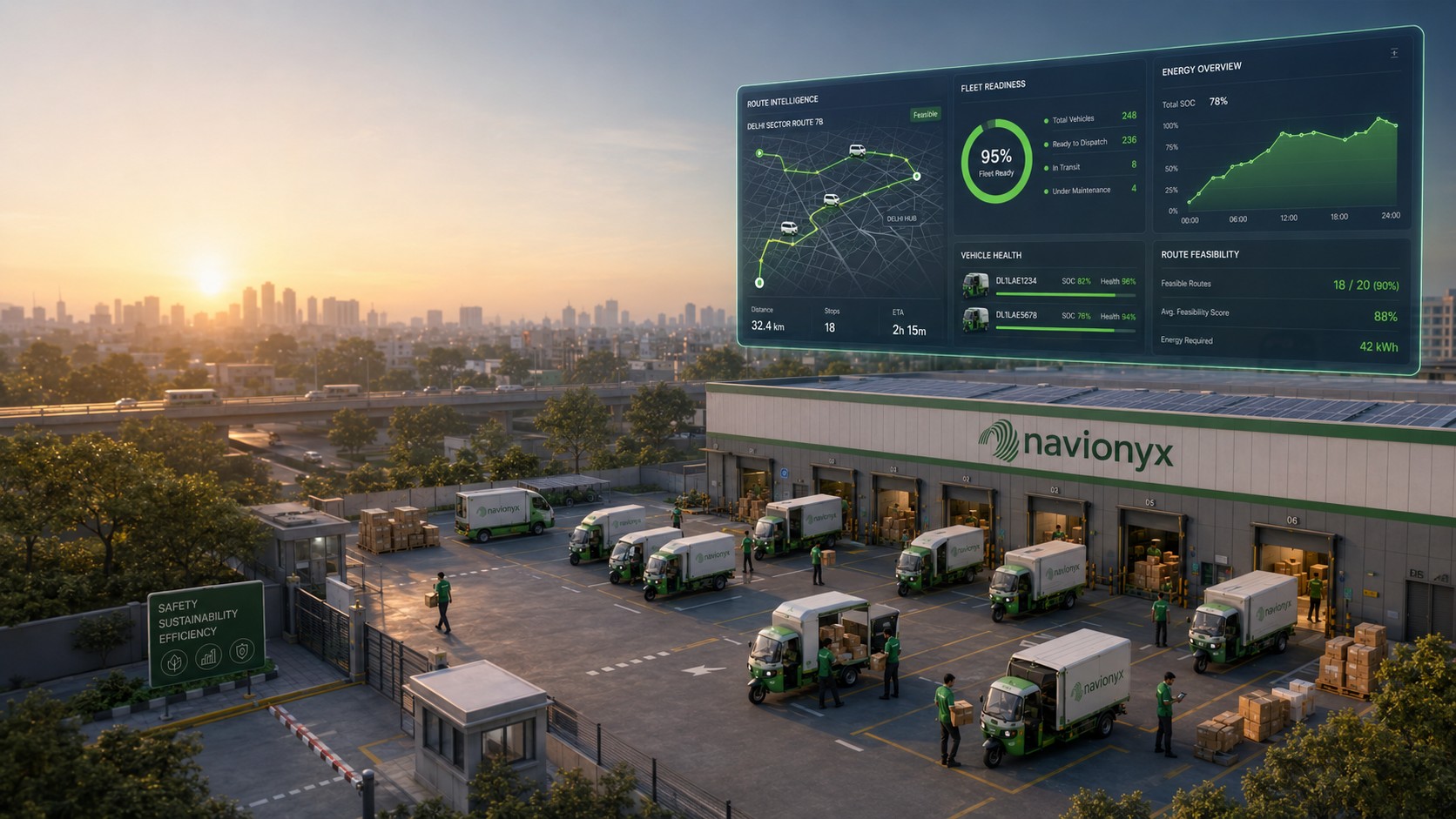
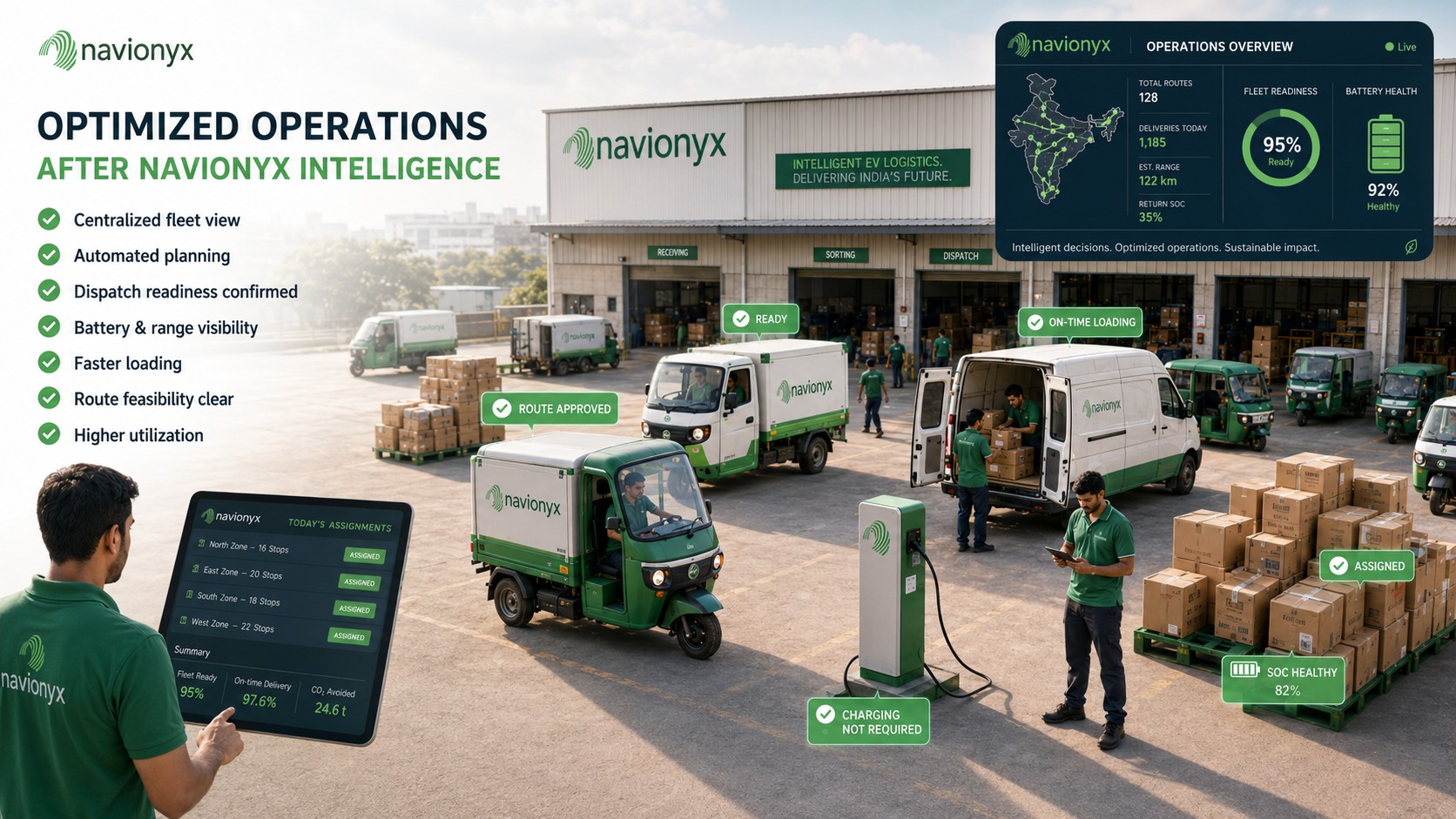
Navionyx combines GPS, BMS, route, payload and charging data to predict route feasibility, delivery capacity, charging requirements and expected return battery before dispatch.
Why EV Last Mile Operations Need More Than GPS
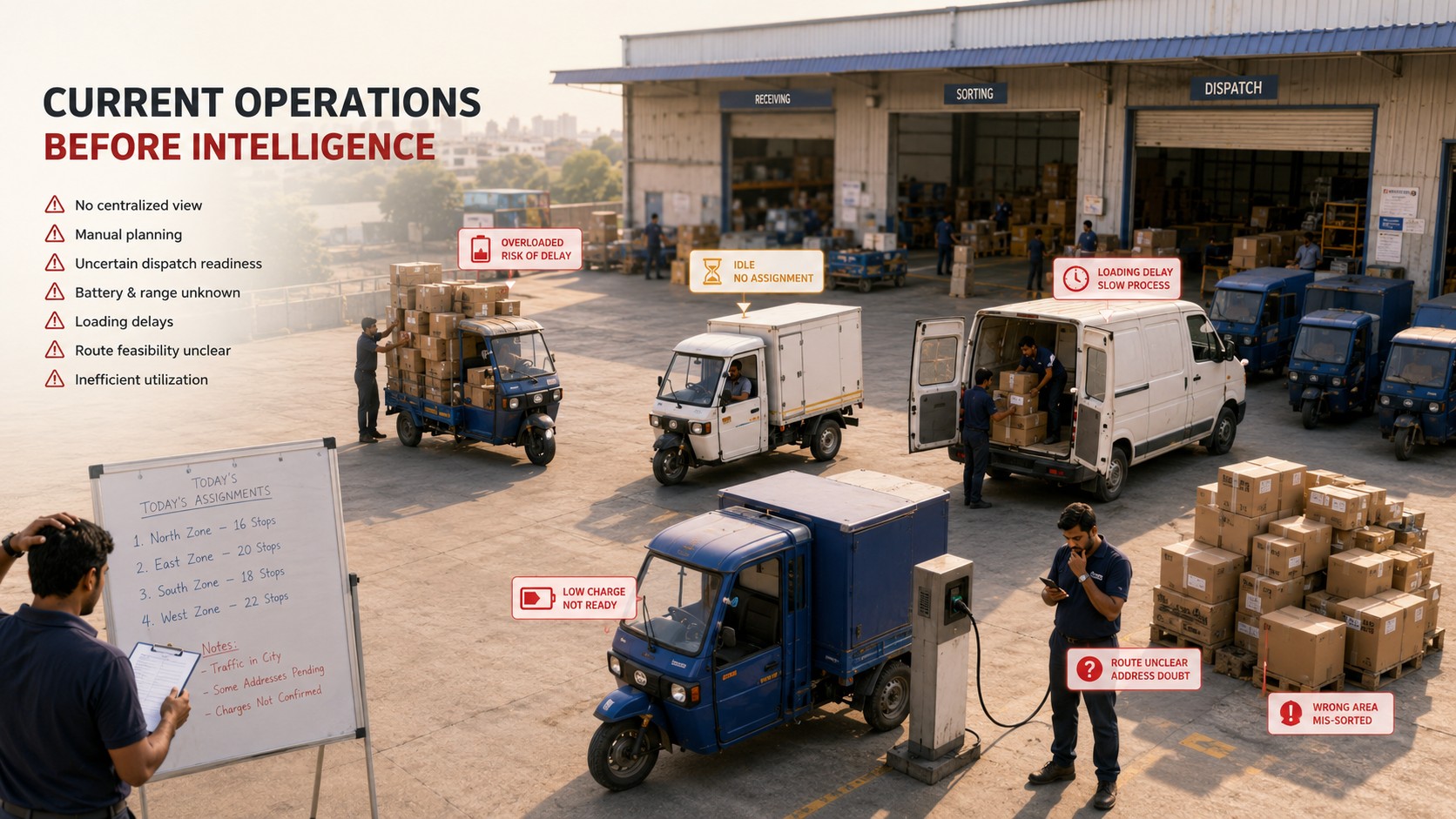
A fleet manager running diesel cargo vehicles needed three answers: where is the vehicle, is the driver behaving, and how much fuel did it consume. EV last mile delivery breaks that model. Battery state varies hour by hour. Range depends on driver, payload, traffic, terrain, weather and battery age all at once. A vehicle with 60% state of charge yesterday is not the same vehicle with 60% state of charge today, because cell balance and pack temperature shift the usable energy.
The India last mile delivery market is projected to grow from USD 7.51 billion in 2025 to USD 14.45 billion by 2031 at a CAGR of 12.67%, with electric vehicles taking the largest share of new fleet additions. Amazon has publicly committed to deploying at least 100,000 electric delivery vehicles globally by 2030. Logistics operators including Shadowfax have stated they are adding approximately 500 to 600 EVs every month. None of these operators can run an EV fleet on tools designed for diesel.
| What Diesel Era Fleet Software Tells You | What EV Last Mile Operations Actually Need |
|---|---|
| Vehicle current location | Vehicle location plus predicted usable range for today's route, driver, payload and weather |
| Fuel level percentage | State of charge plus state of health plus cell balance plus predicted return battery |
| Distance covered | Energy per kilometre, energy per stop, energy per package |
| Driver safety score | Driver behaviour score linked to actual battery consumption and range impact |
| Maintenance alerts based on mileage | Predictive battery alerts based on cell voltage, thermal events and consumption trends |
The Three Questions Every EV Last Mile Hub Asks Every Day
Navionyx organises every capability around three operational questions that a hub manager faces from 5 AM to 10 PM. Every module, every dashboard and every alert maps back to one of them.
Which vehicles are operationally ready this morning?
Fleet readiness classification by state of charge, state of health, fault codes and predicted usable range for the day ahead.
Which vehicle can complete each route, load and delivery window?
Route feasibility on three dimensions: energy, capacity and time, with a configurable minimum battery reserve.
When and where should each vehicle charge without disrupting operations?
Charging coordination across depot, opportunity and swap infrastructure, with depot load and tariff awareness.
The Decision Engine: One Question, One Structured Answer
"Can this specific vehicle complete this specific delivery route today, within the operator's minimum battery reserve, with the assigned payload, in the available time window?"
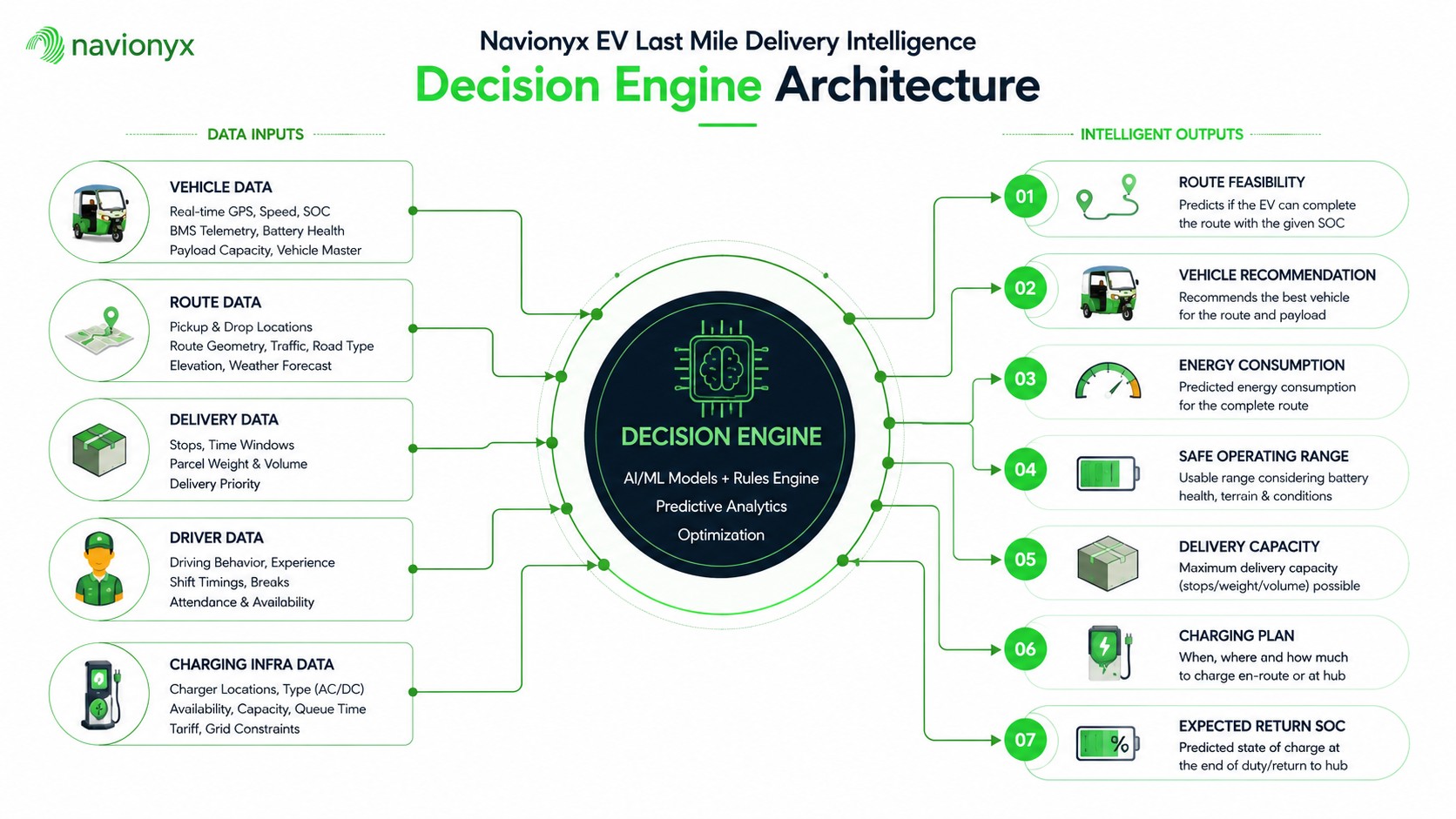
The Decision Engine returns a structured answer, not a yes or no. A dispatcher or an automated routing system can act on it directly.
| Vehicle and battery | SOC, SOH, cell imbalance, pack temperature, current, voltage, fault codes, historical consumption |
| Route | Distance, stop count, elevation, road type, traffic, time windows, expected dwell time |
| Delivery | Package count, cargo volume, payload weight, priority shipments, failed delivery history |
| Driver | Acceleration patterns, braking, speed, route familiarity, historical energy efficiency |
| Charging | Charger location, compatibility, availability, charging speed, tariff, depot electrical load |
| Route feasibility | Approved, approved with warning, charging stop required, reassign, or split |
| Recommended vehicle | Vehicle ID with confidence indicator |
| Expected consumption | kWh required for the route |
| Safe range | Operationally usable range, not OEM nominal |
| Package and capacity feasibility | Whether the cargo physically fits and the route can be completed in window |
| Charging requirement | Pre dispatch, opportunity or post route charging plan |
| Predicted return SOC | Point estimate plus likely range and confidence level |
A better prediction UI shows certainty, not just a number.
Where data is limited, Navionyx begins with a conservative vehicle model baseline and a wider confidence range. As the platform observes real routes, fleet level assumptions are replaced with vehicle, driver and zone specific consumption profiles, and the confidence range narrows.
Predictions are always shown as both a point estimate and a likely range so the dispatcher can judge operational risk at a glance.
This is more honest than a single number and easier for a dispatcher to act on under uncertainty.
A Route Is Approved Only When It Passes Three Checks
A vehicle with enough battery is not the same as a vehicle that can complete the route. Navionyx applies three independent feasibility checks. A route is approved only when all three pass.
Energy Feasible
The battery can complete the route, including the operator's minimum reserve, given the predicted consumption for today's vehicle, driver, payload and conditions.
Capacity Feasible
The vehicle can physically carry the shipment load by weight and cargo box volume, including planned reverse pickups.
Time Feasible
Deliveries can be completed within promised time windows, accounting for stop dwell time, expected traffic and any planned charging stop.
Minimum Battery Reserve Policy
| Route Result | Rule |
|---|---|
| Approved | Expected return SOC above 20% |
| Approved with warning | Expected return SOC between 15% and 20% |
| Charging stop required | Expected return SOC below 15% |
| Reassign | Insufficient range even with practical charging |
| Split route | Route exceeds vehicle payload, volume or energy capacity |
Reserve thresholds are configurable per fleet and can vary by city, vehicle model, weather, battery condition and operator policy.
Six Modules That Run Every EV Last Mile Operation
The platform is organised into six modules. Each owns a clear part of the EV last mile workflow. Capabilities are tagged so an evaluator knows what is available on day one, what requires integration, and what improves as the platform learns from real operations.
Fleet Readiness
Every morning, every vehicle is classified into four readiness states using state of charge, state of health, fault codes, battery temperature, last completed route and expected readiness time.
| Vehicle | Status | SOC | SOH | Action |
|---|---|---|---|---|
| EV3W 014 | 🟢 Ready | 96% | 91% | Assign to full route |
| EV3W 031 | 🟡 Short Route | 71% | 79% | Assign to short route only |
| EV3W 045 | 🟠 Charge | 34% | 86% | Charge 90 min, dispatch 9:30 AM |
| EV3W 052 | 🔴 Attention | 18% | 62% | Battery diagnostics required |
Route Energy Intelligence
Receives delivery routes from the customer's routing or OMS system and returns feasibility on three dimensions (energy, capacity, time) along with confidence levels.
| Route | Distance | Stops | Result | Action |
|---|---|---|---|---|
| R 1041 | 64 km | 78 | ✅ Approved | Dispatch as planned |
| R 1042 | 88 km | 96 | ⚠️ Approved with charge stop | Charge at Station 4 after stop 62 |
| R 1043 | 94 km | 102 | ❌ Reassign | Use EV4W 008 instead |
| R 1044 | 142 km | 128 | ✂️ Split | Divide between two vehicles |
Smart Dispatch
Recommends which vehicle should run which route, considering battery readiness, vehicle capacity, route length, delivery density, road accessibility, charging requirement and historical performance.
| Route | Dist | Pkgs | Vehicle | Reason |
|---|---|---|---|---|
| Route A | 42 km | 75 | EV3W 018 | High SOC, suitable load |
| Route B | 88 km | 132 | EV4W 042 | Higher range and payload |
| Route C | 31 km | 48 | EV3W 009 | Lower SOH acceptable for short range |
Charging Intelligence
Plans charging as a coordinated operational activity. Covers depot charging, opportunity charging, swap station coordination, depot load management and tariff aware scheduling. Includes charger health monitoring.
| Vehicle | SOC Now | Required | Action |
|---|---|---|---|
| EV 018 | 34% | 61% | Charge 1h 20m, start 21:30 |
| EV 042 | 19% | 93% | Priority charging, start immediately |
| EV 009 | 48% | 40% | Delay charging, save on tariff |
Live Operations Control Tower
Live map of every active vehicle, charging session and exception. Each detected issue surfaces with a recommended action, not just an alert.
| Detection | Recommended Action |
|---|---|
| Consumption above prediction | Reorder remaining stops |
| Battery temperature rising | Reduce load or route to safe stop |
| Return SOC below reserve | Add charging stop |
| Charger queue detected | Recommend alternate charger |
| Vehicle likely to fail route | Transfer remaining packages |
| Cell imbalance detected | Restrict vehicle to short route |
| GPS or BMS offline | Apply conservative range estimate |
Battery and Asset Health
BMS native diagnostics for cell voltage spread, pack temperature, charge cycle history, deep discharge events and fault codes. Generates battery passport history exportable for ESG, leasing and NBFC reporting.
| Metric | Reading | Status |
|---|---|---|
| State of Health | 79% | 🟡 Watch |
| Cell Voltage Spread | 0.18 V | 🟠 High imbalance |
| Peak Pack Temperature | 47.8°C | 🟠 Thermal stress flagged |
| Cycle Count | 612 | Within normal range |
| 21 Day Consumption Trend | +14% | 🟠 Degradation alert |
Battery Swap Fleet Support
A meaningful share of Indian 3W last mile fleets run on battery swap rather than fixed packs. Navionyx treats swap as a first class operating model, not an exception.
- Battery pack identity and lifetime history
- Pack to vehicle assignment log
- Swap station inventory and charged pack availability
- Pack SOC and SOH tracking across vehicle changes
- Pack quarantine for thermal or fault events
- Recommended swap timing aligned to next route
- Swap station demand forecasting
- Alerts for unauthorised or missing pack movement
- Battery passport that follows the pack, not the vehicle
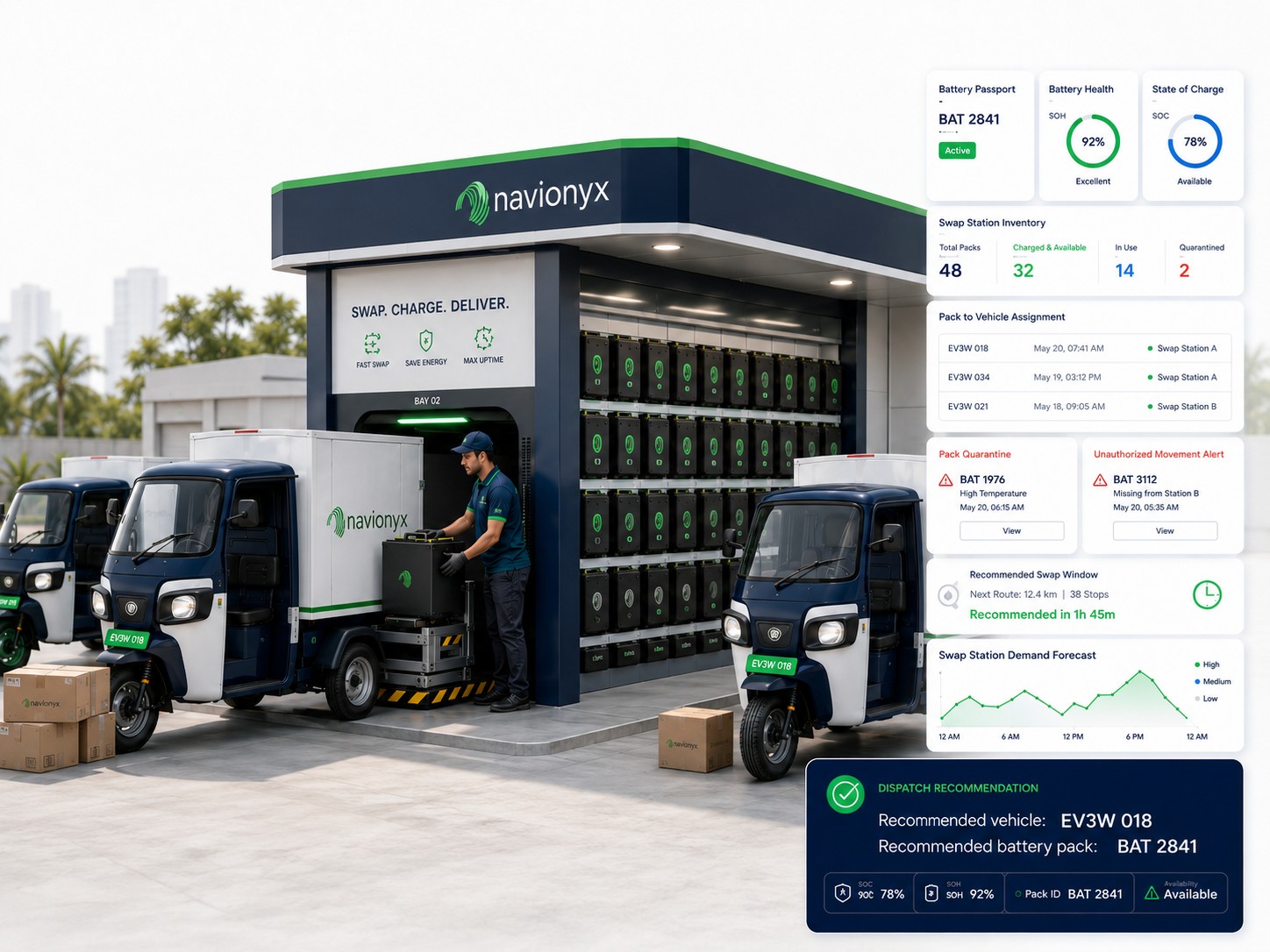
Recommended vehicle: EV3W 018
Recommended battery pack: BAT 2841
For swap fleets, the dispatch recommendation specifies both vehicle and pack. The battery passport follows the pack, not the vehicle, ensuring complete lifecycle traceability regardless of how many vehicles a pack has served.
Multi Hub Coordination for Enterprise Fleets
Enterprise customers run multiple delivery hubs. Capacity, demand and charger availability vary across hubs day to day. Navionyx supports cross hub visibility and balancing.
- Fleet availability by hub
- Vehicle transfer recommendations between nearby hubs
- Charger availability by hub
- Demand forecast by delivery station
- Hub performance benchmarking
- Central, regional and hub level operator hierarchy
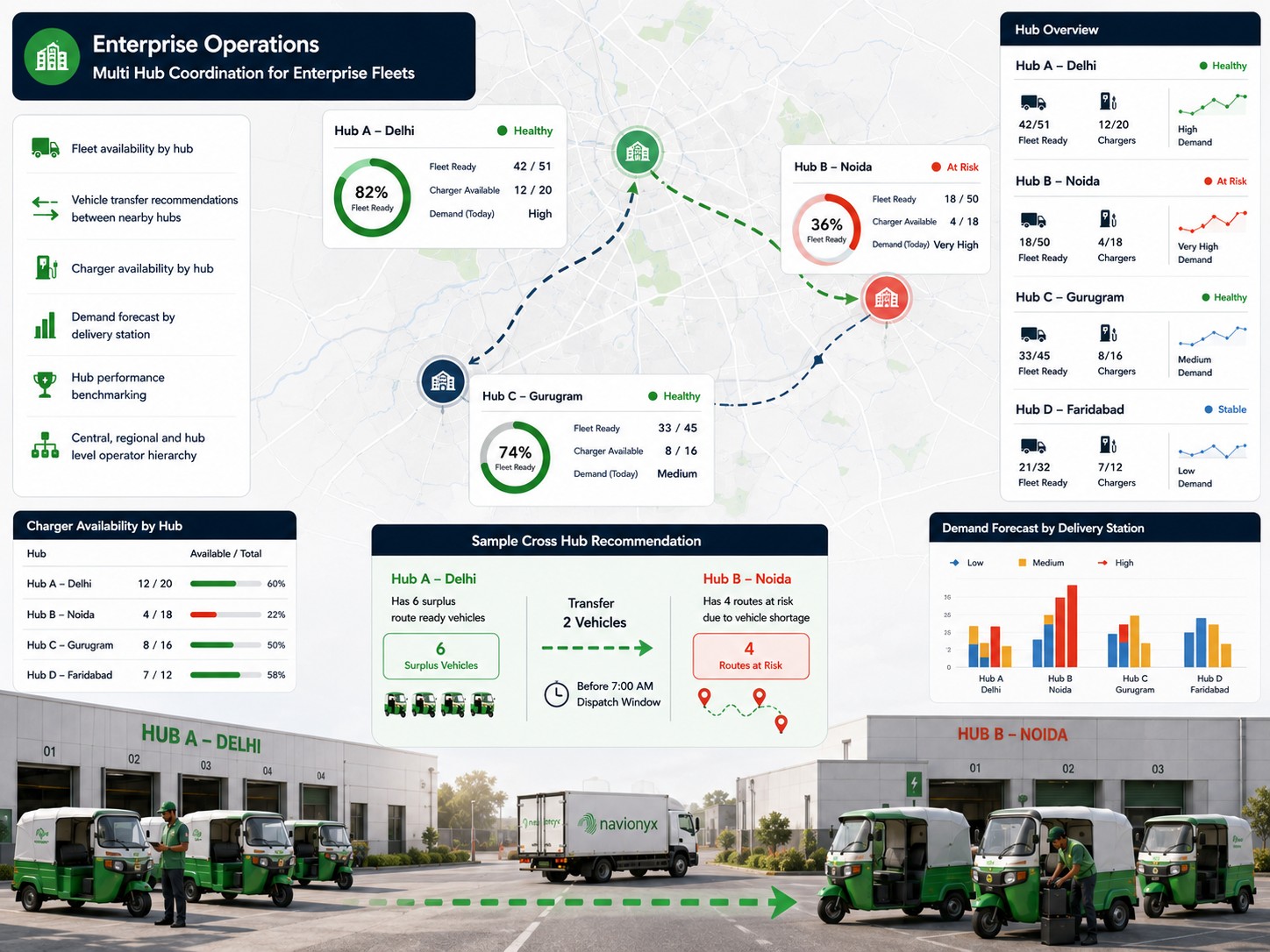
Hub A has 6 surplus route ready vehicles. Hub B has 4 routes at risk due to vehicle shortage.
Transfer 2 vehicles from Hub A to Hub B before the 7:00 AM dispatch window.
How Navionyx Fits Into Your Existing Stack
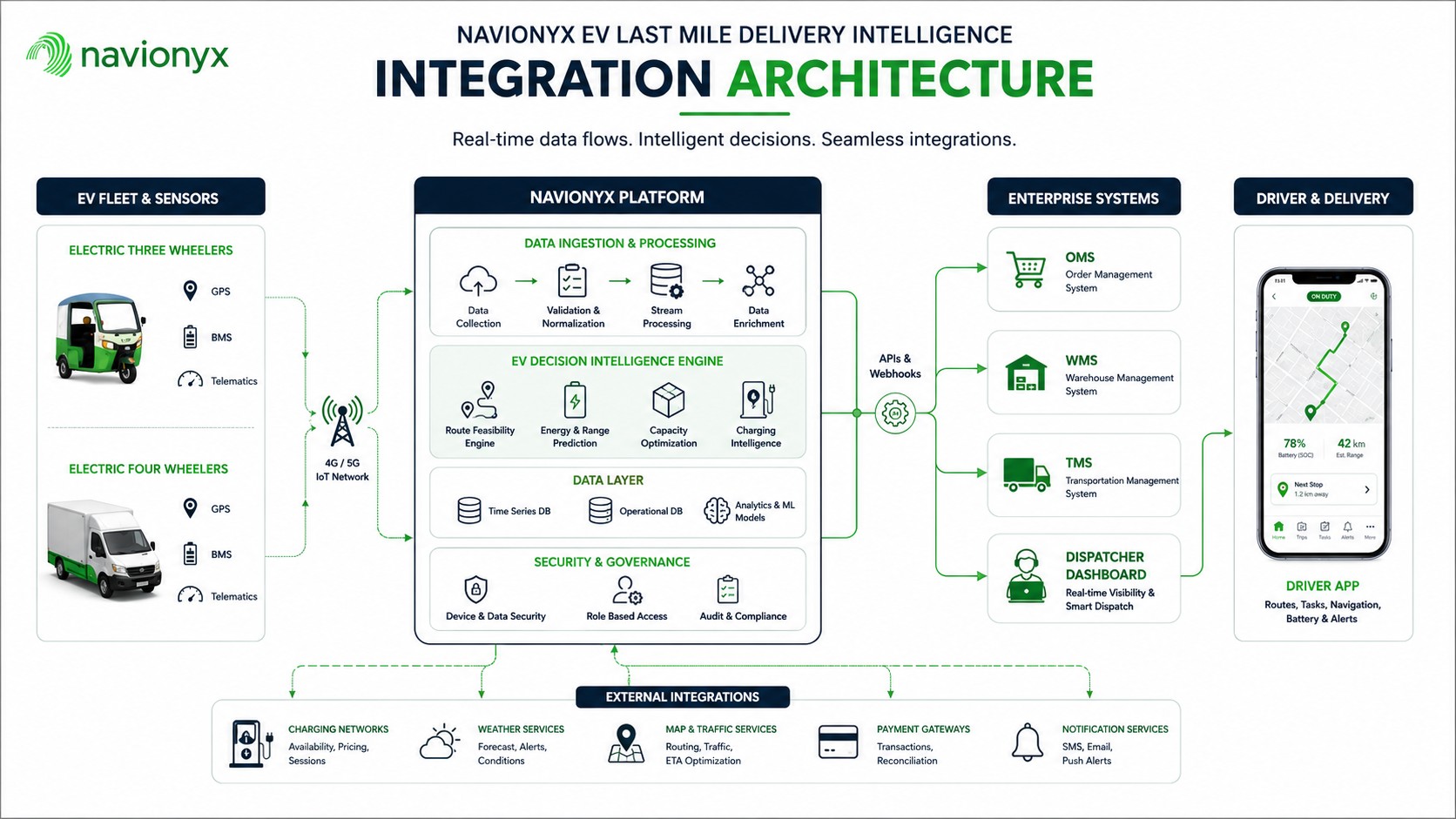
Navionyx does not replace routing, order management or warehouse management systems. It sits as the EV intelligence layer between the vehicle hardware and the customer's existing operations stack.
& BMS
Intelligence Layer
/ TMS
Application
| Inputs to Navionyx | Outputs from Navionyx |
|---|---|
| Routes and stop lists | Route feasibility result |
| Orders and packages | Recommended vehicle and pack |
| Driver roster | Predicted consumption and safe range |
| Vehicle inventory | Charging plan |
| Charger inventory | Predicted return SOC with confidence range |
| Operator hierarchy | Battery and route alerts |
| Customer routing or OMS data | Daily and weekly operations reports |
A Day in an EV Last Mile Hub Running on Navionyx
Fleet Readiness auto refreshes. 42 vehicles report SOC, SOH and overnight charging completion.
Routes uploaded from the OMS. Smart Dispatch returns vehicle assignments. Route Energy Intelligence runs feasibility checks across energy, capacity and time.
Drivers receive route, vehicle, predicted range, expected return time and any charging instructions through the driver app. No vehicle leaves without a confidence indicator.
EV3W 022 shows consumption above the predicted curve. Control Tower flags the deviation and recommends a charging stop. Driver receives the updated route.
Charging Intelligence sequences expected arrivals so depot peak load stays under the sanctioned limit.
Battery and Asset Health flags vehicles for inspection. Daily metrics roll up. The next morning starts with a sharper consumption model.
How Navionyx Compares to Other Software Categories
The EV last mile market is served by adjacent software categories, each built around a different primary problem. Navionyx is designed to connect them.
| Software Category | Primary Focus |
|---|---|
| GPS Telematics | Vehicle visibility and compliance |
| Route Optimisation | Stop sequencing and delivery planning |
| Charging Software | Charger and energy management |
| Navionyx | Connecting route, vehicle, battery and charging decisions into one operational layer |
Navionyx integrates with existing routing, OMS and charging systems rather than requiring the operator to replace them.
Start a 20 Vehicle Pilot
The fastest way to evaluate Navionyx for an EV last mile operation is a structured 30 to 60 day pilot in one or two hubs.
| Duration | 30 to 60 days |
| Fleet size | 10 to 25 vehicles |
| Vehicle types | Electric 3W and 4W |
| Locations | 1 to 2 delivery hubs |
| Integration scope | GPS, BMS, route file ingestion, charging infrastructure |
- Daily fleet readiness dashboard
- Route feasibility report per dispatch cycle
- Expected versus actual return SOC analysis
- Charging requirement plan
- Battery health and exception alerts
- Driver energy efficiency report
- Weekly operations review
- Final improvement and recommendations report
- Prediction accuracy (expected versus actual return SOC)
- Route completion rate
- Vehicles returning below minimum reserve SOC
- Packages delivered per vehicle
- Energy consumed per package
- Mid route charging interventions
- Charger waiting time
- Fleet dispatch preparation time
- Early battery problem detection
- Charger utilisation
Who Should Deploy Navionyx EV Last Mile Intelligence
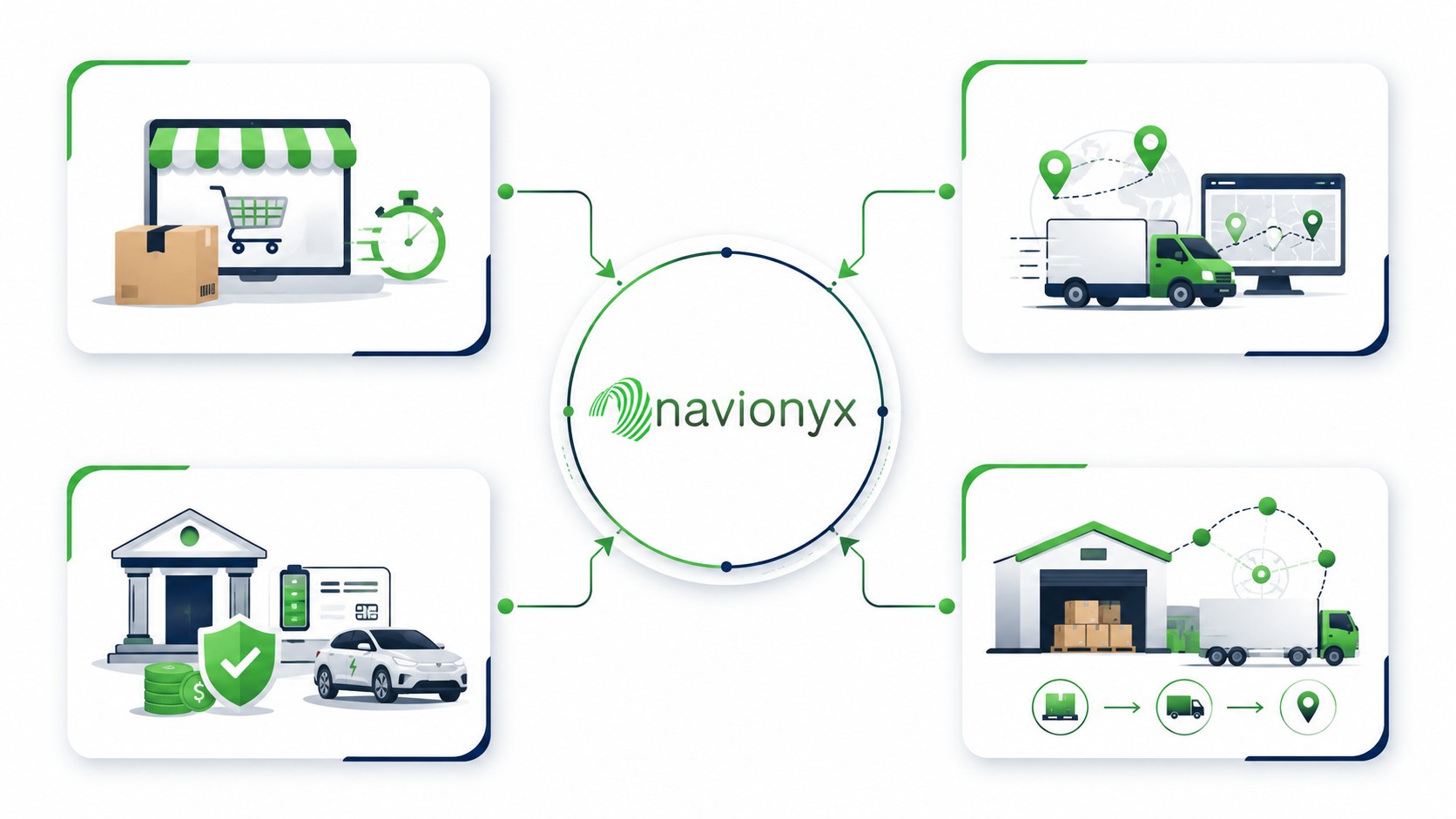
E-commerce and Q-commerce Operators
Brands running last mile delivery through owned or DSP networks. Daily fleet readiness, pre dispatch feasibility, and multi hub control.
Delivery Service Partners (DSPs)
Operators leasing 30 to 300 EVs and contracted to e-commerce customers. Higher packages per vehicle per day and verifiable battery health records for end of lease handback.
EV Leasing and Financing Companies
NBFCs, banks and leasing operators with EV portfolios. Battery passport records, utilisation tracking and portfolio level reporting without exposing unnecessary operational data.
3PL and Logistics Networks Electrifying Fleets
3PL operators transitioning portions of last mile to electric. The EV specific operational layer that diesel fleet software cannot provide.
Data Governance and Enterprise Security
Enterprise EV fleet operators require predictable data handling. Navionyx is built to meet enterprise procurement requirements.
- Role based access with hub, region and national hierarchy
- API authentication and key rotation
- Encryption in transit and at rest
- Audit logs for all dispatcher and admin actions
- Customer data segregation
- Configurable data retention controls
- Device command authorisation
- Indian data residency options
- Controls aligned with ISO 27001 practices
A detailed security overview is available on request.
Frequently Asked Questions
See What Your EV Fleet Can Actually Deliver Today.
Share your fleet size, vehicle mix and hub locations. We will scope a 30 to 60 day pilot with clear success metrics and a defined integration plan.