Battery packs can represent this much of an EV's total cost, turning every unverified warranty payout into a margin problem.
Solution 08 / 10
Battery Warranty Validation and Intelligence for EV and Battery OEMs
Every cell, every cycle, every temperature event captured from day one. Pay valid claims, dispute the rest, and know exactly what each returned battery is worth.
AIS-140 Certified
DPIIT Recognised Startup
Cell Level Data Capture
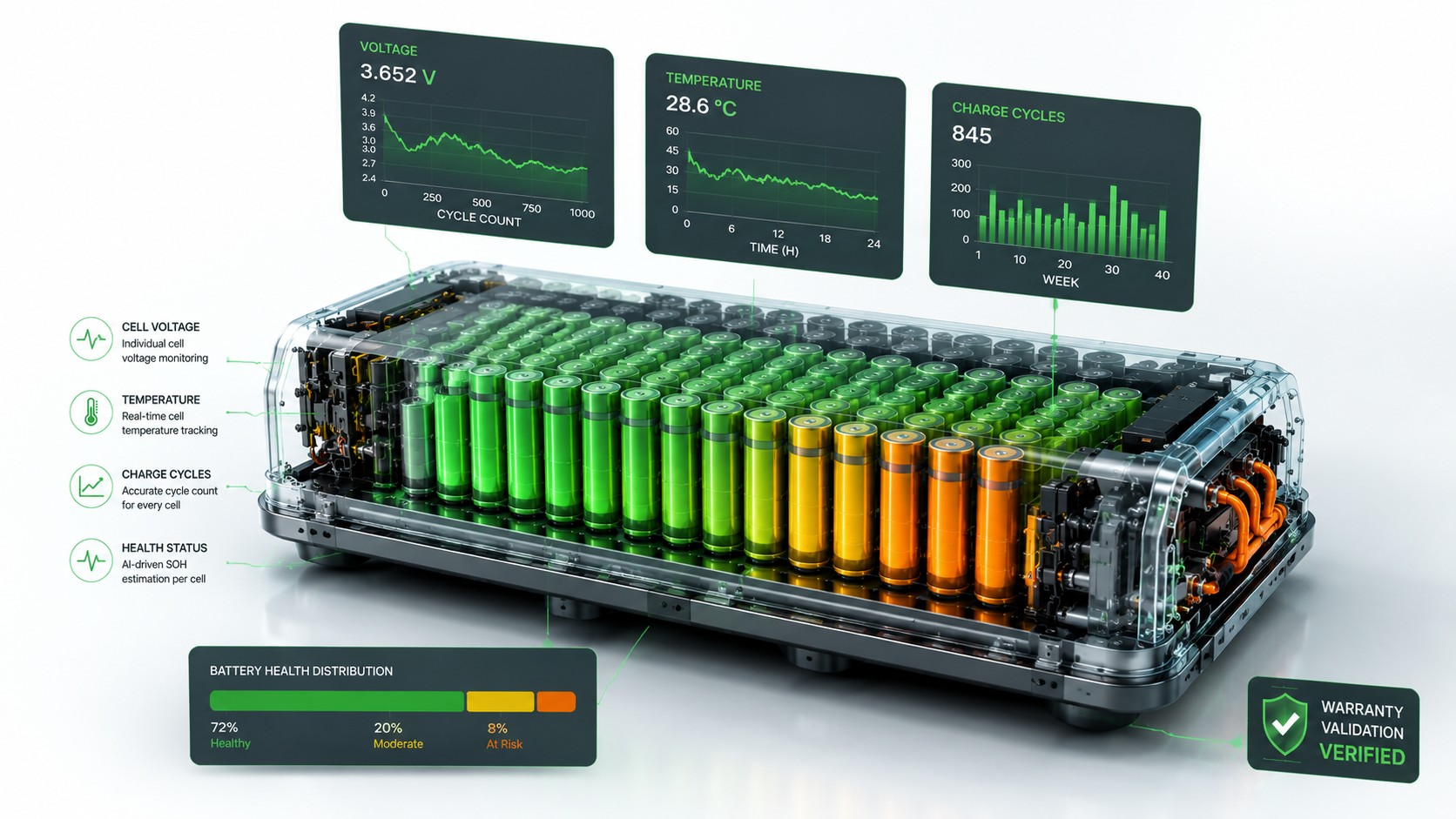
Claim verdict with evidence
Cell history, charge cycles, and abuse events are captured before the claim arrives, not reconstructed after it.
Return routing clarity
Use the same deployment record to decide whether a returned battery should be refined, repurposed, or recycled.
The Warranty Margin Problem
30 to 50 percent
14 to 38 percent
Sub 0.001 percent
Warranty claims are eating margins that should belong to battery OEMs
Battery packs account for roughly 30 to 50 percent of an EV's total cost. When a claim arrives, the OEM has two choices: pay it without proof, or contest it without proof. Both are expensive.
The harder problem is that warranty exclusions written into every contract, including abuse, misuse, deep discharge, over-temperature operation, unapproved charging, and tampering, are rarely enforceable in practice. The OEM has no reliable record of how the battery was actually treated in the field.
The fleet operator has every reason to claim the battery failed on its own. Without independent deployment data, the OEM almost always pays. Battery telematics changes that dynamic by separating genuine failures from misuse and moving the conversation from opinion to evidence.
Lower lifetime CO2 emissions of EVs versus equivalent ICE vehicles in India, based on the IIT Roorkee and ICCT 2025 comparison cited in the brief.
Cell fault rate below which modules become economically viable to repurpose, making cell-level tracking a second-life decision input too.
What Navionyx Captures
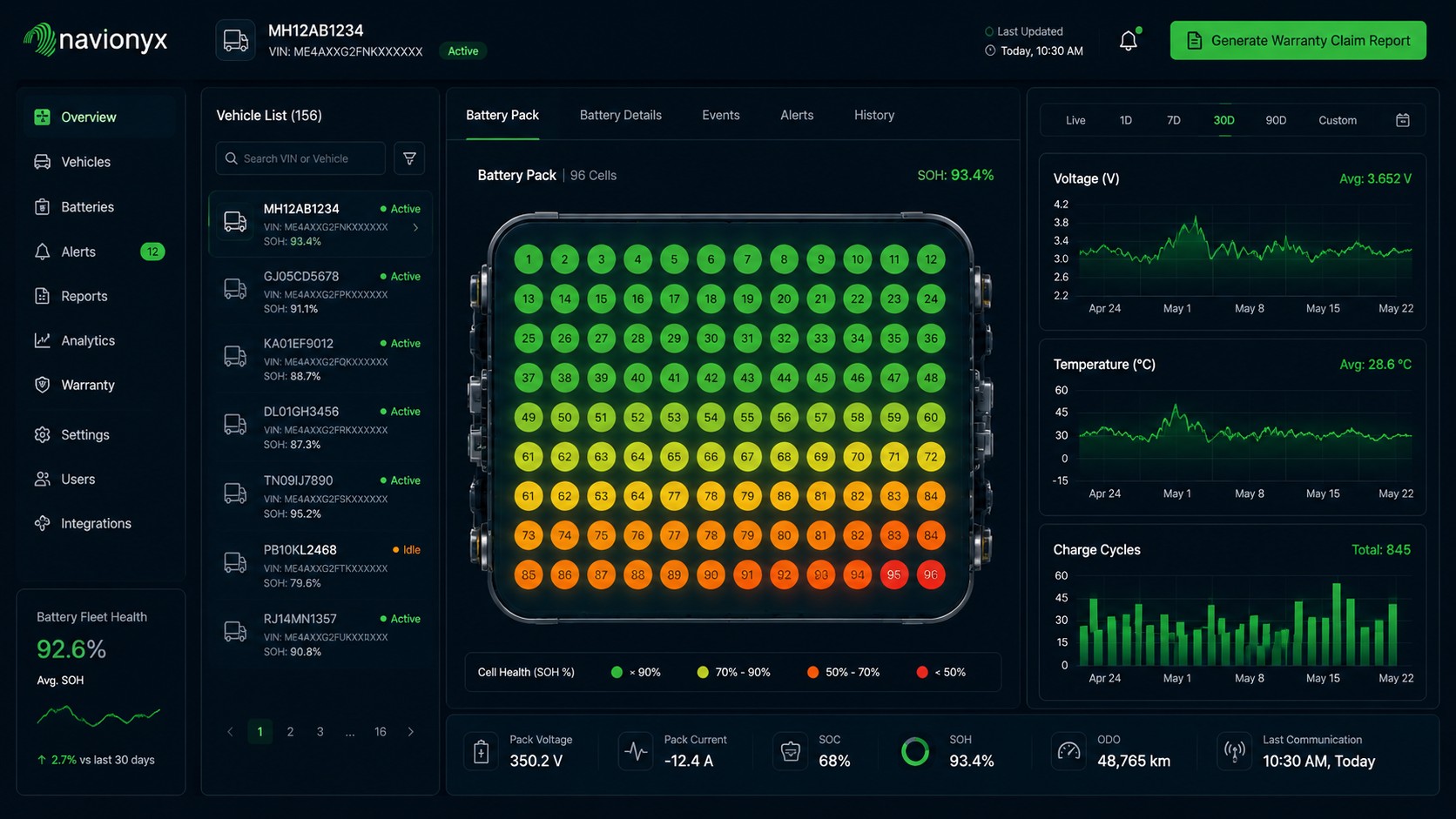
A full deployment record for every battery you ship
Navionyx telematics, paired with BMS integration, builds a continuous deployment record per vehicle and per cell from the day the battery enters service. Nothing is reconstructed after the fact. Every data point is timestamped, immutable, and exportable.
Cell Level Usage History
Per cell voltage, internal resistance, and capacity trends across the full service life. Outlier cells are flagged automatically.
Charge Cycle Records From Day One
Every charge and discharge event logged with C-rate, SoC start, SoC end, and duration. No reconstruction later.
Temperature Abuse Detection
Continuous thermal logging at pack and cell level with threshold breaches stamped by time, location, and operator context.
Deep Discharge History
Frequency and depth of every discharge below manufacturer thresholds so habitual abuse is easy to separate from one-off incidents.
Charging Pattern Analytics
Detection of non-approved chargers, unusually high C-rate charging, and repeated charging habits that accelerate degradation.
Claim Validation Report
A single PDF per claim with cell history, abuse events, charging profile, location trail, and a verdict line: valid, partial, or misuse.
Carbon and Battery Passport Readiness
Every battery you ship is also a carbon reduction asset. We measure it.
The same telematics record that validates warranty claims also proves something the market increasingly asks for: how much CO2 your batteries have prevented from entering the atmosphere.
Navionyx calculates, per vehicle and per fleet, the kilometres driven on the battery, the grid emission factor for the charging location, and the equivalent ICE emissions that would have been produced for the same trips. The result is a verifiable carbon avoidance number tied to your product, not to a generic industry average.
This matters in three places: ESG reporting needs Scope 3 evidence that can survive audit, Battery Passport frameworks demand provenance and usage visibility, and fleet buyers increasingly want emissions accounting before they commit. The same lifecycle signals can also be fed by our EV Charging Analytics workflow for even deeper charging-side context.
CO2 avoided per EV per year
~500 kg CO2e Sample annual avoided-emissions benchmark from the page briefAt an Indian grid emission factor of 1025 g CO2e per kWh, EV operation often lands around 87 to 120 g CO2e per km versus roughly 240 to 270 g CO2e per km for a petrol equivalent. Across a 30,000 km annual run, one EV can avoid close to 500 kg CO2e.
Navionyx logs the exact kilometres and usage history so the avoided-emissions figure belongs to your deployed batteries, not to a generic category estimate.
Second Life Decisions
Path 01
Path 02
Path 03
Decide whether to refine, repurpose, or recycle. With evidence.
When a battery comes back, the question is not just whether the claim is valid. The bigger question is what the battery is now worth. Most OEMs cannot answer that without sending the pack through an expensive lab grading process. Navionyx provides the input data that grading needs, already collected over the battery's service life.
Cell fault rate, capacity retention curves, internal resistance drift, and thermal history together determine which path a returned battery should follow. These same long-range degradation signals also connect naturally with Predictive Maintenance for EV Fleets, where abnormal behaviour is caught long before the return decision.
Lightly Used. Refine and Resell.
Low cycle counts, no temperature abuse, and uniform cell health make these batteries candidates for refurbishment and first-life resale instead of scrap.
Degraded but Healthy. Repurpose to Second Life.
Packs around 70 to 80 percent state of health can still serve stationary storage, telecom backup, and behind-the-meter applications. Cell fault data tells you which ones qualify.
End of Life. Recycle for Materials.
Widespread cell failure, persistent thermal abuse, or capacity loss below useful thresholds point directly to certified recycling without unnecessary lab handling cost.
The financial difference between these three outcomes is significant. Capturing that value depends on knowing which returned batteries still belong in the first-life market, which qualify for second-life deployment, and which should move directly to material recovery.
Battery Health Certificate
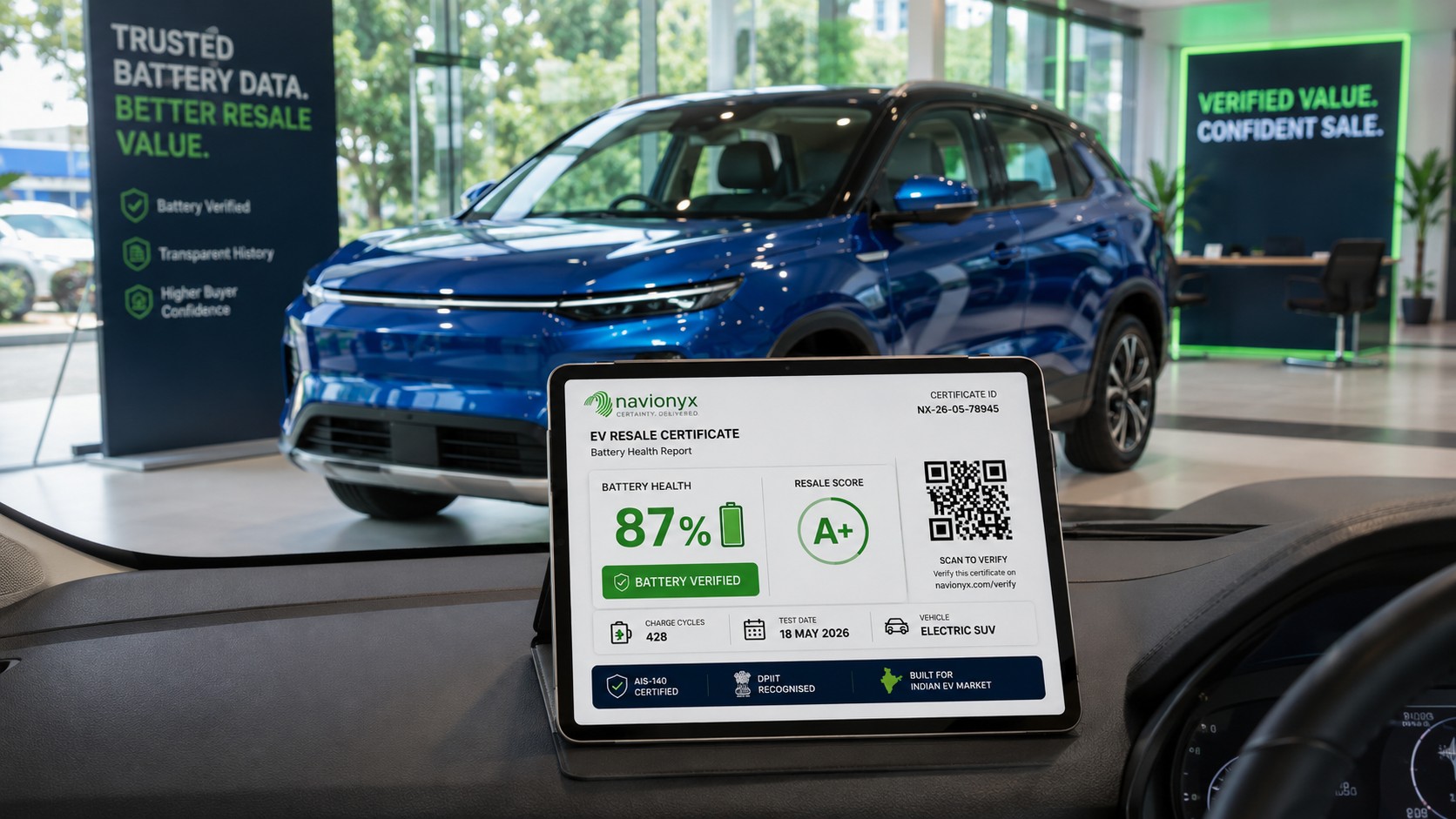
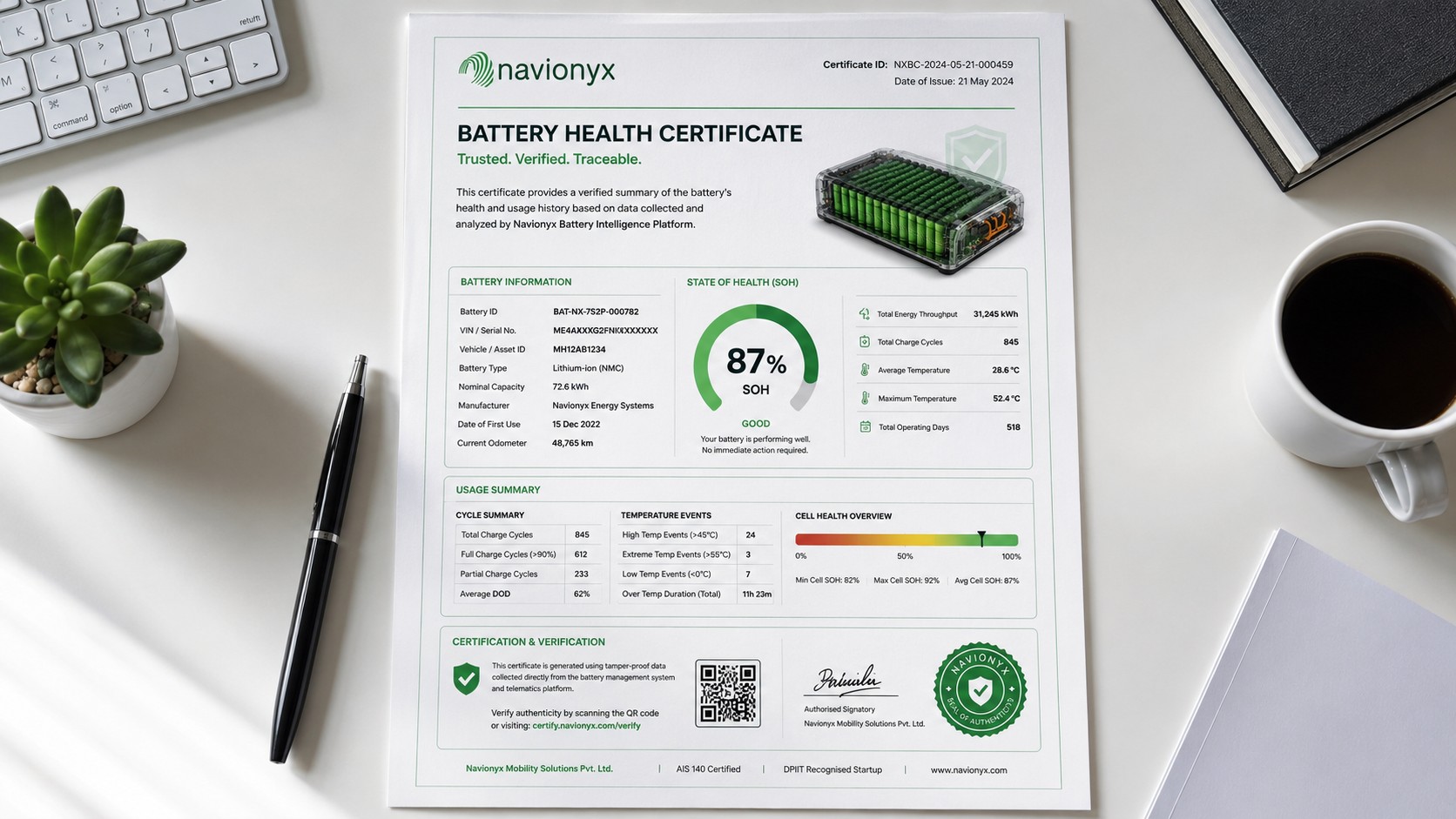
A tamper evident certificate, backed by your own telematics data
Every Navionyx monitored battery can be issued a Battery Health Certificate. The certificate consolidates state of health, charge cycle count, temperature event log, deep discharge history, and a final usability grade into a single tamper-evident document.
It is the asset record that warranty teams hand to legal in a dispute, that sales teams hand to second-life buyers, and that fleet operators show to lenders during refinancing.
The certificate is generated through a controlled process with chain of custody at every stage. The full method, including data inputs, verification checkpoints, and authenticity signals, is documented on the Navionyx battery certification process page.
One certificate, multiple workflows
Warranty review, legal disputes, second-life sales, and refinancing conversations all use the same auditable battery record.
Evidence with authenticity signals
Certificate ID, structured data inputs, and controlled generation steps reduce disputes over document tampering or unsupported battery claims.
Best Fit
Built for OEMs who pay the price of missing data
Battery OEMs
Stop paying out claims you cannot contest. Every pack you ship carries a deployment record that shows whether failure came from a defect or from operator behaviour. The same history helps you recover value from returns through informed refine, repurpose, or recycle routing.
EV Manufacturers
Defend your battery warranty exposure with the same field data your warranty contract already references. Strengthen Battery Passport readiness ahead of EU and Indian regulatory timelines, and differentiate your product with a verifiable carbon avoidance number per vehicle.
Warranty Service Teams
Resolve claims on evidence in days instead of weeks of back-and-forth. Every claim packet includes a defensible deployment history, abuse log, charging profile, and an exportable report that is ready for legal, insurance, or partner review.
Second Life and Refurbishing Operators
Buy retired packs with full provenance instead of uncertain history. Plan grading, disassembly, and routing cost against real cell fault, capacity retention, and thermal exposure data rather than assumptions.
FAQ
Frequently asked questions
Battery telematics continuously records voltage, current, temperature, and state of charge data at the cell and pack level. When a claim is filed, that history is compared against the warranty contract's exclusions. Deep discharge frequency, temperature abuse events, and unapproved charging patterns are surfaced with timestamps. The OEM sees whether the failure path matches a defect or operator behaviour and decides on evidence rather than negotiation.
Navionyx captures per cell voltage, capacity, internal resistance, and temperature at intervals defined by the BMS integration. Outlier cells are flagged automatically when their behaviour diverges from the pack average. This is the same input data second-life grading processes need under UL 1974, captured continuously rather than reconstructed at end of life.
Yes. Each claim validation report includes the full deployment record, location trail, charging profile, and a clear verdict line. Reports are exportable as PDF and timestamped. The data is captured from AIS-140 certified hardware and stored with chain of custody, which helps it stand up in insurance and contractual disputes.
Navionyx calculates avoided CO2 per vehicle by combining logged kilometres, the grid emission factor for the charging location, and a reference ICE emission factor. The result is a per vehicle, per fleet, and per OEM avoided emissions number suitable for ESG reports, Scope 3 disclosures, and Battery Passport submissions.
No. Navionyx integrates with your existing BMS and adds the connectivity, storage, analytics, and reporting layer on top. The BMS continues to do its safety job. Navionyx makes its data usable across warranty, ESG, and second-life decisions.
Each returned pack arrives with its full service history already in the platform. State of health, cell fault rate, thermal abuse log, and cycle count are visible immediately. Packs are tagged for refurbishment, second life, or material recovery routing without sending them through a separate lab grading step.
Battery Warranty Validation
Stop paying claims you cannot verify
Talk to the Navionyx battery intelligence team about a pilot covering 100 to 1,000 vehicles. We will scope the integration, the data points captured, and the reports you receive within one working week.
By Navionyx Team. Reviewed by the Navionyx engineering and product team.
This page was written with AI assistance and reviewed by the Navionyx team.