Fleet Management · EV & Batteries
A practical guide to 12V battery and EV battery weights, plus what battery mass means for range, payload, tyres and fleet operating costs.
Quick answer: how much does a car battery weigh?
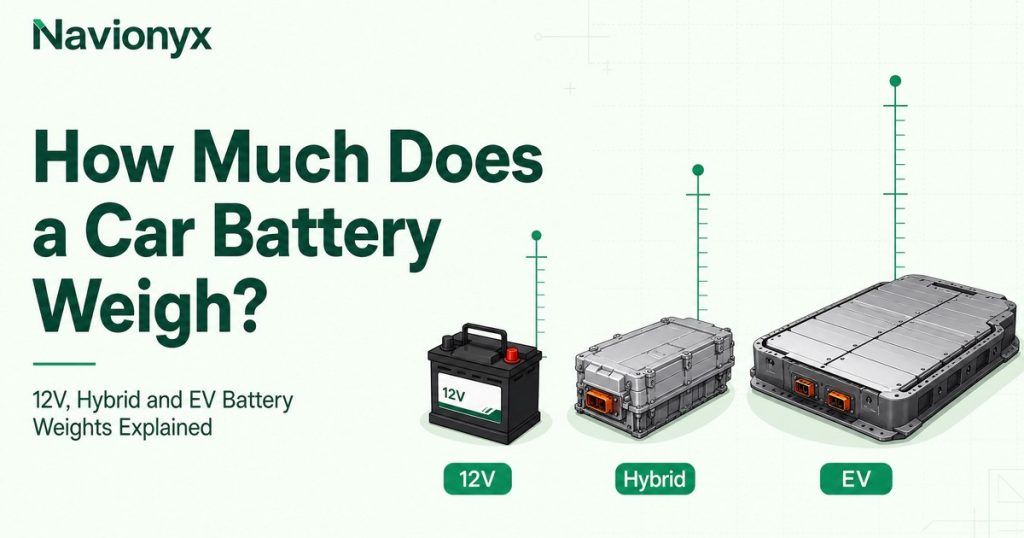
A conventional 12V car battery usually weighs about 14 to 23 kg. A hybrid battery is commonly heavier, while a full electric vehicle battery pack often weighs about 250 to 600 kg, with larger SUVs, vans and trucks sometimes exceeding that range. The exact figure depends on battery chemistry, capacity, vehicle design and whether you mean the small auxiliary battery or the high-voltage traction pack.
When someone searches for “car battery weight”, they may be asking about a removable 12V starter battery. Fleet managers, however, also need to understand the weight of hybrid and electric vehicle traction batteries. These are very different components with very different effects on vehicle performance and operating economics.
This guide explains the typical weight of each battery type, how battery mass affects energy use, tyre wear and payload, and which sources fleet teams should use when they need the exact specification for a vehicle.
How much does a 12V car battery weigh?
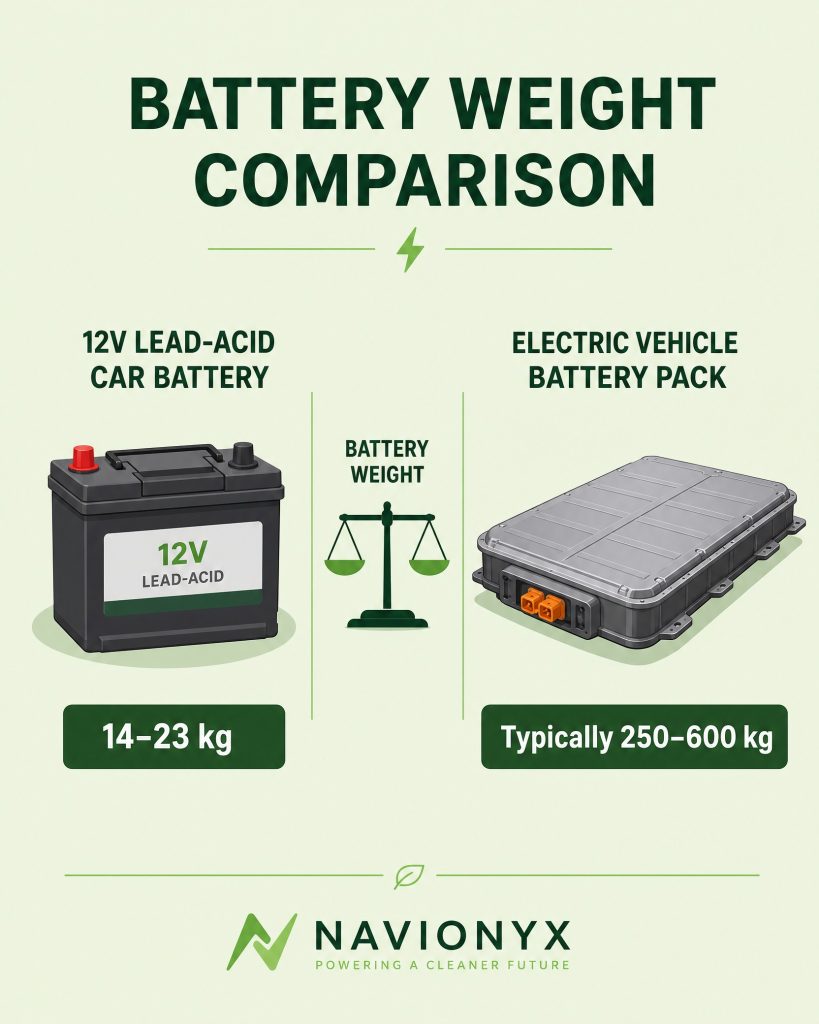
Most conventional passenger vehicles use a 12V lead-acid, AGM or similar auxiliary battery to start the engine and power electrical systems. A typical 12V car battery weighs approximately 14 to 23 kg, or about 30 to 50 lb. Larger commercial batteries can weigh more, while lightweight lithium replacements can weigh substantially less.
The exact weight depends on the battery group size, reserve capacity, cold-cranking rating, casing and chemistry. Do not select a replacement by weight alone. The battery must also meet the vehicle manufacturer’s requirements for voltage, dimensions, terminal layout, capacity and charging compatibility.
How much does a hybrid or EV battery weigh?
Hybrid and electric vehicles use high-voltage battery systems that store far more energy than a 12V starter battery. Hybrid packs are often lighter than full EV packs because they provide less electric-only driving energy. Full EV traction packs are commonly in the 250 to 600 kg range, although larger vehicles can be significantly heavier.
Battery weight generally rises with usable energy capacity, but capacity is not the only variable. Cell chemistry, pack structure, thermal management, crash protection, wiring and the battery enclosure all contribute to the final mass. For fleet comparisons, record the complete pack weight where available rather than estimating it from kWh alone.
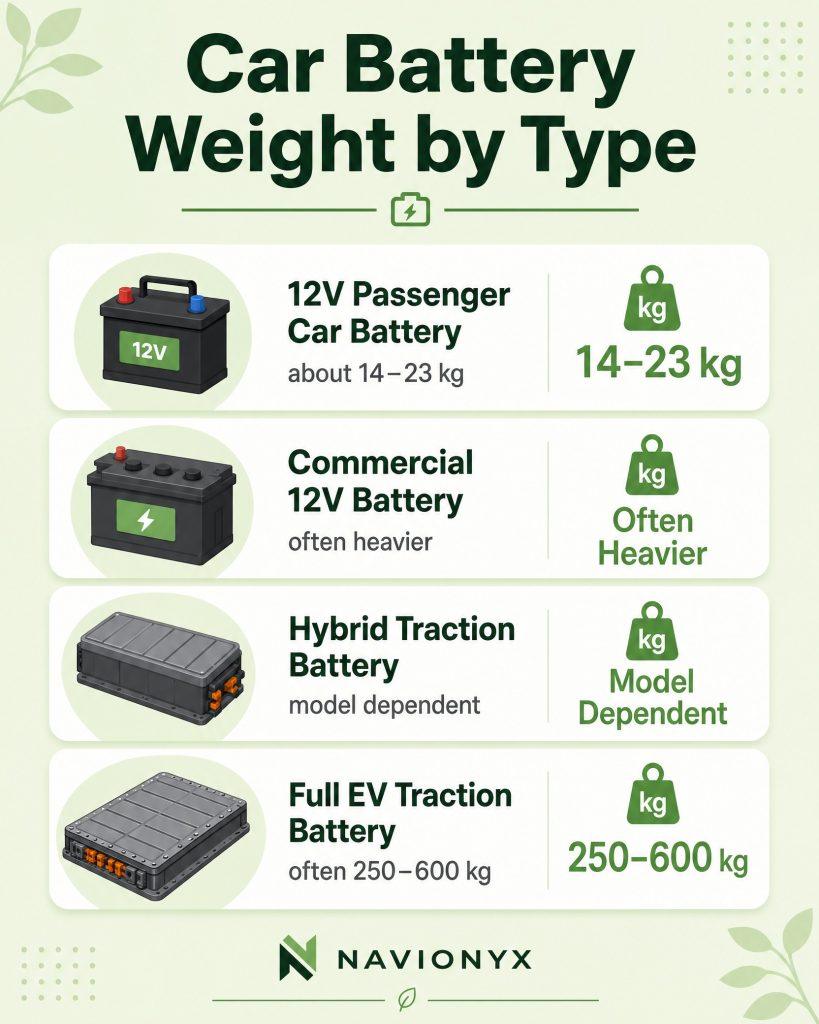
| Battery type | Typical weight | What changes the weight? |
|---|---|---|
| 12V passenger-car battery | About 14–23 kg | Group size, capacity, cold-cranking rating and chemistry |
| Commercial 12V battery | Often above passenger-car range | Higher starting demand, deep-cycle use and larger physical size |
| Hybrid traction battery | Model-dependent; commonly tens to more than 100 kg | Electric range, chemistry, cooling and pack design |
| Full EV traction battery | Often about 250–600 kg | Usable kWh, cell chemistry, structure and thermal protection |
How battery weight affects vehicle performance
Battery mass is only one part of a vehicle’s performance equation, but it matters because the vehicle must accelerate, support and stop that mass. The impact is most important when comparing vehicles with similar body sizes and payload ratings.
Energy consumption and range
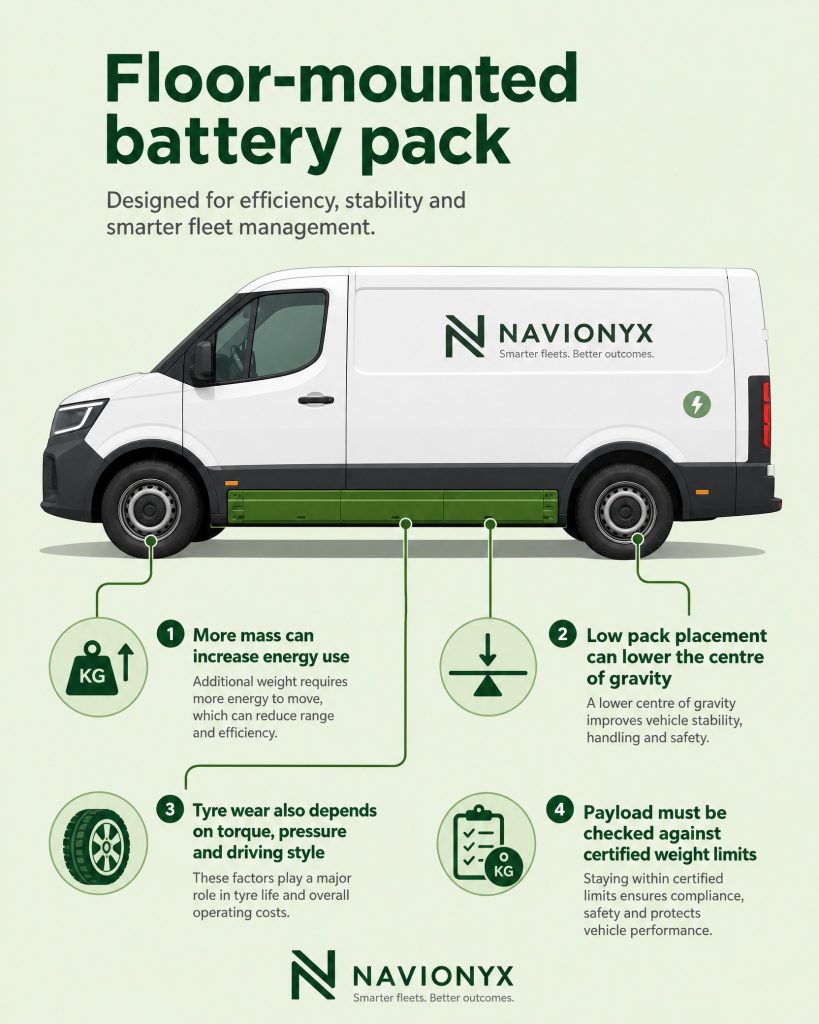
More mass requires more energy during acceleration and uphill driving. A European real-world analysis found that an additional 100 kg increased fuel consumption by an average of roughly 5–7% for a medium-sized car, although the result varies with speed, traffic, road grade, driving style and vehicle design [1]. For an EV, the same principle affects energy use per kilometre and therefore practical range.
Handling and stability
A floor-mounted EV battery can lower the vehicle’s centre of gravity, which can support stable cornering. That benefit does not remove the need to manage total vehicle mass, braking loads, tyre specifications and suspension limits.
Tyre and brake wear
Heavier EVs and their instant torque can increase tyre-wear risk, especially with aggressive acceleration, incorrect inflation or unsuitable tyres. Wear is not determined by battery mass alone, so avoid using a universal “20% faster” rule. Regenerative braking can reduce friction-brake use, while total mass still affects tyre loading and stopping performance [2].
Payload capacity
For a commercial vehicle, the key calculation is legal payload: gross vehicle weight rating minus the vehicle’s running mass and occupants. If two vehicles have the same weight rating, the heavier battery leaves less capacity for cargo. Compare certified payload figures rather than assuming that battery weight alone determines the difference.
How to find the exact battery weight for a vehicle
Use the following order of evidence when building a fleet specification sheet. Estimates are useful for early comparisons, but procurement and payload decisions should use model-specific documentation.
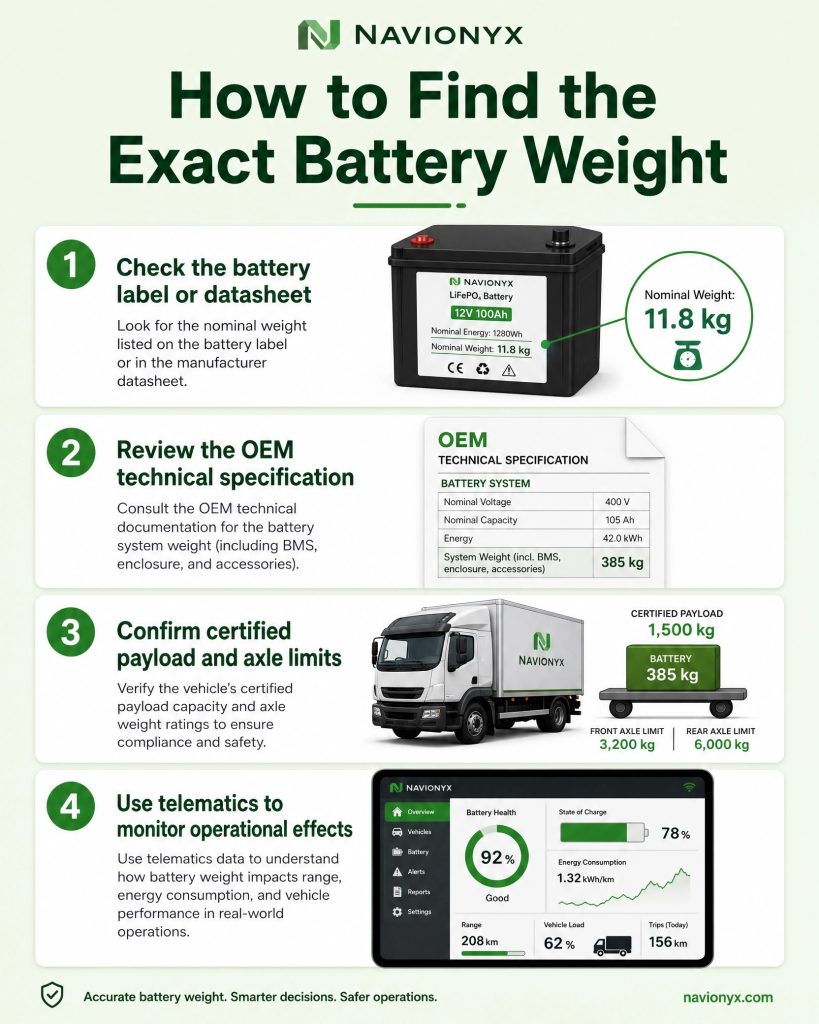
1. Check the battery label or service documentation
For a 12V battery, the label, manufacturer datasheet or parts catalogue may list weight. Use the battery group and exact part number, not only the vehicle make and model.
2. Review the OEM technical specification
For hybrid and EV packs, the vehicle manufacturer’s technical data, homologation documents or service information is usually more reliable than a generic online estimate. Check the vehicle variant because pack size and chemistry can differ within the same model range.
3. Confirm the certified payload and axle limits
For commercial fleets, pack weight should be evaluated together with gross vehicle weight rating, axle limits, body equipment, passenger load and cargo. This is the information that determines how much the vehicle can legally carry.
4. Use telematics to monitor the operational effects
Telematics and BMS integrations do not normally weigh the pack in real time. They can, however, monitor state of charge, state of health, energy consumption, temperature, charging behaviour and route conditions. Comparing those signals across vehicles helps identify when a heavy pack, payload pattern or driving style is affecting operating performance.
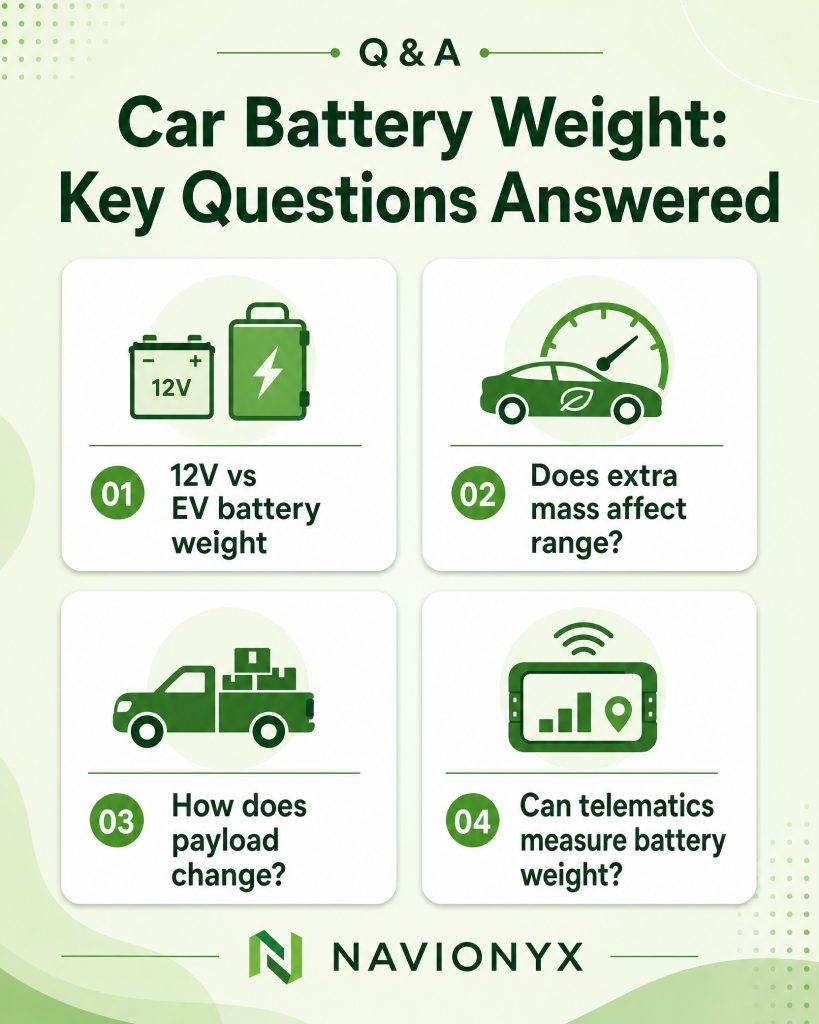
Car battery weight FAQs
Does a heavier car battery reduce fuel economy?
Additional vehicle mass generally increases the energy required to accelerate and climb. The size of the effect depends on the vehicle, route and driving conditions. For EVs, higher energy consumption per kilometre can reduce practical range.
Is an EV battery heavier than a normal car battery?
Yes. A normal 12V car battery is often around 14–23 kg, while a full EV traction battery is commonly several hundred kilograms. An EV may also have a separate 12V or low-voltage auxiliary battery.
Does battery weight reduce an electric vehicle’s payload?
It can. Payload depends on the certified gross vehicle weight rating and the vehicle’s running mass. When comparing commercial EVs, use the manufacturer’s payload and axle-limit figures rather than subtracting battery weight from a diesel vehicle’s payload directly.
Can telematics measure battery weight?
Usually not directly. Telematics can read operational battery data such as state of charge, state of health, temperature and energy consumption. The pack’s physical mass should come from OEM or battery-manufacturer documentation.
Why battery weight matters to fleet operators
For a private car owner, battery weight is mainly a specification detail. For a fleet manager, it belongs in a broader operating model that includes energy cost, payload, tyre replacement, route suitability, charging behaviour and battery ageing.
A useful fleet review should compare vehicles on the same route and under similar payload conditions. Track energy consumed per kilometre, payload utilisation, tyre replacement intervals, charging time and battery state of health. This turns a static battery specification into an evidence-based vehicle-selection and maintenance decision.
The takeaway
A conventional car battery usually weighs about 14–23 kg, while a hybrid or full EV battery can weigh far more. The exact number matters, but the operational question is more important: how does the vehicle’s total mass affect energy use, payload, tyres, braking and battery life on the routes your fleet actually drives?
The best approach is to combine model-specific battery and payload specifications with real-world telematics data. That gives fleet teams a clearer basis for selecting vehicles, planning routes and managing total cost of ownership.
Measure EV fleet performance in real time
Navionyx connects GPS, vehicle and battery data to help fleet managers monitor energy use, battery health, charging behaviour and route performance across the fleet.
Get a Free DemoSources: Fontaras, Zacharof and Ciuffo (2017), “Fuel consumption and CO2 emissions from passenger cars in Europe” [1]; Michelin, “An overview about how to reduce tire wear on EVs” [2]; EVBox, “Electric car battery weight explained” [3]. This article was researched and written with AI assistance and reviewed by the Navionyx team. Battery weights vary by model and configuration; verify specifications with the vehicle or battery manufacturer before making safety, payload or procurement decisions.