Fleet Management · Regulatory Business
Everything a prospective AIS 140 dealer in India needs to know : what AIS 140 is, which states require it, what devices cost, how the RTO process works, and how dealer economics actually play out.
AIS 140 is one of the most significant regulatory changes for the Indian commercial vehicle industry in the last decade. The standard makes GPS tracking mandatory for state permit commercial vehicles in 18 Indian states and for all national permit vehicles regardless of registration state. For dealers, this creates a stable, compliance driven demand base that grows every year as the vehicle fleet grows.
This guide covers every aspect of running an AIS 140 dealership : what the standard actually specifies technically, which vehicles need fitment, how state pricing varies, how the RTO paperwork process works, what dealer economics look like, and how to structure your first 90 days as an AIS 140 dealer.
What Is AIS 140 Technically
AIS 140 is Automotive Industry Standard 140, a technical specification issued by the Ministry of Road Transport and Highways through the Automotive Research Association of India (ARAI). The standard defines the requirements for a Vehicle Location Tracking Device (VLTD) that must be fitted to certain categories of commercial vehicles.
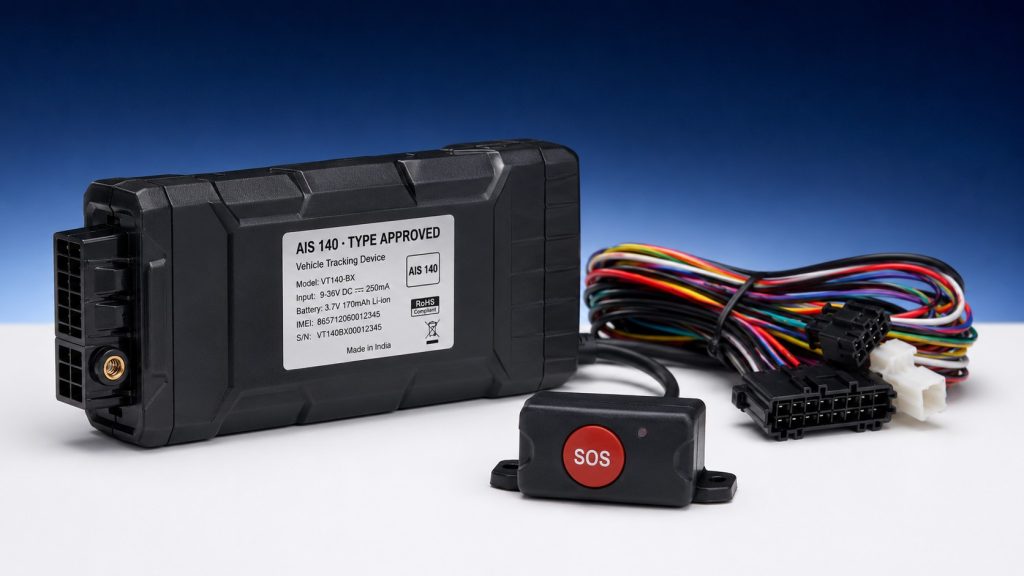
Every AIS 140 compliant device must include :
- ARAI type approved GPS hardware
- A panic button (SOS) accessible from the driver seat
- An audio buzzer or hooter for local alerts
- Dual profile eSIM with automatic failover across two Indian telecom networks (typically Airtel and BSNL)
- Data reporting to the state RTO backend server at defined intervals
- Encrypted communication protocol matching the AIS 140 specification
- Battery backup for a defined minimum duration if primary power is disconnected
The current active amendment is AIS 140 Amendment 2. Devices sold today must be certified against this amendment. Any dealer offering AIS 140 devices should confirm that the hardware they sell carries current type approval and that the certificate reference can be verified.
The regulatory foundation of AIS 140 creates one of the most stable, recurring demand bases in Indian consumer electronics : every new commercial vehicle registered in a mandated state is a required customer, every year, for the life of that vehicle.
Which Vehicles Need AIS 140
AIS 140 fitment is required in two circumstances :
1. State mandate for state permit commercial vehicles.
18 Indian states have made AIS 140 fitment mandatory for state permit commercial vehicles registered in that state. The mandated states are : Andhra Pradesh, Arunachal Pradesh, Assam, Dadra and Nagar Haveli and Daman and Diu, Delhi, Gujarat, Haryana, Himachal Pradesh, Jammu and Kashmir, Jharkhand, Kerala, Nagaland, Odisha, Punjab, Rajasthan, Tamil Nadu, Telangana, and West Bengal.
2. National permit rules for inter state commercial vehicles.
Every commercial vehicle holding a national permit must have AIS 140 fitment regardless of which state it is registered in. This means even in states without a state level mandate (Maharashtra, Karnataka, Uttar Pradesh, Madhya Pradesh, Bihar, and others), national permit vehicles need AIS 140. This is a substantial fleet base since national permit vehicles handle inter state freight.
Vehicle categories typically covered : taxis and autos, school buses, tourist vehicles, public transport buses, goods carriers with national permit, ambulances, and any other commercial passenger or goods vehicle as defined by the state transport department.
How State Pricing Works
AIS 140 device pricing varies by state because each state’s transport department has different approval fees, certification renewal cycles, and tracking period requirements bundled into the certified package. Broadly, states fall into 3 pricing tiers :
TIER 1 · STANDARD PRICING
Most mandated states + national permit markets
Andhra Pradesh, Arunachal Pradesh, Assam, DNH and DD, Gujarat, Haryana, Himachal Pradesh, Jammu and Kashmir, Jharkhand, Nagaland, Punjab, Telangana. Dealer buy price band in the ₹4,200 to ₹4,400 range. Suggested sell price in the ₹5,000 to ₹5,300 range. Dealer profit ₹700 to ₹1,050 per device.
TIER 2 · MEDIUM PRICING
Delhi, Rajasthan, Odisha, Kerala
Delhi has its own tier for state specific approval fees. Rajasthan is 1 year package only. Kerala offers both 1 year and 2 year variants. Odisha has a slight tier premium. Dealer buy price ranges from around ₹3,900 (Kerala 1 year) to ₹5,100 (Odisha). Dealer profit ₹700 to ₹1,300 per device depending on variant.
TIER 3 · HIGHER PRICING
Tamil Nadu, West Bengal
Both states have higher state approval fees. Dealer buy price ₹7,900 to ₹10,500. Suggested sell price ₹8,800 to ₹11,800. Dealer profit ₹900 to ₹1,300 per device. Absolute profit per device is higher than tier 1 states even though percentage margin is similar.
The right supplier keeps the state pricing chart current and helps you order the correct variant for each customer’s registration state. This matters because a Delhi variant device cannot be used for a Tamil Nadu fitment, and vice versa.

The RTO Paperwork Process
The RTO paperwork is what separates AIS 140 from consumer GPS as a dealer business. Every AIS 140 fitment requires a set of documents that the customer submits to the state RTO to record the device installation on the vehicle’s fitness certificate. Missing paperwork means the customer’s fitness renewal or vehicle transfer can be blocked.
Documents typically required per fitment :
- ARAI type approval certificate reference (proves the device model is AIS 140 compliant)
- Backend server slip (proves the device is registered with the state RTO backend server)
- Device serial number and IMEI (unique identifiers for the specific device)
- Installation certificate signed by the fitting agency or dealer
- State specific certificates where applicable (some states require additional approvals)
A good AIS 140 supplier provides all of these documents through your dealer login. You download the PDF, print it, and hand it to the customer with the installed device. Some states accept digital submission through the state RTO portal; others still require a physical printed copy at the counter. Your supplier should keep an updated process guide for each state’s RTO submission.
Dealer Economics in Detail
AIS 140 dealer economics break down into 4 revenue and cost elements :
| Element | Typical range |
|---|---|
| Dealer buy price per device (standard states) | ₹4,200 to ₹4,400 |
| Suggested sell price to customer | ₹5,000 to ₹5,300 |
| Installation labour (if you engage a technician) | ₹300 to ₹500 |
| Dealer profit per device (net) | ₹700 to ₹1,050 |
| Annual renewal dealer share (from year 2) | ₹400 to ₹600 per device per year |
A dealer selling 25 AIS 140 devices per month in a standard state earns approximately ₹22,000 gross monthly profit in year 1 from device sales alone. From year 2, the 300 devices sold in year 1 generate an additional ₹1,20,000 in annual renewal revenue (₹10,000 per month), on top of the new sales. This is the annuity effect that makes AIS 140 dealerships attractive over the long term.
First 90 Days as an AIS 140 Dealer
A structured first 90 day plan for a new AIS 140 dealer looks like this :
Days 1 to 15 : Setup and first customer conversations.
Apply to your chosen supplier, complete the onboarding call, receive your first stock (5 devices minimum). Contact 20 to 30 potential customers in your local area : commercial taxi operators, school bus operators, tourist vehicle operators, national permit truck fleet owners. Focus on the customers who have upcoming fitness certificate renewals since AIS 140 becomes urgent for them.
Days 15 to 45 : First installations and process refinement.
Install for your first 5 to 10 customers. Learn the fitment nuances (which wires to tap for permanent power, where to mount the panic button so it is accessible but not accidentally triggered, how to route the antenna for best signal). Submit the RTO paperwork for each fitment and note which office asks for which additional documents. Build a personal process guide for your local RTOs.
Days 45 to 90 : Scale and referrals.
Your first 5 to 10 customers are your best marketing. Ask each for 2 referrals. Reorder stock as you approach 30 percent of your monthly sales volume. Target 15 to 25 installations per month by day 90. Start conversations with fleet operators who have 10+ vehicles for bulk fitment opportunities.
Conclusion
An AIS 140 dealership is a regulated, compliance driven business with predictable demand, defined pricing, and a strong annual renewal revenue stream. The 18 mandated states plus the national permit vehicle base creates a customer pool that grows every year as new commercial vehicles are registered. Dealer profit per device is ₹700 to ₹1,300 depending on state, and annual renewal revenue from year 2 onwards materially compounds long term earnings.
Success as an AIS 140 dealer comes down to 4 things : work with a supplier that provides current RTO paperwork and current ARAI certificates, learn your local RTO submission process, build a customer base among high frequency segments (school buses, tourist vehicles, national permit trucks), and track every customer for annual renewal follow up. Do these 4 things consistently and the business scales predictably.
Start an AIS 140 Dealership with Navionyx
Navionyx runs a nationwide AIS 140 dealer program with dealer pricing across all 18 mandated states, full RTO paperwork support per fitment, ARAI type approval on every device, and priority WhatsApp support. No joining fee. Minimum first stock 5 devices.
See the AIS 140 Dealer Program →