A Complete Safety Guide for Schools, Parents & Transport Operators in India
Every Parent’s Greatest Worry – And the Technology That Solves It
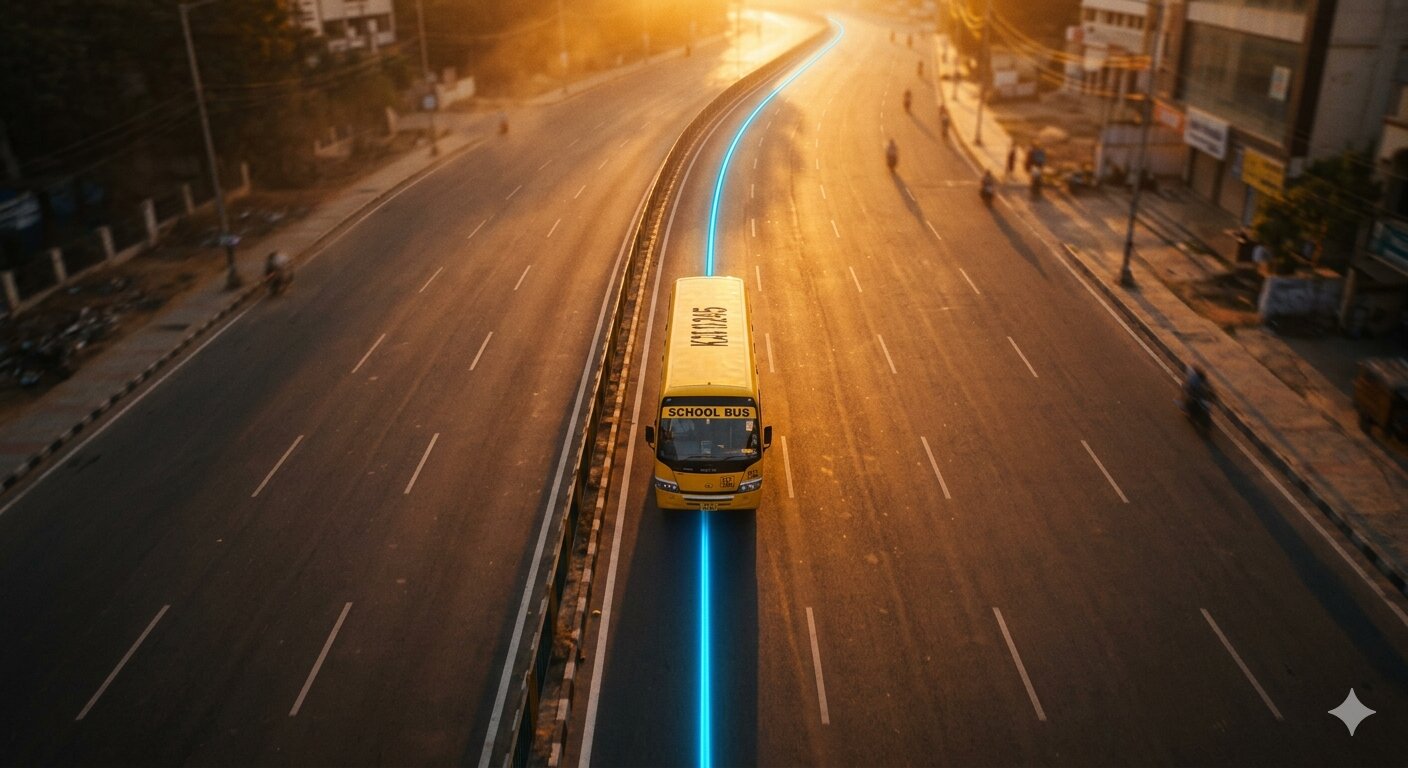
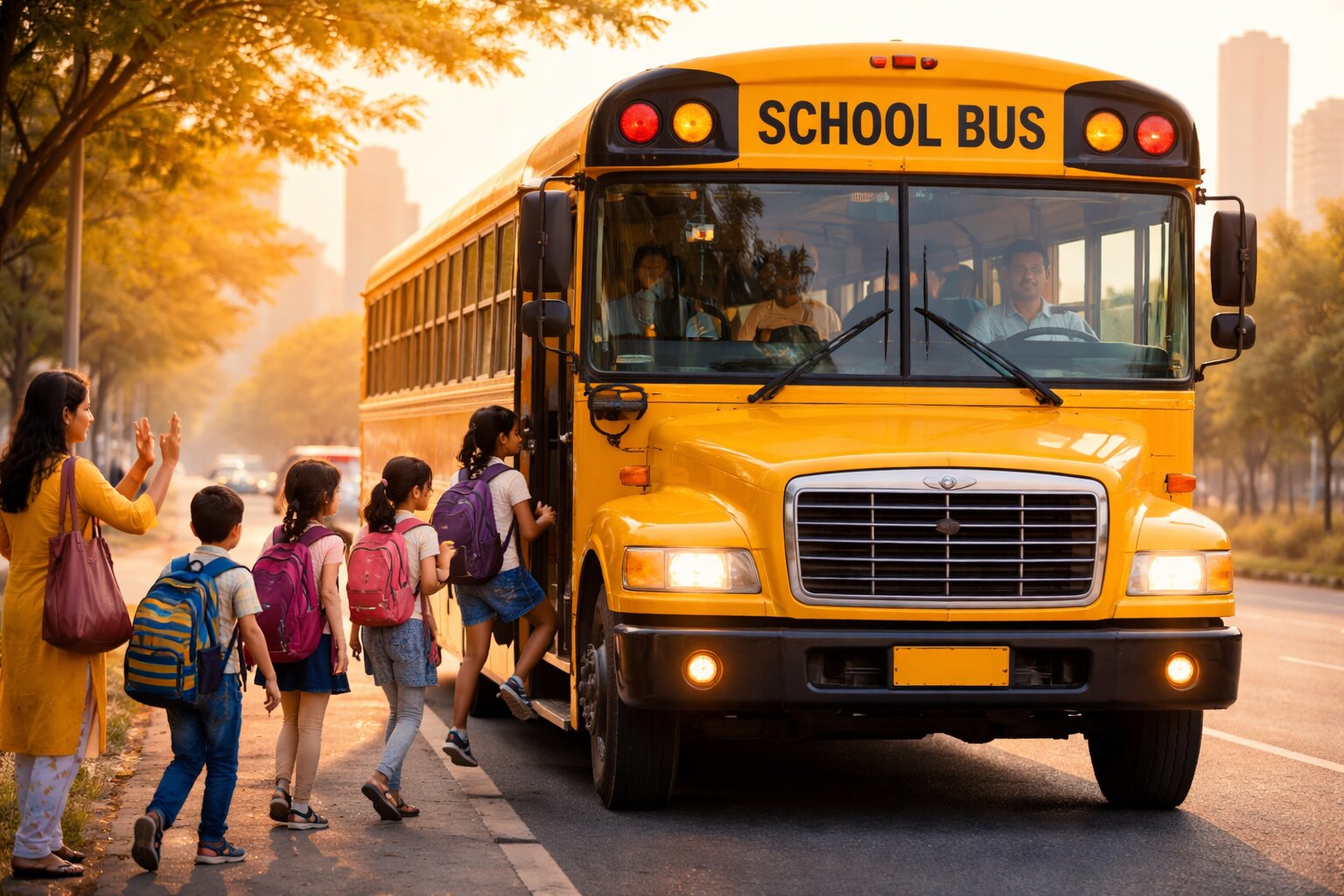
The morning school run is a daily ritual for millions of Indian families. A child steps onto a school bus, parents wave goodbye, and then they wait. They wait for a message that the child arrived safely. They wait for updates if the bus is late. And sometimes, unfortunately, they wait for news they never wanted to hear.School transportation is one of the most critical yet under-monitored aspects of a child’s daily life. Buses travel through congested city streets, navigate sharp turns, and carry the most precious cargo imaginable – our children. Yet, until recently, most schools relied on little more than a driver’s word and a schedule to manage this responsibility.Today, that is changing. Smart dashcam and GPS tracking systems are transforming school bus safety across India – giving parents real-time visibility, giving schools accountability, and giving children a far safer journey every single day.
The Hidden Risks in School Transportation
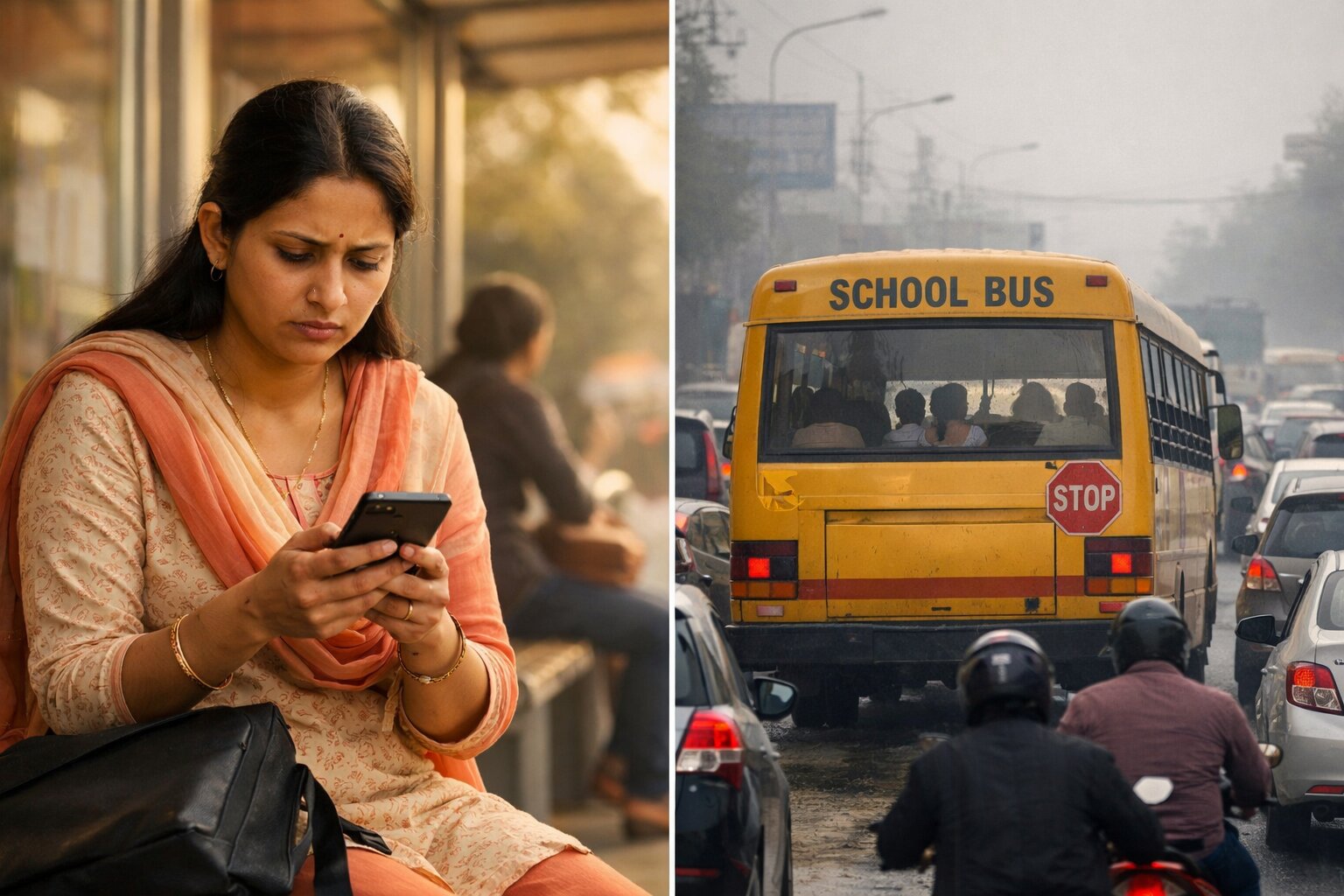
Most parents assume a school bus is inherently safe. But the reality on Indian roads is more complex. Without proper monitoring systems, several serious risks go unchecked every day.
What Can Go Wrong Without Monitoring
- Reckless or overspeeding driving, especially when drivers are unaware they are being watched
- Drunk or impaired driving – recent checks in Karnataka caught over 25 out of 5,100 school bus drivers operating under the influence during morning peak hours
- Bullying, fights, or inappropriate behavior among students inside the bus
- Unauthorized stops or route deviations that parents are never informed about
- Drivers dropping students far from their designated stop, placing children at risk
- Unexplained delays with zero communication to waiting parents
- Accidents that become disputed with no objective evidence to resolve them
The Wake-Up StatisticIndia accounts for approximately 10-11% of all global road crash deaths while having just about 1% of the world’s vehicles. School buses share these same roads every day. This makes monitoring technology not a luxury but an absolute necessity for child safety.
What Is a Smart School Bus Dashcam System?
A modern school bus dashcam is far more than a simple recording device. Think of it as a complete intelligent safety ecosystem installed inside and outside the bus – one that monitors, alerts, records, and communicates continuously in real time.At its core, a smart system combines these components working together:
- Front-facing camera capturing the road ahead in HD
- Cabin-facing camera monitoring students and driver behavior inside
- Real-time GPS tracking with AIS-140 certification
- Live video streaming to secure cloud storage
- AI-powered alert systems for safety and behavior events
- Integration with a parent-facing mobile app for instant updates
Together, these components create a transparent, accountable environment from the moment a child boards the bus to the moment they arrive home safely. Nothing is left to assumption.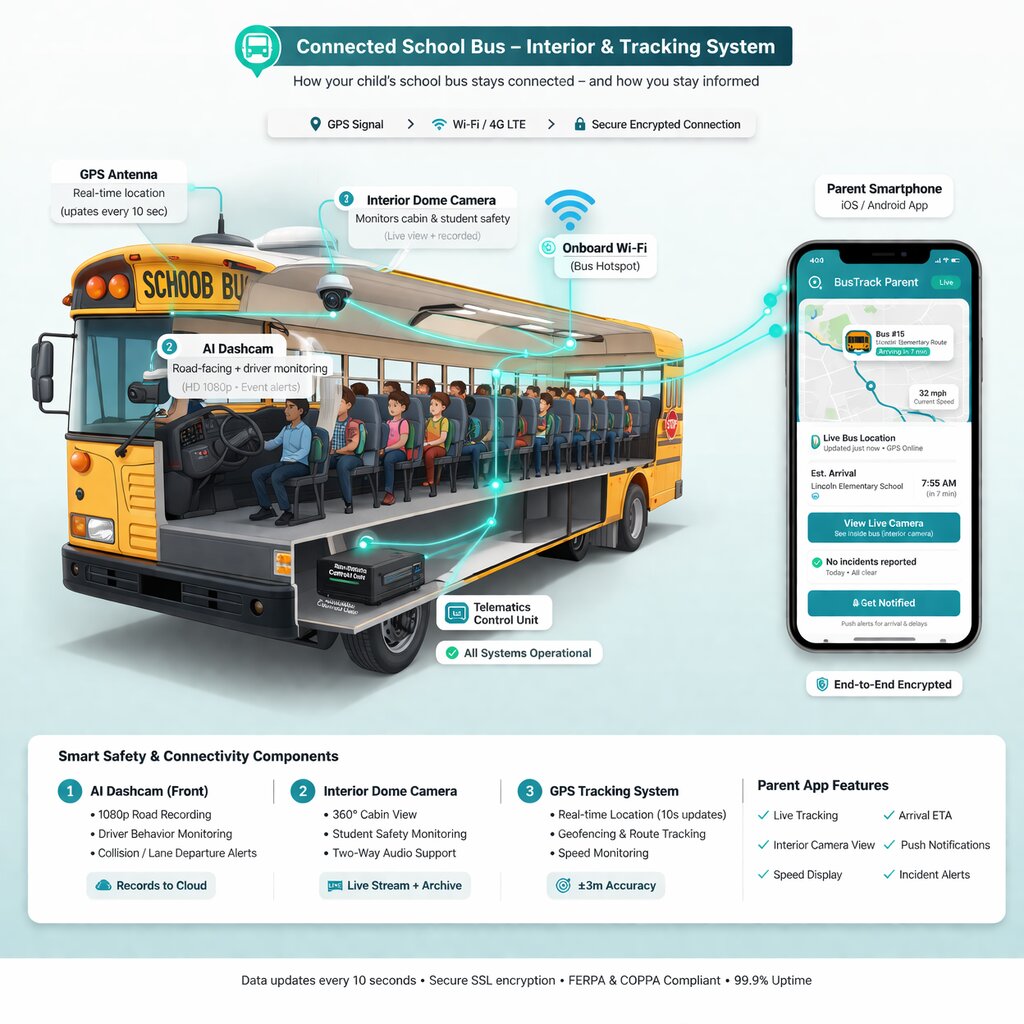
Key Features That Make the Difference
1. Live HD Video MonitoringModern dashcams record in Full HD (1080p) or 4K resolution, capturing crisp footage of both the road ahead and the bus interior. Wide-angle lenses eliminate blind spots. Every seat, every student, and every action is visible. School administrators and authorized staff can view live footage remotely at any time, ensuring immediate incident awareness and continuous driver accountability.2. Real-Time GPS TrackingGPS tracking is no longer optional in India – it is the law. CBSE’s revised school transport guidelines (2024-25) mandate GPS tracking devices in all affiliated school buses. Maharashtra’s Government Resolution requires GPS in every school bus with live location data accessible to principals for emergency response.With GPS, parents see exactly where the bus is at any moment, schools verify that routes are being followed, and emergency services can respond with precise location data.3. AI-Powered Driver Behavior AlertsThis is where modern dashcam technology truly sets itself apart. AI systems built into advanced dashcams detect and instantly alert for:
- Overspeeding beyond the legal 40 km/h limit for school buses
- Harsh braking or sudden acceleration events
- Mobile phone usage while driving
- Driver drowsiness, distraction, or inattention
- Route deviation or unscheduled stops
When a trigger occurs, the system auto-saves the footage, timestamps the event, and sends immediate alerts to the school administrator, transport manager, and parents as configured.4. Cloud Storage and Secure PlaybackAll footage is automatically uploaded to encrypted cloud servers. Under Indian regulations, CCTV footage from school buses must be retained for a minimum of 60 days and made available to authorities upon request. Cloud storage preserves evidence even if a camera is physically damaged or tampered with.5. Emergency SOS and Panic ButtonAdvanced systems include a physical panic button accessible to the driver or attendant. In any emergency, pressing it instantly shares live GPS coordinates with emergency contacts, triggers an alert to the school control room, and flags the incident for immediate human response.6. 360-Degree View and Passenger CountingPremium systems use multiple cameras – front, rear, left, right, and interior – providing a complete view around the entire bus. Advanced models also include automated passenger counting, so schools always know exactly how many students are on board at any point.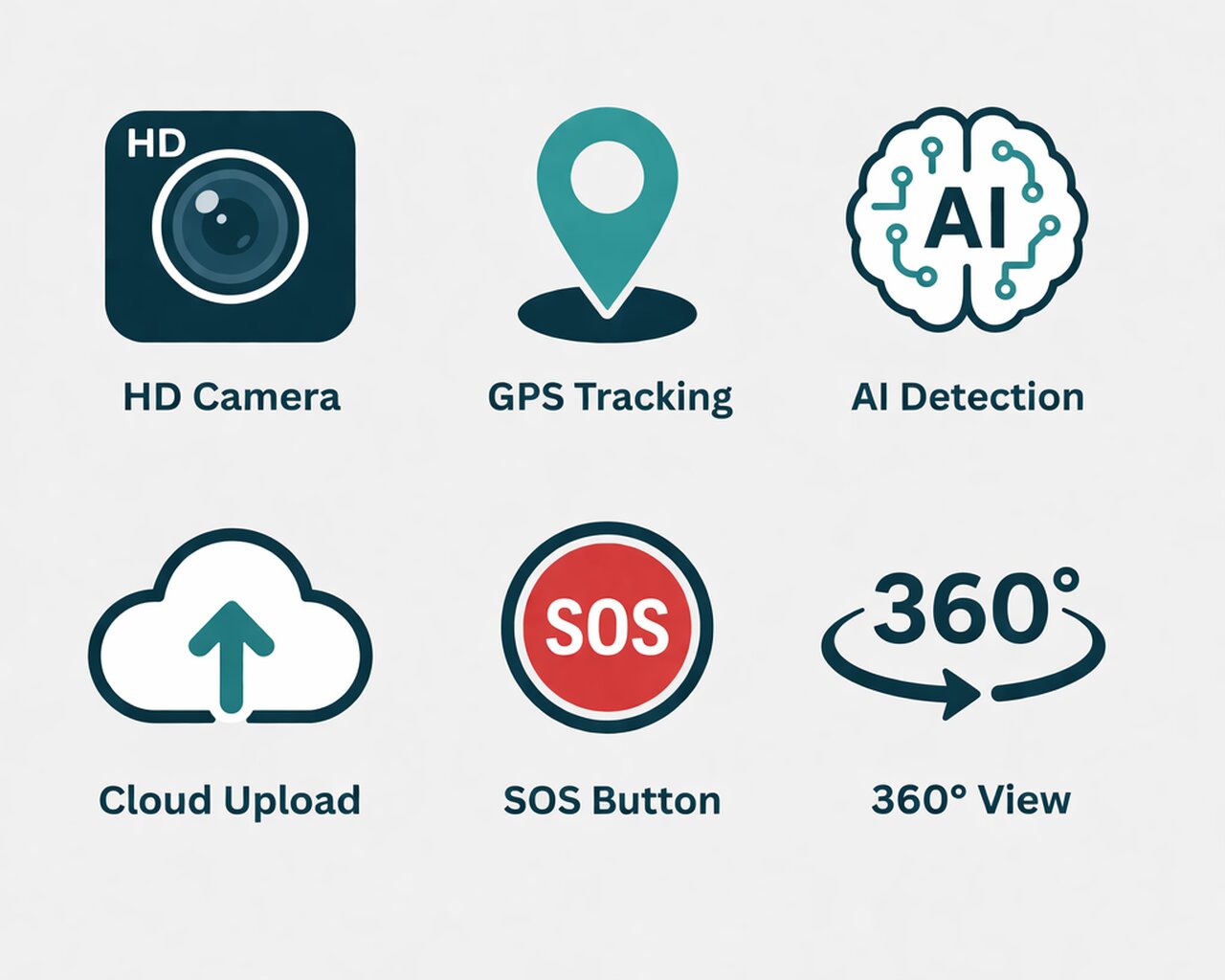
How Dashcams Directly Protect Your Child
The Deterrent EffectThe single most powerful safety benefit of a dashcam is one that requires no action at all: the presence of the camera itself. When drivers and students know they are continuously recorded, behavior improves immediately and measurably.
- Drivers follow speed limits more carefully when they know infractions are captured
- Harsh braking, reckless overtaking, and phone use on the road reduce significantly
- Students are far less likely to bully or fight when they know it is on video
- Unauthorized route diversions essentially stop because deviations trigger instant alerts
Real-World Impact in IndiaIn Karnataka, AI dashcam systems with integrated alcohol detection have been specifically deployed after the alarming discovery that school bus drivers were operating under the influence during morning runs. Mandatory pre-start breath tests combined with continuous AI monitoring provide a safety net that human supervision alone could never achieve.
Preventing and Resolving Bullying
Bullying on school buses is one of the most underreported child safety issues. Away from teacher supervision, buses can become spaces where weaker students face intimidation. Continuous cabin recording changes this completely – incidents are captured with irrefutable evidence, the camera deters misconduct, schools can take action based on footage, and parents receive full transparency.
Faster Emergency Response
In any accident or medical emergency, GPS coordinates and live video give rescue teams precise location information and real-time situational awareness before they even arrive on scene. In India’s urban traffic conditions, this speed advantage can be critical in saving lives.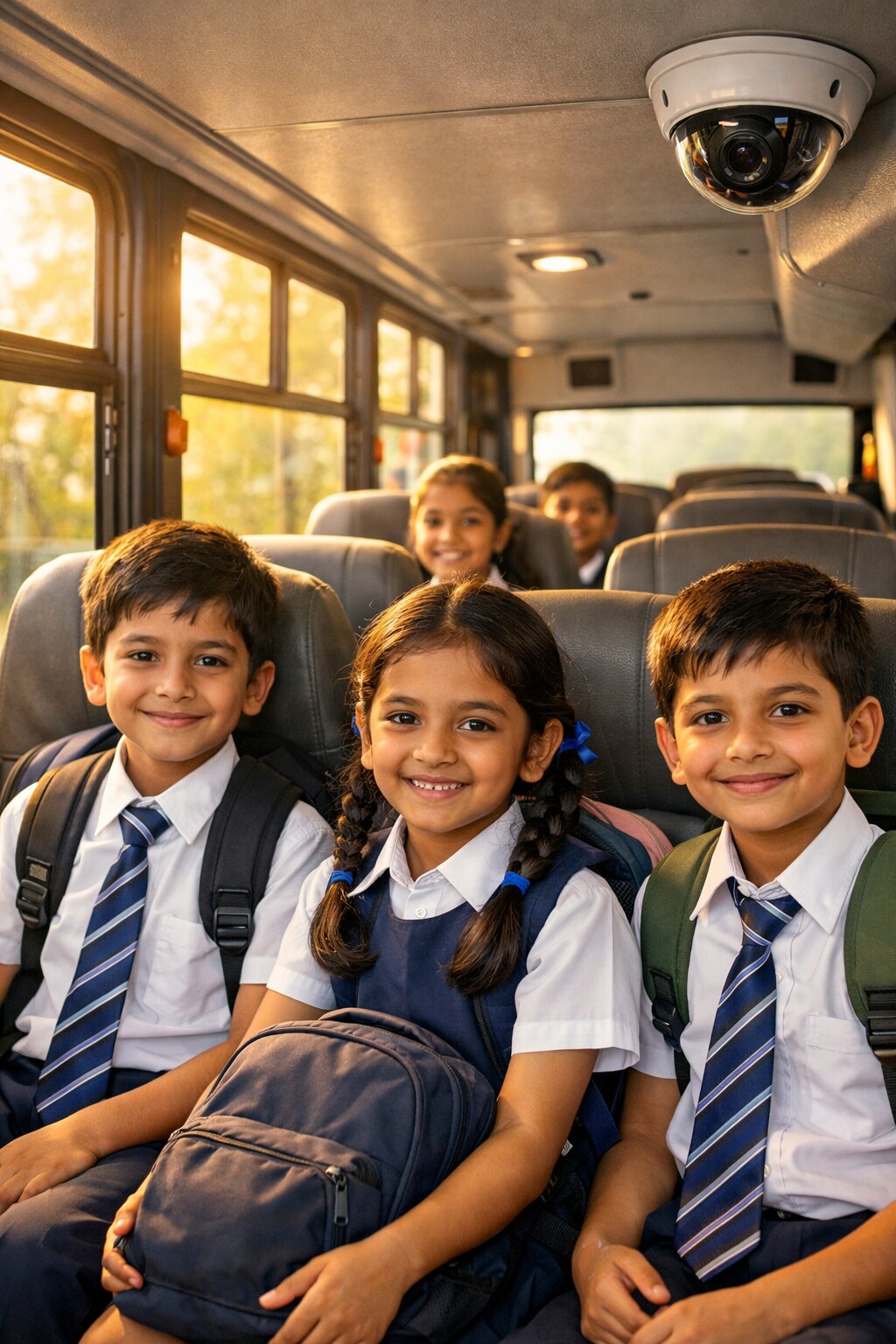
A Parent’s Complete Peace of Mind: The Tracking Experience
For parents, the dashcam and GPS system comes to life through a dedicated smartphone app. The modern parent tracking experience offers transparency that was unimaginable just a few years ago.Live Bus Location on Your PhoneOpen the app at any time and see a live map showing exactly where your child’s bus is, the route it has taken, and its estimated arrival time at your stop. No more anxious guessing or unnecessary calls to the school.ETA NotificationsThe app sends automatic push notifications when the bus is a set number of minutes away from your stop. You can prepare and meet your child on time, without waiting unnecessarily in heat or rain.Boarding and Drop-Off ConfirmationSystems integrated with RFID cards send you an instant notification the moment your child boards, and again when they are safely dropped off. You receive a time-stamped confirmation for every journey.Geofencing AlertsDefine boundaries around your home area, the school, or any safe zone. If the bus exits these areas or stops at an unscheduled location, you receive an immediate alert. Route deviations are flagged in real time.Transparent Delay CommunicationTraffic jams, breakdowns, route changes – the app communicates all of them proactively with updated ETAs. The age of unexplained delays and unanswered calls is over.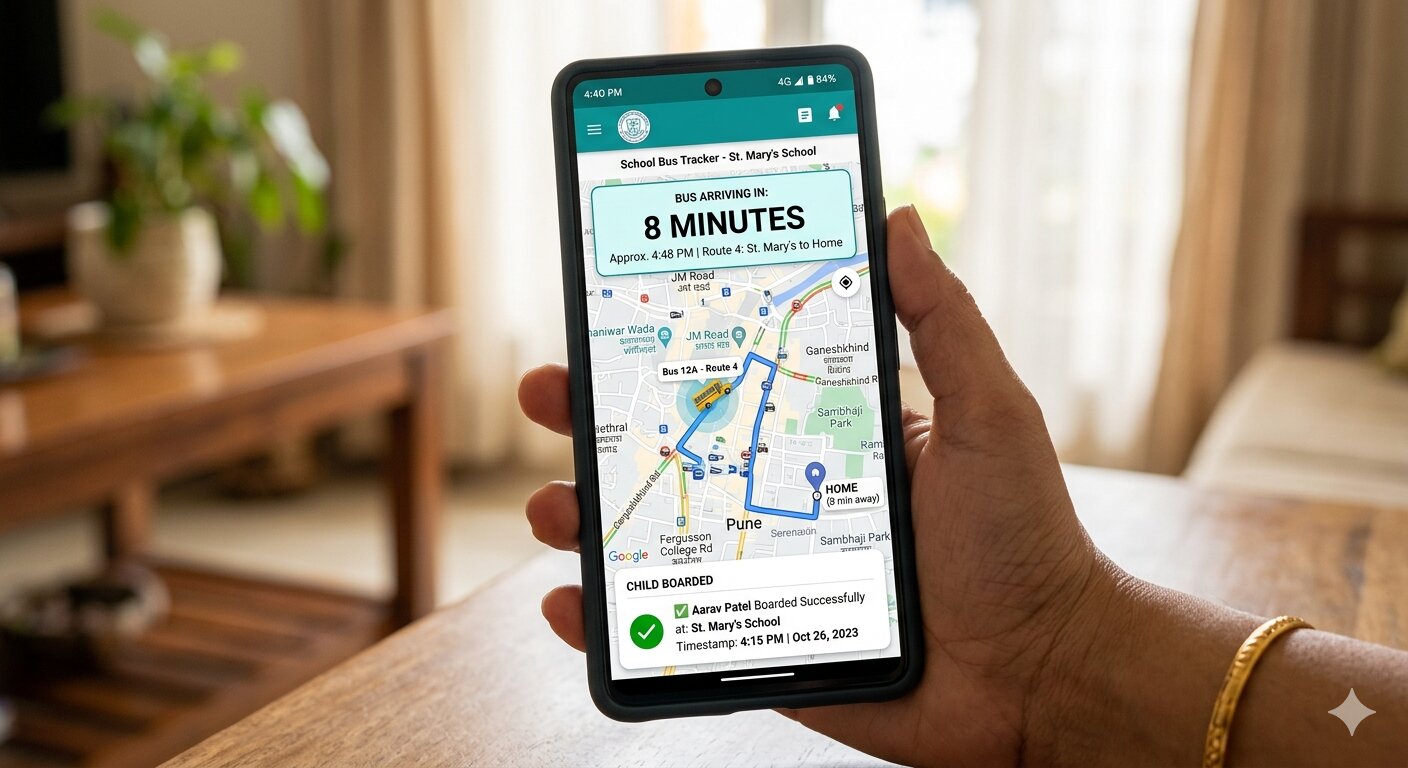
What the Law Says: Regulations in India
School bus safety monitoring is no longer just best practice – it is increasingly the law, backed by mandates from India’s highest educational and judicial authorities.
CBSE Mandatory Guidelines (2024-25)
The Central Board of Secondary Education, alongside the Supreme Court of India, has mandated that all CBSE-affiliated school buses must be equipped with GPS tracking devices, CCTV surveillance cameras, speed governors capped at 40 km/h, and real-time transport management software.
Maharashtra Government Resolution
Maharashtra has issued one of India’s most comprehensive school transport safety directives, binding on all schools across the state:
- CCTV cameras mandatory in all school buses
- GPS systems for live real-time tracking in every bus
- Centralized CCTV monitoring for operators collecting transport fees from parents
- Alert systems for any child going missing or failing to board
- Background checks, police verification, and weekly alcohol and drug screening for all drivers
With over 6,000 school buses operating in Mumbai alone, this resolution is one of the most significant child transport safety mandates in India’s history.
AIS-140 Certification
India’s AIS-140 standard requires GPS trackers in all commercial vehicles, including school buses. AIS-140 certified devices meet government specifications for tracking accuracy, data transmission, and emergency alerting – making them the baseline for any compliant fleet installation.
ADAS Mandate from April 2026
From April 2026, India’s Ministry of Road Transport requires Advanced Driver Assistance Systems in all new vehicles carrying more than 8 passengers. This applies directly to school buses and includes emergency braking, drowsiness warning, and lane departure alerts – all capabilities built into modern AI dashcam systems.
| Compliance Means Legal ProtectionSchools that deploy GPS and CCTV systems protect themselves legally as well as safeguarding children. Documented footage and GPS logs are admissible evidence in Indian courts and can shield schools from false liability claims and insurance disputes. |
What Does It Cost? A Practical Guide for Indian Schools
The investment in dashcam and GPS systems is far more affordable than most administrators assume – especially measured against the potential cost of an unmonitored incident.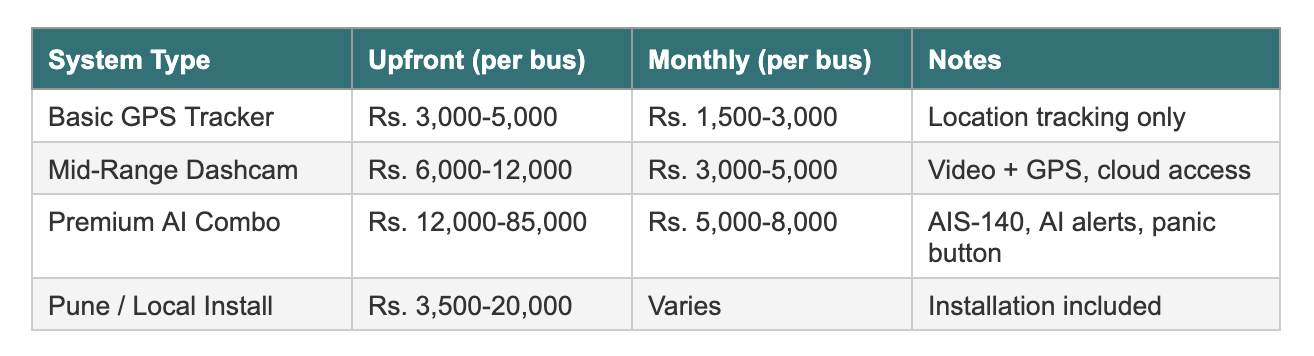
Pune and Maharashtra Local Pricing
In Pune and across Maharashtra, local installers typically offer basic 4G dashcams from Rs. 3,500 to Rs. 8,000 per unit, dual-channel fleet cameras at around Rs. 21,000, and full multi-camera CCTV systems with cloud access from Rs. 20,000 to Rs. 85,000 installed. For a 10-bus fleet, expect Rs. 1-2 lakhs upfront with Rs. 20,000-50,000 in monthly operating costs.
The Real Cost of NOT Installing
A single incident – an accident, a bullying case that escalates legally, a missing child report – can cost a school lakhs in legal fees, insurance claims, and reputational damage that cannot be repaired. A complete monitoring system costs a fraction of a single significant incident, and prevents most incidents from happening at all.
How to Choose the Right System for Your School
Must-Have Features
- HD resolution (minimum 1080p) for both front and cabin cameras
- AIS-140 certified GPS with real-time tracking
- Cloud storage with minimum 60-day retention as required by regulations
- AI alerts for speeding, harsh braking, and driver behavior events
- Parent mobile app with live tracking and automatic ETA notifications
- Panic button and SOS emergency functionality
- Tamper-proof camera design
Good to Have
- Alcohol detection with pre-start ignition interlock
- RFID student boarding and drop-off confirmation
- Automated passenger counting
- 4G/LTE connectivity for uninterrupted live streaming
- Integration with school ERP or management software
Questions to Ask Your Vendor
- Is the GPS device AIS-140 certified?
- How is footage stored, encrypted, and for how long?
- Who has access to video feeds?
- What happens if the camera is tampered with or internet drops?
- Is the system compliant with India’s Digital Personal Data Protection Act (2023)?
- What is the service level agreement for technical issues and downtime?
Why Schools That Adopt This Today Win Tomorrow
In a competitive educational landscape, parents trust the schools that visibly care for student wellbeing in every aspect of school life – including transportation. Schools that adopt smart dashcam systems gain a powerful parent trust signal, legal protection through documented evidence, CBSE and state compliance, reduced liability for transport incidents, operational insights to optimize routes and driver performance, and a differentiated reputation as a safety-first institution.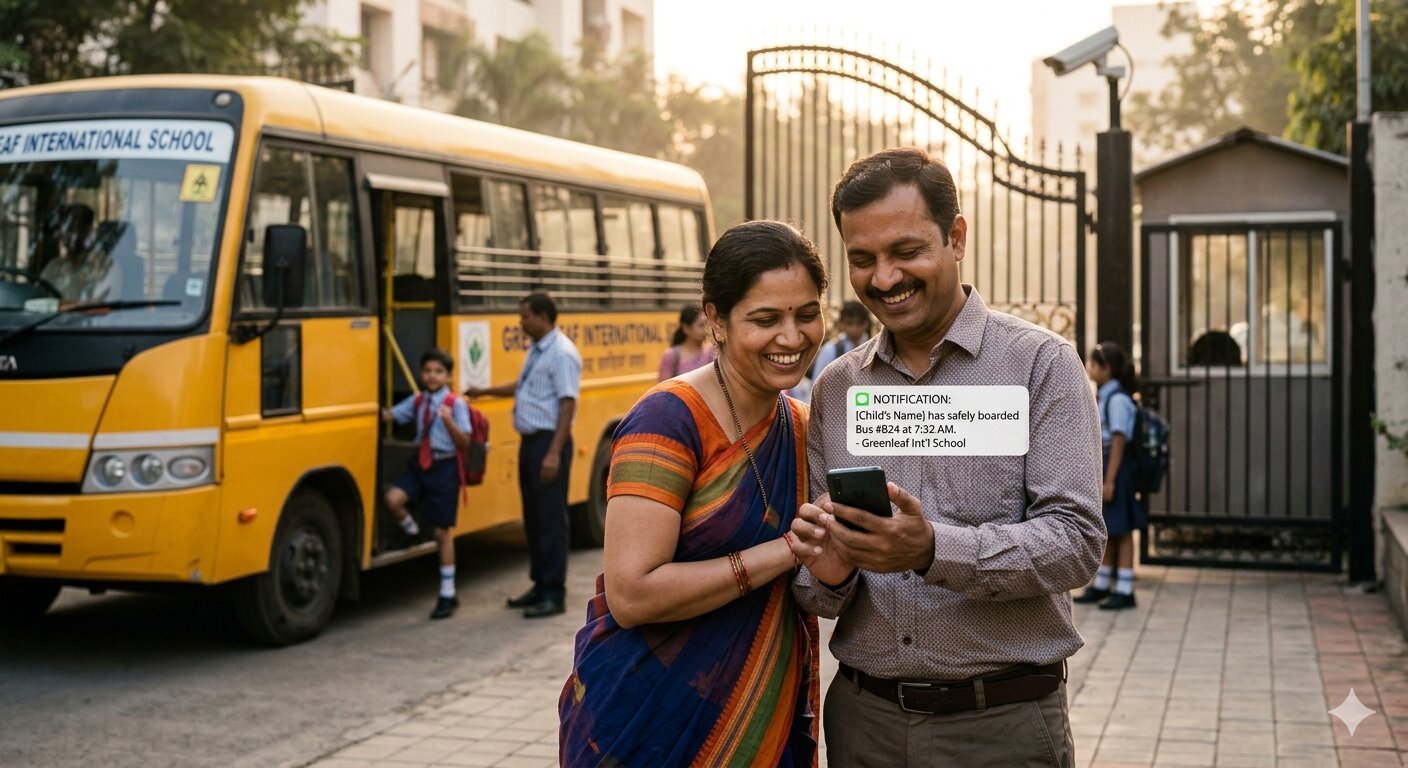
A Smarter Bus Today. A Safer Child Tomorrow.
The question for every school administrator, transport operator, and parent in India is no longer whether dashcam and GPS monitoring is necessary. The questions are: how quickly can we deploy it, and which system serves our children best.India faces 1.7 lakh road accidents every year. Our roads are busy, our traffic is unpredictable, and our children deserve more than hope as a safety strategy.Modern dashcam systems with GPS tracking, AI monitoring, parent apps, and cloud storage represent the single most impactful investment a school can make in transport safety. They are affordable, compliant with national and state regulations, and proven to reduce incidents through both deterrence and real-time response.The technology exists. The regulations require it. The parents are asking for it. The only question left is: when will your school implement it?
Track. Protect. Reassure. Every journey, every child, every day.