EV Intelligence · Industry Analysis
India sold 24.5 lakh electric vehicles last year. As the first wave enters the resale market, nobody agrees on what a used EV is actually worth.
India’s electric vehicle market has grown beyond the early adopter phase. In FY2025 to 26, the country recorded approximately 24.5 lakh EV sales across all segments, marking a 24.6% year on year increase. EV penetration crossed 8.5%. Several major automakers now compete aggressively in the passenger EV space, and roughly 30 new EV models are expected to launch in 2026 alone.
This acceleration means something else is quietly building: a used EV market. The first large cohorts of EVs purchased between 2021 and 2023 are now three to five years old. Original owners are upgrading. Fleet operators are cycling out vehicles. Leasing contracts are expiring. These vehicles need to find second owners.
And here is where the problem begins. Nobody agrees on what a used EV is worth. There is no standard, no universally accepted method, and no certification that a buyer or seller can point to and say, “This is the fair price.”
The ICE Market Had This Figured Out Decades Ago
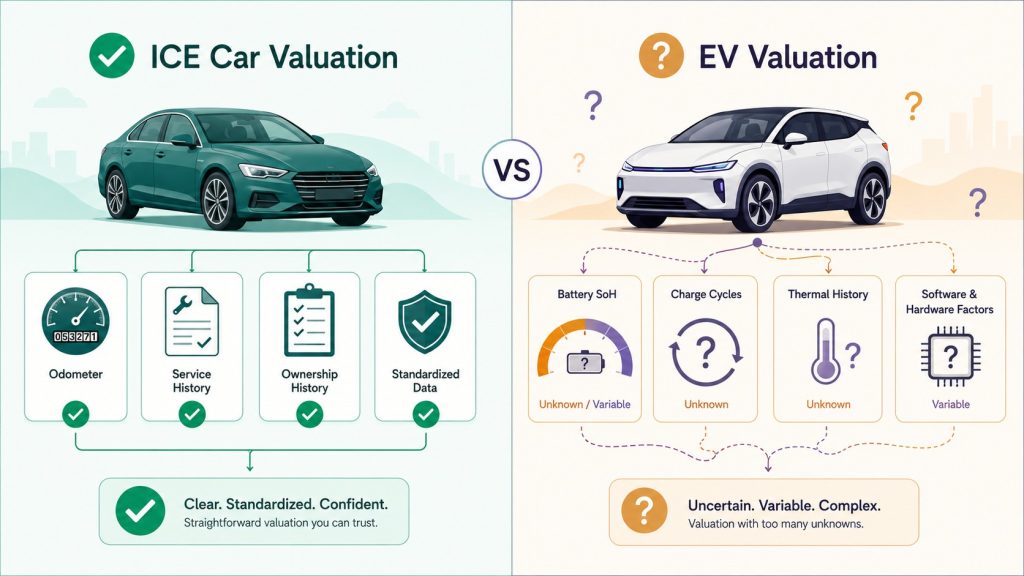
When you buy a used petrol or diesel car in India, the valuation process is straightforward. You check the odometer reading, the service history, the number of owners, and the vehicle’s physical condition. Insurance companies use standardised depreciation schedules. Banks have established loan to value ratios. Resale platforms have built algorithms around these well understood variables.
The entire used ICE vehicle ecosystem rests on a simple truth: the engine and transmission have predictable lifespans. An odometer reading is a reliable proxy for how much life the vehicle has left. A car with 40,000 km on it is worth more than the same model with 80,000 km. Everyone, from the buyer to the insurer to the lender, understands this.
Now try applying that logic to an electric vehicle. It falls apart immediately.
Why Mileage Does Not Work for EVs
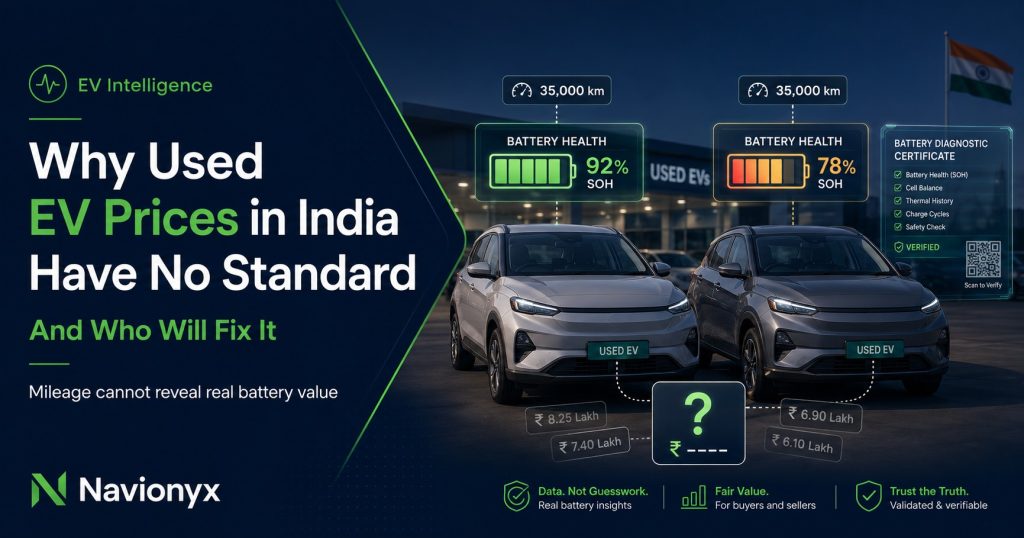
In an EV, the battery pack accounts for 35% to 45% of the vehicle’s total cost. It is the single most expensive component, and it is the one that determines range, performance, and resale value. But unlike an engine, a battery does not degrade based on mileage alone. Two identical EVs with the same odometer reading can have dramatically different battery health depending on how they were charged, where they were parked, and how deeply they were discharged.
Consider two electric SUVs of the same popular model, both three years old, both with 35,000 km on the odometer. One was owned by a driver who charged primarily at home using a slow AC charger, kept the battery between 20% and 80% state of charge, and parked in a covered garage. The other was used in a ride hailing fleet, fast charged on DC chargers multiple times a day, regularly discharged below 10%, and parked outdoors in 45 degree Celsius summers.
On paper, these vehicles look identical. In reality, the first might have 92% State of Health remaining. The second might be at 78%. That difference translates to lakhs of rupees in real value, but there is no standardised system to surface it.
In a survey of over 500 used EV seekers in India, 73% said they would consider buying a pre owned EV only if it came with a minimum 3 years of battery warranty remaining or a certified State of Health report.
Source: EVXpertz 2025 Consumer Survey
India Has No Mandatory Battery Health Framework
This is the core of the problem. The Ministry of Road Transport and Highways (MoRTH) has not yet notified used EV certification rules under the Central Motor Vehicle Rules. There is no mandatory battery State of Health disclosure during ownership transfer. RTOs do not record battery swaps or replacements. Most OEMs do not provide easily accessible battery health data to third parties.
The result is a market where pricing is based on guesswork. Dealers, unsure how to value the battery, apply heavy blanket depreciation regardless of actual condition. Industry analysis has noted that India currently has no universally accepted standard to measure or certify battery health for resale. Insurers rely on proxy indicators like vehicle age, warranty period, and manufacturer reputation rather than actual battery diagnostics.
This creates a lose lose situation. Sellers with well maintained EVs get lowballed because there is no way to prove their battery is healthy. Buyers overpay for vehicles with degraded batteries because there is no way to verify the truth. And platforms sitting in the middle lose transaction volume because both sides lack confidence.
“India is still lacking a professional battery health certification that buyers can blindly trust. As the value of a replacement battery is very expensive, buyers are reluctant to approach the used EV market.”
Industry analysis, AllAboutEVs, June 2026
The Numbers Tell the Story
The depreciation data makes the trust gap visible. Mass market EVs in India retain approximately 40% to 55% of their original price after three years. The equivalent for ICE vehicles is 55% to 65%. That gap is not explained by mechanical wear. It is explained by uncertainty. When a buyer does not know whether the battery will last another five years or need a replacement costing several lakhs, they price in the worst case scenario.
Data from over 2,980 real used EV listings across Indian marketplaces shows an average annual depreciation of approximately 14% per year across all models. But the variance within that average is enormous. Models with strong brand trust and transferable warranties from established automakers hold value significantly better than niche or low volume imports. Vehicles with 4 to 6 years of battery warranty remaining consistently command a price premium over those nearing warranty expiry.
The pattern is clear: wherever transparency exists (warranty status, brand reputation), value holds. Wherever transparency is absent (actual battery condition, charging history, cell level health), value collapses.
Global context: The UK is introducing standardised Battery Health Certificates for used EVs. The US Inflation Reduction Act offers a $4,000 tax credit for used EV purchases. The Netherlands provides subsidies of up to €2,000 for second hand EV buyers. India currently has no equivalent framework.
The Market Is Already Moving
The industry recognises the gap. In July 2026, a leading resale platform announced a partnership with an OEM to build a structured ecosystem for pre owned EVs. The collaboration introduces standardised battery health assessments and certification, initially rolling out across 13 cities. The platform’s CEO acknowledged that transparency in battery diagnostics is critical to building trust in the used EV market.
This is a significant move, but it is also brand specific. The partnership covers only one OEM’s vehicles. Owners and sellers of other electric models do not benefit from this arrangement. The used EV market needs a platform agnostic, OEM agnostic standard that works across all brands, all models, and all platforms.
That is exactly the gap Navionyx is built to fill.
What a Real Standard Looks Like
A genuine used EV pricing standard needs to go beyond a single State of Health number. SoH alone is a headline metric, not a complete picture. A proper certification must include the full set of data points that actually determine battery condition and remaining life.
This means tracking charge cycle count and the ratio of fast DC charging to slow AC charging. It means recording depth of discharge patterns over the vehicle’s lifetime. It means capturing cell level voltage variance, because a pack where individual cells are drifting apart is aging differently from one where all cells are balanced. It means logging thermal history, because a battery that spent three summers parked outdoors in Nagpur has experienced very different stress than one garaged in Bengaluru.
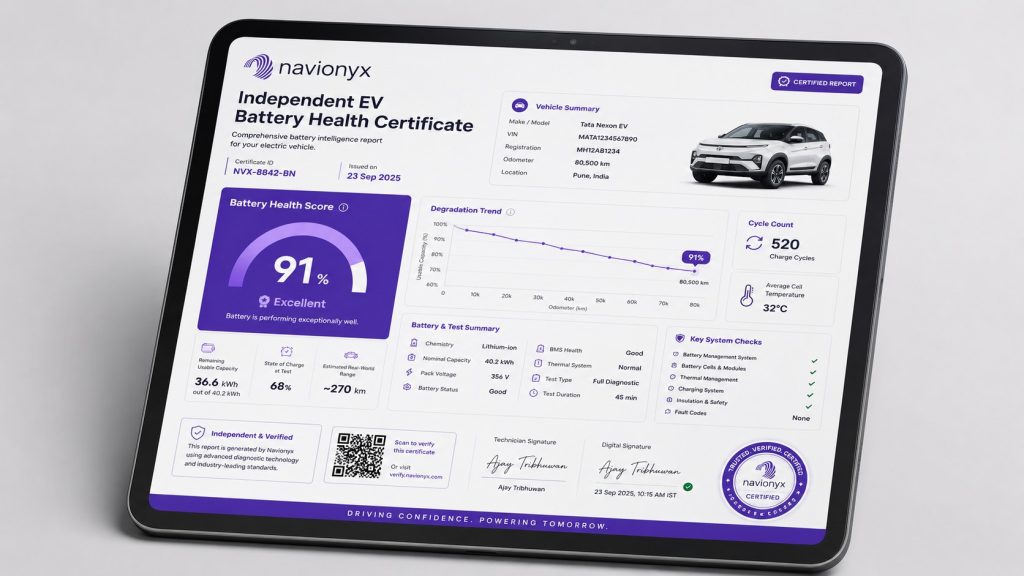
The Navionyx EV Resale Value Intelligence platform captures all of this. Every vehicle monitored through Navionyx builds a continuous usage profile from first deployment. The output is not just a percentage. It is a battery health based resale score, a charge cycle and degradation trend report, and an ownership confidence report, all packaged into a QR verifiable Navionyx EV Certificate that any buyer, dealer, or platform can independently verify.
This is what a standard looks like. Not a number on a dashboard, but a complete, auditable, verifiable record of how a battery was used throughout its life.
Who Needs This Most
The used EV trust gap is not just a consumer problem. It is a commercial problem for every company that touches the secondary EV market.
Resale platforms need battery scoring at scale to price EV inventory accurately. Without it, they either overpay during acquisition or underprice during sale, both of which erode margins. A standardised battery assessment API that integrates into existing acquisition workflows would allow these platforms to evaluate battery condition as part of every vehicle inspection, not as a special case.
Dealerships need certification to differentiate their EV inventory. A “Navionyx Certified” badge on a used EV listing signals to the buyer that the battery has been independently assessed. This builds the same kind of buyer confidence that certified pre owned programs have built for ICE vehicles over the past two decades.
NBFCs and insurance companies need battery health data to underwrite used EV loans and policies accurately. Without it, they either refuse to finance used EVs entirely or apply risk premiums that make the vehicles unaffordable for second buyers. Standardised battery data feeds directly into the risk models these institutions already use.
The used EV market in India is projected to grow at 25% to 30% CAGR over the next five years. The companies that solve the trust problem first will capture the market. Those that wait for government regulation will be years behind.
The Window Is Now
India’s used EV market is at an inflection point. The vehicles are entering the secondary market. The buyers are showing up. But the infrastructure of trust that makes transactions happen efficiently does not exist yet.
The question is not whether a standard will emerge. It will. The question is whether it will be driven by the market or imposed by regulation years too late. Every month without a reliable battery assessment standard means more value destroyed through uncertainty, more buyers walking away, and more sellers accepting unfair prices.
The market does not need to wait. The technology to assess, certify, and verify EV battery health at the cell level exists today. What it needs is adoption.
If you operate a used EV platform, run a dealership with EV inventory, or finance pre owned electric vehicles, download a sample Navionyx EV Certificate to see exactly what a battery health standard looks like in practice.
See What a Navionyx EV Certificate Looks Like
Download a sample battery health report showing charge cycle analysis, cell level diagnostics, degradation trends, and the overall resale readiness score.
Download Sample ReportRelated Reading
The Hidden Cost of a Bad Battery in a Leased EV Fleet
EV Battery Health Is More Than SoH: How Cell Level IoT Analytics Reveal the Real Story
This article was researched and written with AI assistance and reviewed by the Navionyx team.