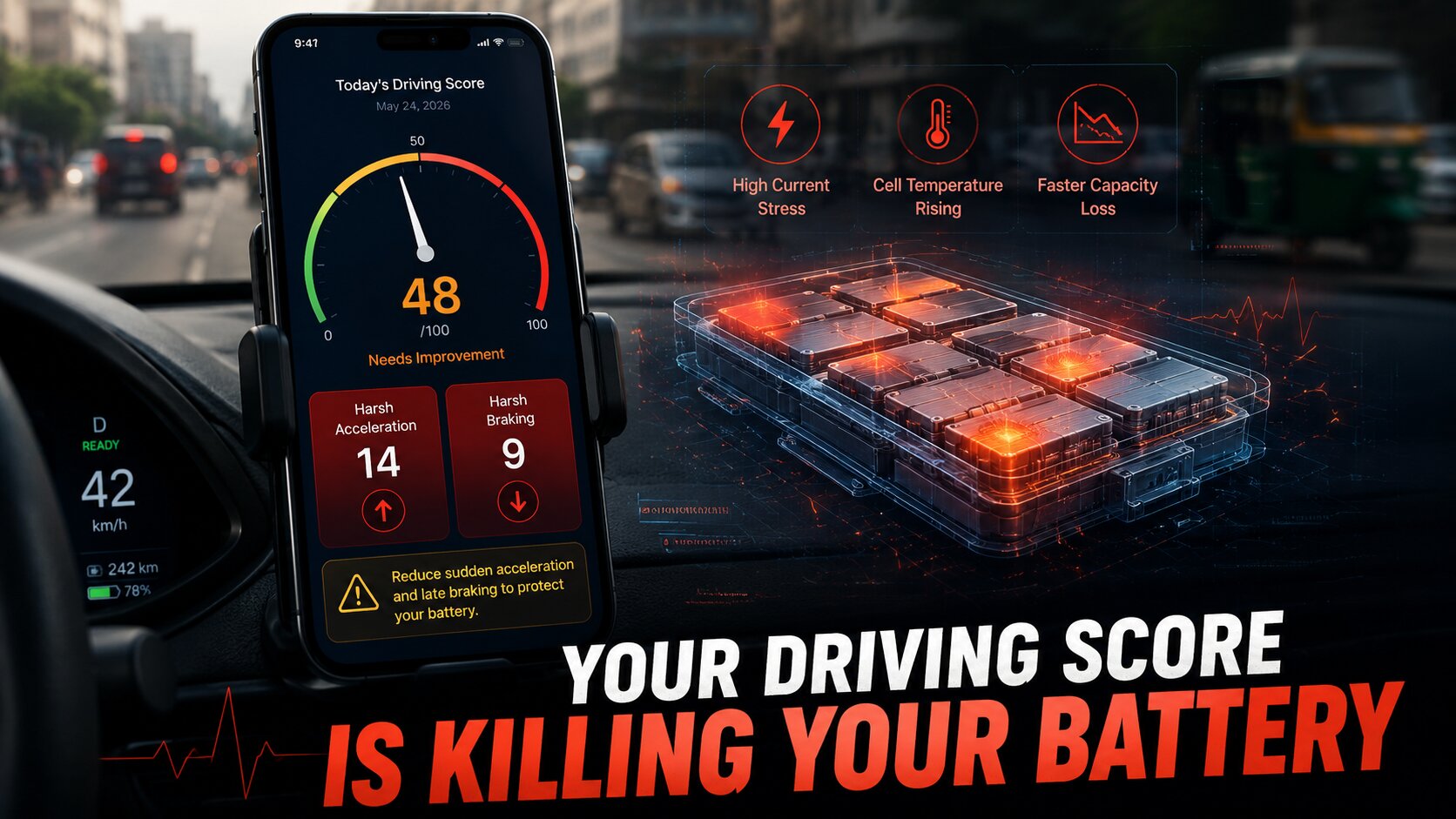
Most EV owners focus on one number: how much range is left on the battery indicator. But there is a second number — one that barely gets talked about — that determines whether your EV gives you 150 km per charge today and 110 km per charge two years from now. That number is your driving score.
Every time a driver floors the accelerator at a traffic light, stomps the brakes at the last second, or rides at full throttle on an open road, the battery absorbs a high-current stress event. Do that a few hundred times and the damage begins to compound. Research from a 2025 analysis of over 22,700 electric vehicles found that aggressive operational habits — particularly high current draws from rapid acceleration — are one of the top measurable drivers of accelerated battery capacity loss. The average EV already loses around 2.3% of its capacity every year under normal conditions. Rash driving pushes that curve steeper.
This is what Navionyx BMS was built to address. Not just to monitor your battery, but to connect what is happening inside the pack directly to how the vehicle is being driven — and to give fleet managers and EV owners the visibility to act before the degradation becomes expensive.
What Rash Driving Actually Does to Your Battery
An EV battery is not a simple tank of energy. It is an electrochemical system that has a preferred operating window — steady, moderate current draws that let lithium ions move smoothly between electrodes. When a driver hammers the accelerator, the motor demands a sudden burst of high current from the pack. That spike generates localised heat at the cell level, stresses the electrolyte, and accelerates the formation of a layer on the anode called the SEI (Solid Electrolyte Interphase). Over time, a thickened SEI means reduced usable capacity and reduced range.
Hard braking compounds the problem differently. In an EV, gentle deceleration feeds energy back into the battery through regenerative braking — effectively a free top-up. Slam the brakes and that regenerative window is lost entirely. The kinetic energy that could have extended your range by a few more kilometres disappears as heat in the brake pads instead.
What the data says
Studies on fleet driving behaviour show that aggressive driving — characterised by rapid acceleration and hard braking — can reduce energy efficiency by 15% to 40% compared to smooth driving. For an EV with a 150 km range, that means up to 60 km of lost range on a single shift, purely from driving style.
This is not a theoretical problem. It plays out every day in commercial EV fleets where drivers have no feedback loop, no score, and no awareness that the way they drive today is shortening the life of an asset worth lakhs of rupees.
How Navionyx BMS Reads Your Driving Score From the Battery Up
Most driving score systems work top-down: they use GPS speed data and accelerometer readings to label events as “harsh acceleration” or “hard braking.” That is useful, but it tells you about the vehicle motion, not what is actually happening inside the battery.
Navionyx BMS works from the battery up. The system reads live data directly from the battery management system — cell voltages, pack temperature, state of charge, current draw, and discharge rate — at high frequency. When a driver accelerates aggressively, Navionyx sees the current spike at the cell level. When braking is smooth and regenerative, it registers the energy recovered. This data feeds into a driving score that reflects not just how the vehicle moved, but what the battery experienced.
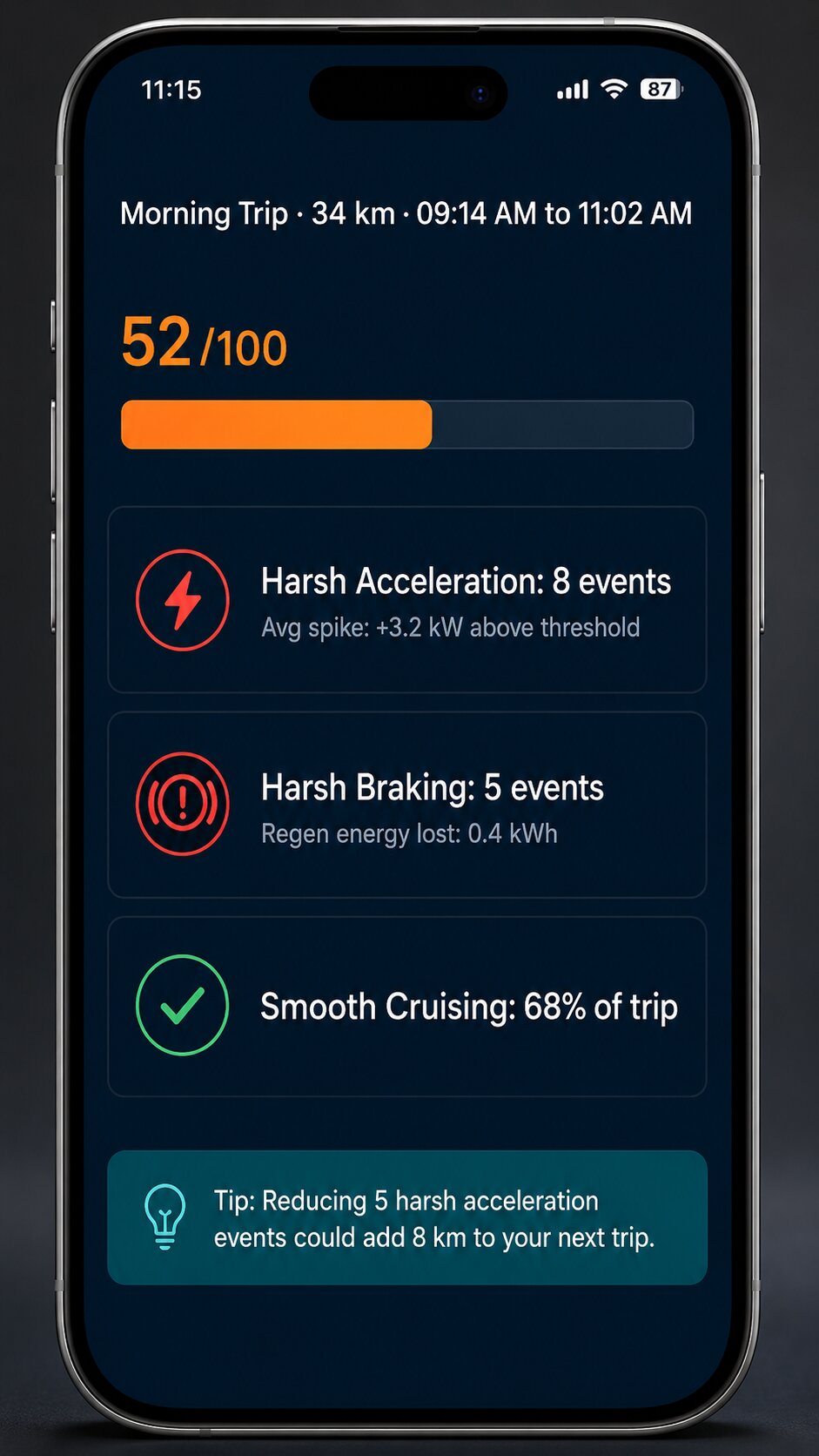
The result is a score that improves or worsens based on actual electrochemical impact, not just motion events. A driver who accelerates quickly but smoothly, without a sudden current spike, is treated differently from one who floors it from a dead stop. That nuance matters when you are trying to build genuine behaviour change in a fleet.
Three driver habits that Navionyx BMS scores and tracks
Extra acceleration events: Sudden high-current draws that spike battery temperature and stress cell chemistry. Navionyx logs each event, counts frequency per trip, and shows the trend over time.
Hard braking events: Each hard stop where regenerative energy recovery is lost. The platform quantifies how much recoverable energy was wasted versus captured on a given journey.
High-speed sustained load: Extended periods of high current draw that keep the battery operating at elevated temperatures, accelerating long-term degradation.
The Score Improves — and So Does Range
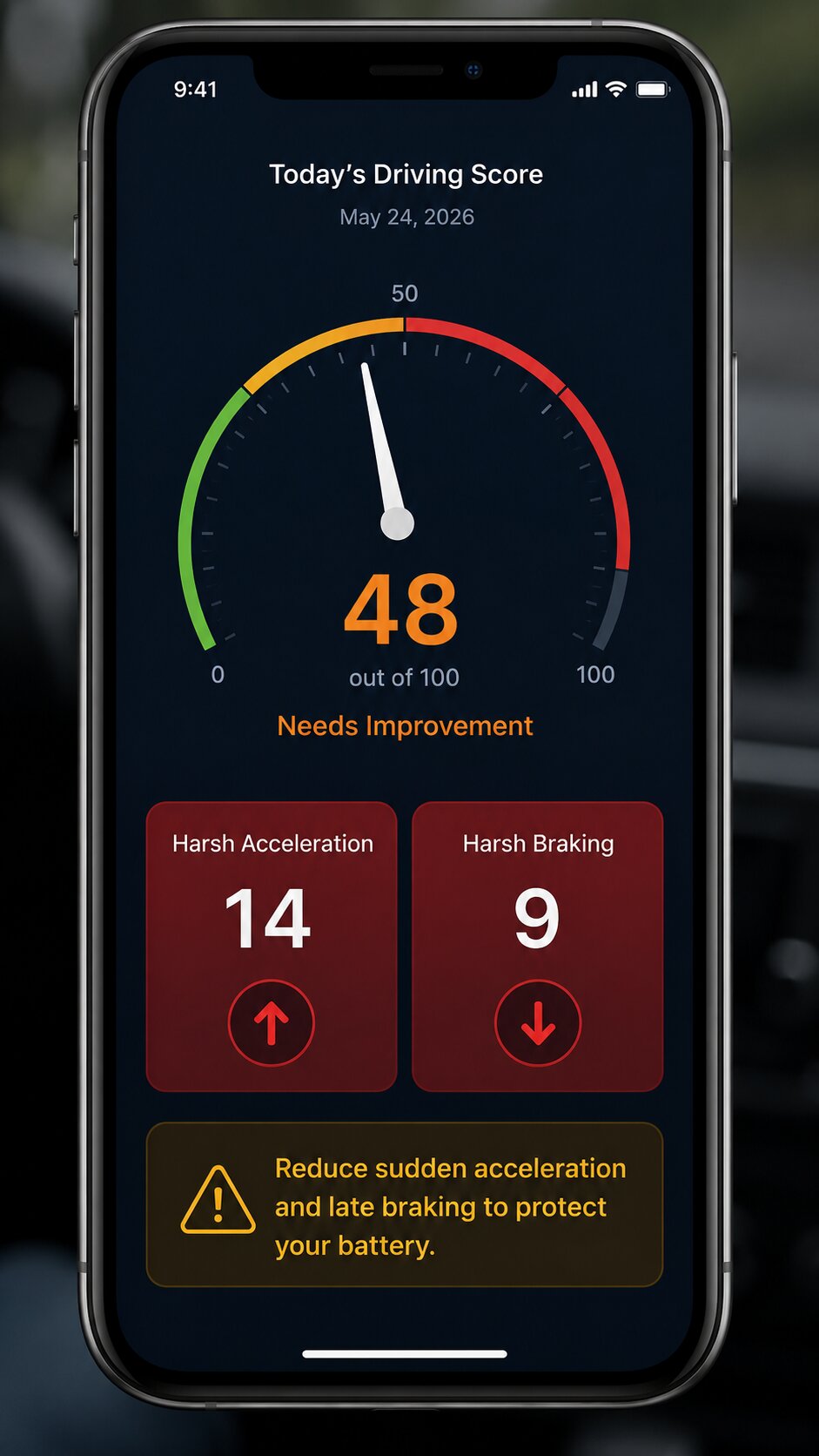
The most practical value of a driving score is not the number itself. It is the feedback loop it creates. When a driver can see on their app that yesterday’s trip scored 62 out of 100, and that three hard acceleration events were the main reason, they have something specific to change. When the next trip scores 78, and the range on that shift was noticeably better, the connection between behaviour and outcome becomes real.
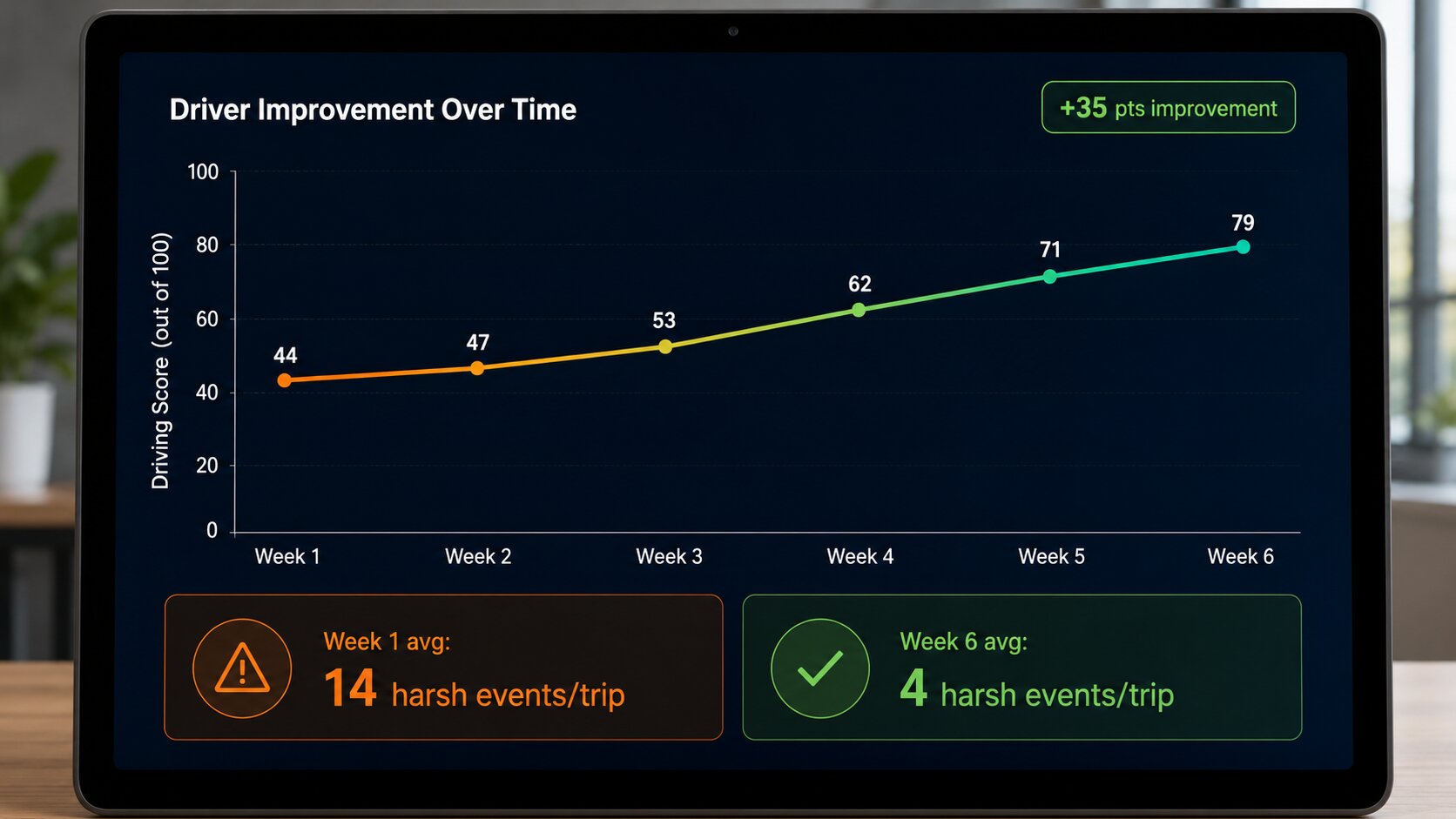
Navionyx surfaces this feedback in two places. Fleet managers see an aggregated score per driver and per vehicle on the operations dashboard, with trend graphs that show whether driving quality is improving week over week. Drivers can see their own trip-level breakdown in the app — including how many acceleration and braking events occurred and where on the route they happened.
Over a period of weeks, fleets that act on this data consistently see two things happen in parallel: driving scores go up, and average per-trip energy consumption goes down. Better driving style means more energy per kilometre, which translates directly into more range from the same charge.
Remote Relay: Lock the Vehicle When the Score Is a Concern
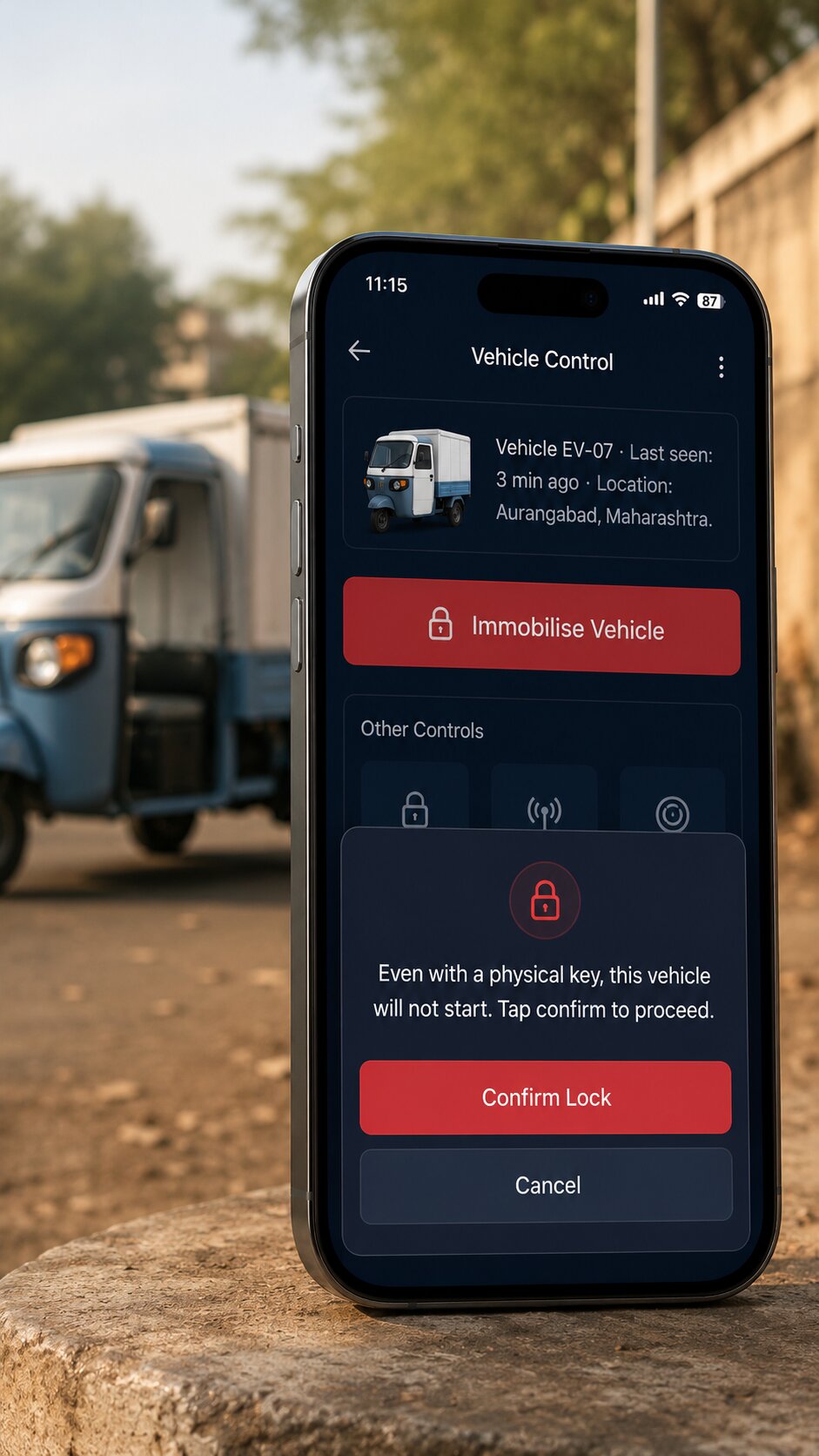
Monitoring driving scores is only one side of the picture. There are situations where a fleet manager needs to go further: a vehicle dispatched without authorisation, a driver who consistently ignores guidance, or a vehicle that needs to be held at a location for operational reasons.
Navionyx includes a remote relay feature that lets a fleet manager lock the vehicle immobiliser directly from the platform. Even if someone has the physical key, the vehicle will not start. The relay command is sent over the cellular network and executed at the vehicle level, with a confirmation logged in the platform. When the manager is ready to release the vehicle, a single tap restores normal operation.
This capability matters particularly for NBFCs and financiers who hold security interest in EV assets. If a loan account becomes overdue, the ability to remotely immobilise the vehicle without a physical repossession team changes the risk equation significantly — and it is one of the reasons Navionyx is trusted by several leading NBFC lenders.
What Smarter Driving Looks Like in Practice
The shift from rash to smooth driving does not require a new vehicle or new hardware. It requires awareness and a feedback loop. Here is what the difference looks like at a practical level for an EV driver operating a commercial vehicle in an Indian city:
Driving habits that protect battery health and extend range
Roll into acceleration. Instead of pressing the accelerator fully from a standstill, apply throttle gradually. The battery sees a lower peak current draw, the cells stay cooler, and the vehicle actually accelerates more smoothly in traffic.
Brake early, brake gently. Start slowing down earlier before a stop. Regenerative braking works best at moderate deceleration — it is recovering energy back into the battery. A late, hard stop throws that energy away entirely.
Maintain steady speed. Constant speed on a clear stretch uses far less energy than repeated acceleration and braking cycles. On predictable routes, a steady pace can meaningfully extend per-charge range.
Watch your score trend, not just today’s number. A single trip score is a snapshot. The trend over two or three weeks tells you whether habits are genuinely changing or just varying with route conditions.
The Maintenance Angle: Your Score Predicts Your Service Costs
Battery degradation is not just about range. A pack that has been subjected to repeated high-current stress events ages faster at the cell level. That means earlier capacity fade, reduced SoH (State of Health), and potentially earlier replacement of cells or the entire pack — a cost that can run into several lakhs for a commercial EV. Driving score data gives fleet maintenance teams an early warning signal that is far more actionable than waiting for the battery to show symptoms.
Navionyx BMS correlates driving score trends with battery health metrics over time. A vehicle whose driving score has been consistently poor for three months will typically show a measurably different SoH trajectory than a well-driven vehicle of the same age and model. That correlation lets a proactive fleet manager schedule a battery inspection before a roadside breakdown or warranty claim becomes necessary.
The financial case in plain numbers
A fleet vehicle with a consistently low driving score that loses 5% extra battery capacity per year compared to a well-driven equivalent will reach the point of needing cell replacement significantly earlier. On a 3-year ownership cycle, that is the difference between a healthy resale value and a vehicle that financiers will not touch. Driving score is not a vanity metric — it is an asset preservation tool.
Your Battery Remembers How You Drive
An EV battery does not forget. Every hard acceleration event, every late braking stop, every high-speed blast — they all leave a mark on the electrochemistry of the pack, and that mark compounds over time into reduced range, reduced performance, and higher maintenance costs.
Navionyx BMS gives fleet managers and EV owners the first tool that connects driving behaviour directly to battery health — not as a theoretical model, but as a live measurement from within the pack itself. The driving score is not about judging drivers. It is about giving them the information they need to drive better, protect the vehicle, and get more out of every single charge.
Combined with remote relay for vehicle security and cell-level health monitoring for early fault detection, Navionyx BMS turns a passive battery into an active, manageable asset. Whether you are running a two-wheeler delivery fleet or a commercial EV portfolio financed by an NBFC, the data is available — and it starts with the score.
See Your Fleet’s Driving Score Today
Connect Navionyx BMS to your EV fleet and get cell-level battery health, live driving scores, and remote vehicle control — all in one platform.
Book a Free DemoGet EV Battery Health Report
A real sample of the report buyers, dealers, and platforms use to verify battery condition before an EV resale transaction.
Get EV Battery Report