Connected Vehicle Intelligence · Deep Research
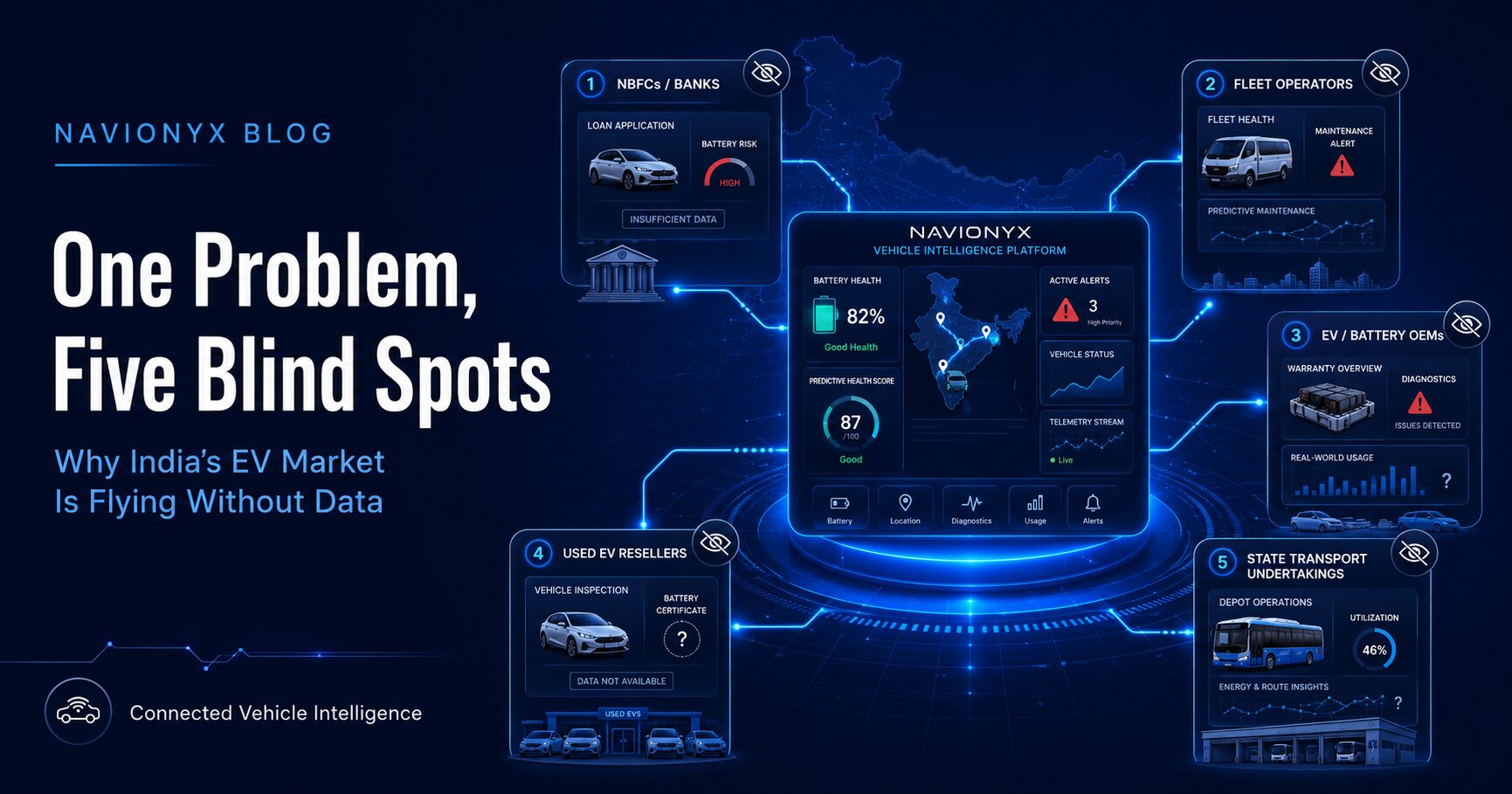
From NBFCs approving loans on degraded batteries to fleet operators reacting to breakdowns that were visible days in advance, India’s EV ecosystem is scaling rapidly while its decision intelligence lags behind.
Three things are happening somewhere in India as you read this. An NBFC loan officer is approving a disbursement on an electric three-wheeler whose battery is already operating at 63% of its original capacity, because nothing in the approval workflow surfaces that number. A fleet manager is getting a 6am call about a vehicle that broke down mid-route, a battery failure that the vehicle’s degradation trend had been signalling for three weeks. An EV manufacturer is reviewing a warranty claim, and the team around the table is split on whether this is a genuine manufacturing defect or the result of repeated deep-discharging by the customer, because there is no longitudinal battery data to settle the question.
None of these are edge cases. They are the daily operating reality of an industry that crossed 2.27 million EV sales in 2025, growing at 16% year on year, and is on a trajectory that industry forecasters expect to reach $266 billion by 2030. The market is scaling. The number of vehicles on the road is compounding. The infrastructure of physical hardware, financing, fleet operations, manufacturing, and resale is all expanding in parallel. What has not expanded at the same rate is the decision intelligence layer: the real-time, continuous, vehicle-level data that would let every participant in this ecosystem make better decisions about the assets at the centre of it.
Five distinct groups of organizations are navigating this gap right now: NBFCs and banks, fleet operators, EV and battery OEMs, used EV resellers, and state transport undertakings. Each of them approaches the problem from a different commercial angle, with different stakes and different operational constraints. What they share is the same root problem, approached in five different ways, each with its own characteristic blind spot. This is an examination of all five.

1. NBFCs and Banks: Managing Portfolio Risk Against an Asset They Cannot See
India’s EV financing market was valued at approximately $2.4 billion in 2025 and is projected to reach $19.9 billion by 2030, growing at a CAGR of 63%. The majority of that credit does not flow through commercial banks. As of today, only a handful of scheduled commercial banks offer formal EV financing products for two and three wheelers. The organized credit market for the segment operates almost entirely through NBFCs, which have a higher risk appetite, greater presence in tier 2 and tier 3 cities, and more willingness to lend to borrowers who are new to formal credit.
That positioning creates an enormous opportunity and an enormous risk. The NBFCs writing EV loans are doing so against an asset class that behaves fundamentally differently from anything they have lent against before. When a traditional NBFC disburses a loan on a petrol two-wheeler, the collateral follows a known depreciation curve. Visual inspection at disbursement is reasonably reliable. Resale value is predictable within a range. For an electric vehicle, none of that holds.
By the numbers
EV loan interest rates in India run 5 to 14% higher than equivalent ICE vehicle loans. LTV ratios are set 10 to 30% lower than ICE equivalents. The industry is pricing risk in rather than managing it out. (Source: RMI / EMFIA India)
The core issue is that the value of an electric vehicle is inseparable from its battery health. A three-year-old e-rickshaw at 85% state of health and a three-year-old e-rickshaw at 45% state of health are not the same collateral. They may look identical on a field visit. They are not identical as income-generating assets. When an e-rickshaw driver’s range falls below 60 kilometres because nobody caught the early degradation signal, his daily earnings drop with it. The loan, which was affordable when the vehicle was earning well, starts to look unserviceable. The borrower does not call to explain. An EMI is missed. The NPA process begins. By the time the NBFC’s recovery team locates the vehicle, months have passed and the underlying asset condition has deteriorated further.
Research from RMI and the Electric Mobility Financiers Association of India, which represents 35 of India’s top NBFCs, identifies this pattern clearly: EVs carry a higher default rate than ICE equivalents among similar borrower profiles, driven partly by uncertain battery performance and partly by the absence of a structured secondary market that would otherwise create price discovery and repossession value clarity.
“EV financing in India has historically posed high risk for lenders, especially NBFCs, due to a combination of factors: an unstructured resale market, uncertain battery performance, and borrowers with low or no credit history. These risks often result in higher NPAs and limited loan approvals.” — Varun Goenka, CEO, Chargeup
The solution the industry has converged on, charging higher interest rates and requiring larger down payments, is not risk management. It is cost recovery after the fact, which simultaneously makes EV adoption more expensive for the borrower and does not actually reduce the probability of default.
What changes the risk profile structurally is continuous asset intelligence. When a lender can see battery state of health at disbursement and every day after, monitor usage patterns that predict income volatility before it becomes a missed EMI, and respond to an early default signal with a remote soft immobilization rather than a field recovery dispatch, the portfolio behaves differently. Not because the borrower population changed. Because the lender is now holding information they did not have before, and that information changes every decision from approval through recovery. Lenders who have deployed this stack, including several Navionyx NBFC customers, are managing EV portfolios with a fundamentally different risk architecture than those still operating on periodic field visits and phone call follow-ups. The full solution set Navionyx built for lenders, from BMS battery scoring to relay immobilization and live portfolio dashboards, is available across both EV and mixed vehicle portfolios.
2. Fleet Operators: Reacting to Breakdowns That Were Predictable Days Earlier

Consider a last-mile delivery fleet running forty electric two-wheelers across a city. The fleet manager knows where each vehicle is, approximately when it left the depot, and when it returned. She has a WhatsApp group for driver check-ins. She has a spreadsheet for mileage tracking. What she does not have: a view of which battery packs are degrading faster than the rest, which driver is deep-discharging consistently and shortening the life of their pack, whether the vehicle that returned early ran out of charge or had a mechanical issue, or whether the two diesel backup vehicles had fuel drainage events last week. These gaps are not exotic. They are the standard operating reality for Indian fleet operators who have GPS tracking but nothing beyond it.
Fleet operators who moved to EVs largely did so expecting lower operating costs. On fuel and scheduled maintenance, that expectation is correct. The hidden cost is elsewhere: in unplanned downtime, in incidents without video evidence, and in battery pack replacements that happened earlier than they should have because no one caught the early signal. A study by CESL notes that electric buses reduce operating costs by 31% compared to diesel equivalents. That advantage erodes when unplanned downtime and early pack replacement are factored in against a fleet that has no predictive intelligence.
Safety is the second dimension. Road accidents involving commercial fleet vehicles in India carry enormous operational and legal weight. When an incident happens and there is no dashcam footage, no drowsiness event log, no driver score history, and no speed record for that trip, the fleet operator is defending a claim with no data. AI dashcam technology has changed what is available here. Road-facing and cabin-facing cameras that detect drowsiness, distraction, mobile phone usage, and harsh driving in real time, alert the driver immediately, and log the event with timestamped video have moved from expensive enterprise-grade hardware to fleet-scale accessible deployments. The shift they enable is from responding to incidents to preventing them, and from defending claims without evidence to resolving them with video.
On the battery side, the operational shift that matters most is from scheduled servicing to condition-based maintenance. Cell temperature anomaly detection and degradation trend alerts give a maintenance team a window of days to weeks before a vehicle fails on the road. That window is the difference between a planned maintenance event and a breakdown call at 6am. For mixed fleets that run diesel vehicles alongside EVs, fuel sensors that detect exact-quantity drainage events with timestamps close a cost leak that, across many fleets we have deployed into, runs into lakhs per quarter without being detected by any existing system.
3. EV and Battery OEMs: Managing Warranty Exposure Without the Data to Justify Decisions
Every electric vehicle ships with a warranty. For most Indian EV and battery manufacturers, that warranty program is also their largest financial uncertainty. Not because the products are unreliable, but because when a claim arrives, the information required to evaluate it honestly is usually absent.
The standard scenario: a customer brings in a vehicle two years into ownership. The battery diagnostic reads 68% state of health. The service team’s question is whether this is a genuine manufacturing defect or the accumulated result of the customer’s usage patterns. Was this pack deep-discharged repeatedly? Was it stored at high state of charge during summer months, in ambient temperatures that routinely exceed 40 degrees in Indian conditions? Is the degradation rate consistent with a cell defect, or consistent with what you would expect from the usage profile? Without continuous BMS data from day one of the vehicle’s deployment, the honest answer is that nobody in that service bay can tell with certainty. The decision becomes a judgment call.
Judgment calls, made at scale across thousands of warranty claims, produce financial outcomes that compound. OEMs that cannot distinguish genuine defects from customer-caused degradation err towards settlement to avoid disputes. Warranty reserves in the automotive industry are sized as a percentage of revenue. For EV OEMs facing an uncertain failure distribution, those reserves are larger than they need to be because there is no data to narrow the uncertainty. The cost of that uncertainty sits in the P&L.
The R&D gap
India’s operating environment presents battery conditions no laboratory fully replicates: ambient temperatures consistently above 40°C in summer, inconsistent charging infrastructure producing partial cycle patterns, and gig economy usage profiles driven by income pressure rather than recommended charging practice. OEMs without field data from deployed vehicles are improving product on inference, not evidence.
The second layer of the same problem is product development. Indian batteries operate in conditions that no lab test fully replicates. High ambient temperatures, inconsistent charging infrastructure that creates irregular partial cycle patterns, and usage driven by gig economy economics rather than manufacturer recommendations all produce degradation behaviour that diverges from the models. If an OEM does not have longitudinal field data from vehicles deployed across different geographies and usage profiles, the product improvement cycle is slower than it should be, and the next generation of battery is designed partly on assumptions about real-world performance that field data would immediately correct.
What continuous telemetric intelligence gives an OEM is a full battery usage record from day one. Charge cycle count and depth. Cell temperature logs with timestamps. Deep discharge frequency and severity. Geographic context for every anomalous event. That data transforms warranty claim management from a judgment-based process into an evidence-based one, and it feeds product engineering with the real-world performance signals that lab testing cannot provide.
4. Used EV Resellers: Competing on Price Because There Is No Way to Compete on Trust
India does not have a standardized framework for used EV valuation. Two and three wheelers make up over 90% of the country’s electric vehicle sales. The secondary market for those vehicles is enormous in volume but almost entirely unstructured in practice. A used e-rickshaw changes hands based on negotiation, visual inspection, an odometer reading, and a test drive. Nobody in that transaction has a credible answer to the most important question: what is the remaining useful life of this battery?
The absence of that answer creates a market that functions on discounting rather than differentiation. A reseller who has maintained their vehicle well and has a battery at 88% state of health cannot capture a premium for that condition because they cannot prove it. A buyer who is taking on a battery at 54% does not always find out until several months into ownership, when the range shortfall starts affecting daily earnings. The market settles at an average price that is systematically unfair to sellers of well-maintained vehicles and sometimes still inadequate protection for cautious buyers.
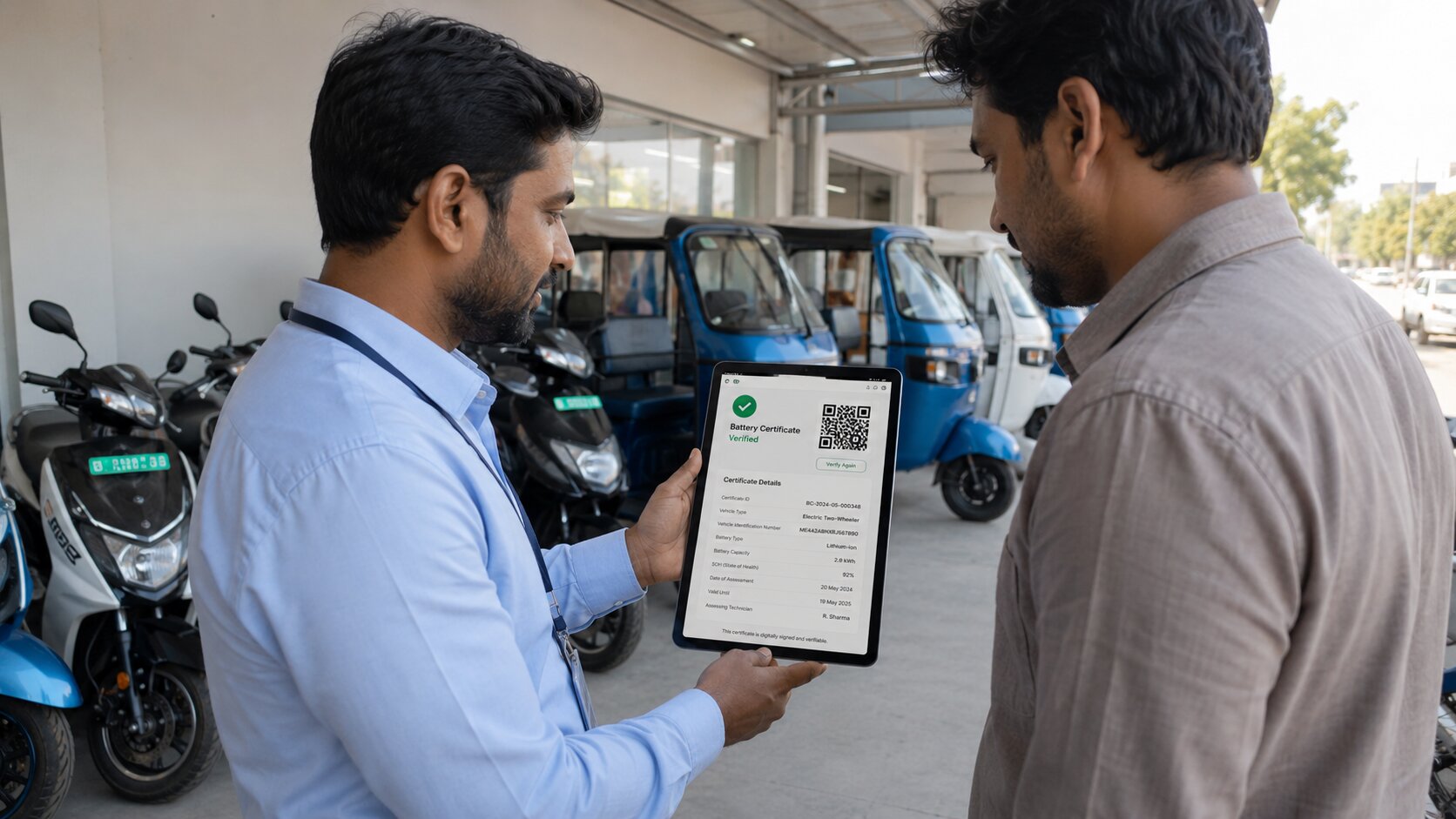
The trust gap is not a technology problem. The technology to assess battery health exists and is accessible. It is a standardization and verification problem. A reseller can commission a diagnostic today, but the buyer has no independent way to verify it. A dealer can claim their inventory is in good condition, but that claim carries no more weight than the seller’s word. What the market needs is an independent standard: a health assessment conducted by a neutral party, packaged in a format that travels with the vehicle, and verifiable by anyone who scans a QR code.
The Navionyx EV Certificate is that standard. After a full diagnostic assessment covering state of health, charge cycle history, degradation behaviour, temperature patterns, and usage profile, Navionyx issues a QR-verifiable certificate that any buyer can scan to confirm the vehicle’s condition independently. Dealers who build inventory around certified vehicles attract buyers who are willing to pay a premium, because the premium is now backed by verifiable third-party data. Platforms that require certification across their listings build a reputation that generic listings cannot compete with. The transaction structure shifts from “how much risk am I willing to accept” to “here is the condition, here is the price.”
5. State Transport Undertakings: Scaling an Electric Fleet With Infrastructure Built for Diesel
India’s state transport undertakings are in the middle of a fleet transition that the operational infrastructure behind them was not designed for. By 2024, India had registered nearly 10,000 electric buses, growing at over 65% CAGR. The government’s PM-eBus Sewa scheme is committing deployment of over 38,000 more e-buses between FY 2024-25 and FY 2028-29. Delhi was operating approximately 2,000 e-buses by December 2024. The scale of the transition is ambitious and accelerating.
The scale of the mandate
The PM-eBus Sewa scheme has a total estimated outlay of Rs. 57,613 crore. The PM-eBus Sewa Payment Security Mechanism, approved in September 2024 with Rs. 3,435 crore, adds a further commitment to deploy 38,000 e-buses through FY 2028-29. Electric buses reduce operating costs by 31% compared to diesel equivalents. But that saving depends on uptime, and uptime depends on intelligence the current systems are not built to provide.
Most STUs running electric buses today manage them with operational systems originally built for diesel or CNG fleets. Route scheduling, maintenance calendars, and compliance reporting all operate on assumptions that do not hold for electric vehicles. A diesel bus’s serviceable range is predictable. An electric bus’s effective range on any given day depends on variables that change continuously: charge state at depot departure, ambient temperature, driver behaviour on that route, charging quality the night before, and cell-level health across a pack that is now several years into its operating life.
When a bus leaves the depot on a battery that the system flags as charged but is actually operating at 72% of its original capacity, the range shortfall shows up mid-route. The driver knows. The passengers know. The operational planning team finds out when the incident report comes in. At fleet scale, with hundreds of buses operating across routes, this is not an occasional event. It is a pattern, a predictable one, that fleet-wide battery health monitoring would surface as an alert days in advance rather than a breakdown report after the fact.
AIS-140 compliance is a parallel challenge that compounds at scale. State transport operators are required to maintain certified VLTD hardware across their fleets with valid certificates, functioning SIM cards, and tamper-free devices. Managing certificate renewal dates, device health status, and SIM validity across hundreds of buses using spreadsheets or manual tracking is operationally costly and produces the kind of compliance gaps that become visible only during an RTO audit, at which point the remediation cost is significantly higher than continuous monitoring would have required. A centralized compliance dashboard that surfaces device status, certificate validity, SIM health, and tamper detection alerts across an entire fleet does not just reduce audit risk. It changes the operational relationship between the STU’s compliance function and the actual condition of the fleet on the ground.
The Root Problem Is the Same Across All Five
Five segments, five different operational pressures, five different commercial models. An NBFC’s risk team and an STU’s operations manager do not appear, at first glance, to be working on the same problem. But strip back each of the five blind spots described above and the root is identical: high-stakes decisions are being made about electric vehicles without continuous, real-time intelligence from those vehicles.
An NBFC assessing default risk and an OEM validating a warranty claim are asking the same question: what has happened to this battery, and what is it worth right now? A fleet operator trying to prevent a mid-route breakdown and an STU planning preventive maintenance across its bus fleet are asking the same question: which vehicle is about to fail, and do we know before it does?
The difference between a basic GPS tracker and a connected vehicle intelligence platform is not a matter of degree. It is a matter of what decisions become possible. A GPS tracker tells you where a vehicle is. A connected intelligence layer tells you the battery health, driver safety score, charging quality, compliance status, fuel integrity, and asset risk, all in real time, all from a single platform.
The decisions that become possible with full vehicle intelligence are categorically different from what is possible without it. NBFCs can underwrite risk precisely rather than price it bluntly. Fleet operators can prevent failures rather than respond to them. OEMs can manage warranty reserves on evidence rather than on estimation. Resellers can build a trust premium that holds rather than competing on discount. STUs can run public transit at the reliability standard they are publicly accountable to deliver.
None of this requires a different set of vehicles. It requires connecting the vehicles that already exist to an intelligence layer that turns the signals those vehicles are already generating into decisions. Hardware that reads battery management system data, captures driver behaviour, monitors fuel levels, controls vehicle access, and reports compliance status. A platform that makes all of that readable, actionable, and integratable. An architecture flexible enough to serve a single-segment operator and a multi-segment enterprise from the same stack.
This is what Navionyx built, and it is built specifically for the five segments described above. The full solution architecture, mapped to each decision-maker’s context and the exact intelligence each one requires, is on our solutions page. Every solution can be deployed as a standalone or as part of a fully integrated stack, depending on where an operator is starting from and what they need to solve first.
What Happens When the Blind Spots Close
India’s EV market is at an inflection point. The volume is there. The policy support is there. The manufacturing investment is there. What the ecosystem is still building is the intelligence layer that makes all of that scale work at the quality level each segment needs.
When NBFCs can see battery health in real time, EV lending becomes a risk they can price precisely rather than one they price defensively. When fleet operators have predictive maintenance signals and AI dashcam data, downtime drops and safety records become assets rather than liabilities. When OEMs have longitudinal field data from deployed vehicles, warranty management becomes an evidence-based process and product development accelerates. When used EV resellers have an independent certification standard, the secondary market builds trust premiums that change the economics of resale. When STUs have fleet-wide battery intelligence and a compliance dashboard, they can deliver the public transit reliability their passengers and regulator expect.
Each of these shifts is available now, with hardware that is already deployed, a platform that is already operating, and a team that has already built the integrations for lenders, OEMs, fleet operators, and STUs. The blind spots are not waiting for technology that does not exist yet. They are waiting for the decision to close them.
This article was researched and written with AI assistance and reviewed by the Navionyx team. Data sources include EVreporter, RMI, EMFIA India, CESL, PM-eBus Sewa official documentation, and industry reports cited inline.
Ready to close your blind spot?
See how Navionyx is built for your segment
Whether you are managing a lending portfolio, running a fleet, building an EV, certifying used vehicles, or operating public electric buses, Navionyx has a solution configured around the decisions you actually need to make.
Explore All Solutions Request a Demo