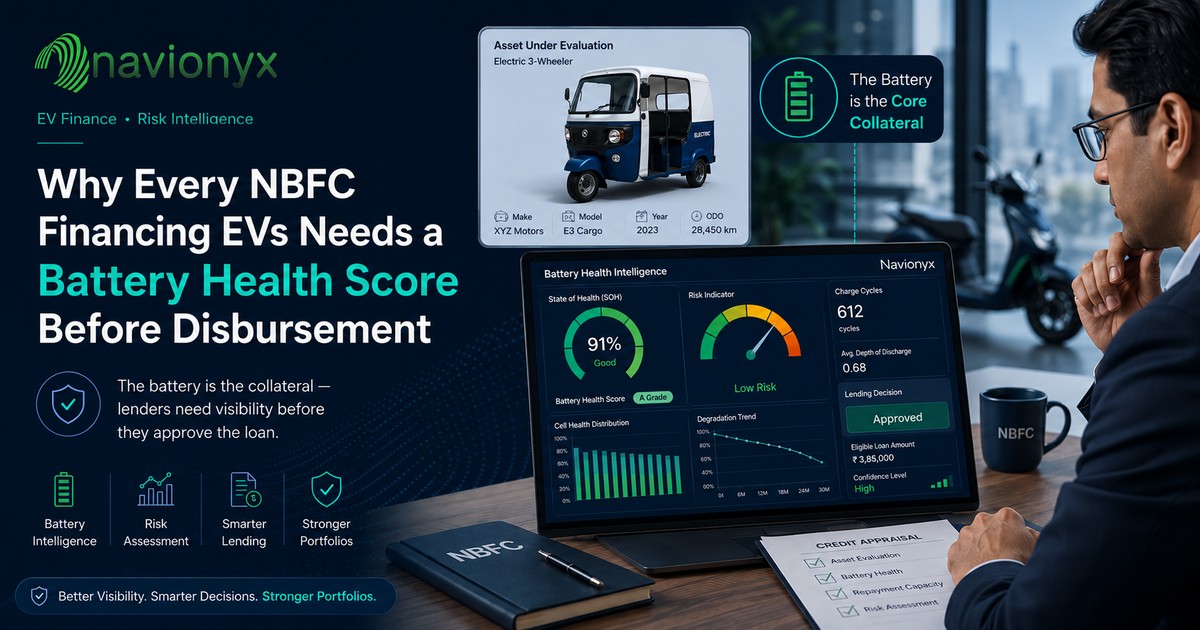
EV Finance · Risk Intelligence
The battery is the collateral. But right now, most lenders are approving EV loans without ever knowing its condition.
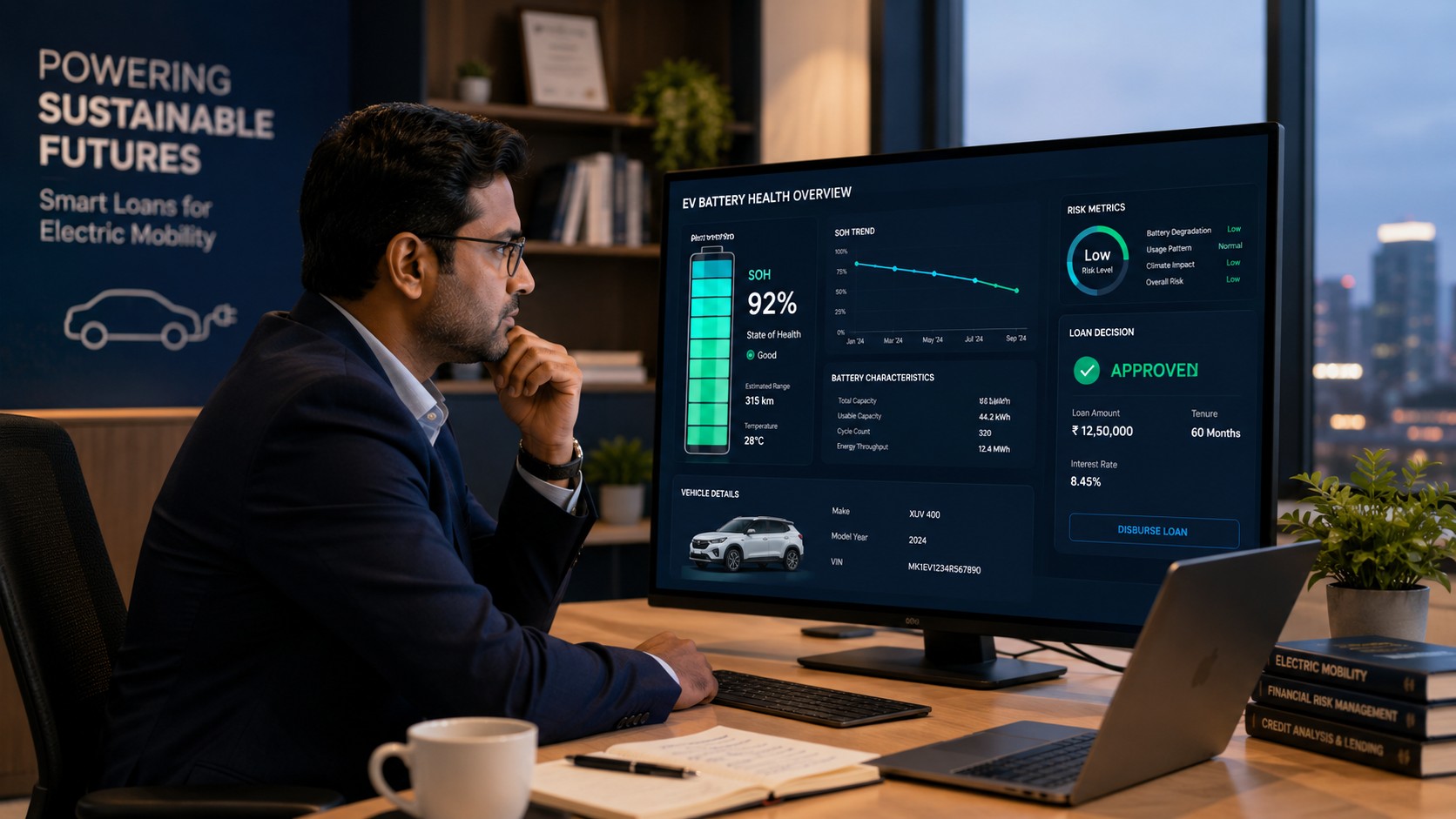
India’s NBFCs have become the quiet engine of the EV revolution. When banks stepped back from financing two-wheelers and three-wheelers, citing unfamiliar risk profiles and absent resale benchmarks, it was the NBFCs that stepped in. Today, 65% of all EV financing in India comes from non-banking lenders, according to data compiled by industry investors and mobility data providers. That is both a leadership position and a concentrated exposure.
The problem is not that NBFCs are financing EVs. The problem is how they are assessing those EVs before handing over capital. Most disbursement processes still lean on borrower creditworthiness, income verification, and the standard collateral valuation of the vehicle. What they are not yet measuring is the one component that makes an electric vehicle fundamentally different from every ICE asset they have ever financed: the battery.
This is not a minor operational gap. In the context of EV lending, not knowing the battery’s state of health at disbursement is equivalent to approving a home loan without inspecting the foundation.
“The binding constraint is not a lack of capital in the system. It is how EV risk is priced. When lenders remain uncertain about battery performance, residual values, and cash-flow stability, that uncertainty gets reflected in higher interest rates.”
IEEFA India, February 2026
The NBFC EV Lending Boom Is Real. So Is the Risk Concentration.
The scale of what is underway is significant. The Indian EV financing market is projected to reach USD 28.79 billion by 2031, expanding at a CAGR of over 51%, according to industry analysis. Two-wheelers and three-wheelers, which accounted for more than 94% of EV sales in FY25, are at the center of this growth. They are also the segment where NBFCs dominate and where the battery represents the most disproportionate share of total vehicle value.
For electric two-wheelers and three-wheelers, the battery pack accounts for up to 40% of the on-road cost. This is not a secondary component the way an engine part might be in an ICE vehicle. It is the primary cost driver, the primary performance driver, and in a financing context, the primary collateral risk driver.
Yet the dominant approach to EV disbursement still treats the vehicle the way it would treat any motorised asset: verify the borrower, value the vehicle at purchase price, document the chassis, disburse. Battery condition is assumed to be intact at the time of purchase and is left unmonitored through the life of the loan.
Market Context
Commercial EV borrowers in India currently face interest rates of 15% to 33% per annum, a direct consequence of unpriced battery risk and absent residual value benchmarks. Bringing structured battery intelligence into the lending process is widely identified as the most direct lever to reduce this cost. (Source: IEEFA, 2026)
What Battery Degradation Actually Means for a Lender
Battery degradation is the gradual, measurable decline in a battery pack’s ability to store and deliver energy relative to its original capacity. This is tracked using a metric called State of Health (SOH), expressed as a percentage of the battery’s original rated capacity. A new battery begins at 100% SOH. As cycles accumulate, temperatures stress the cells, and charging habits take their toll, that number declines.
According to Geotab’s 2025 analysis of over 22,700 electric vehicles across 21 models, the average annual battery degradation rate is 2.3% per year, with vehicles relying heavily on DC fast charging degrading at up to 3.0% per year, roughly double the rate of those using primarily AC charging. In India’s heat, where ambient temperatures routinely stress battery thermal management, degradation can accelerate further.
The EV community data for India paints this clearly: a well-maintained battery at five years should still be above 85% SOH. A neglected one, subjected to frequent fast charging, chronic high SoC storage, or inadequate cooling, could be at 70 to 75% SOH within the same timeframe. That is not a cosmetic difference. Below 70% SOH, degradation accelerates non-linearly, which means the battery’s useful life shortens rapidly from that point.
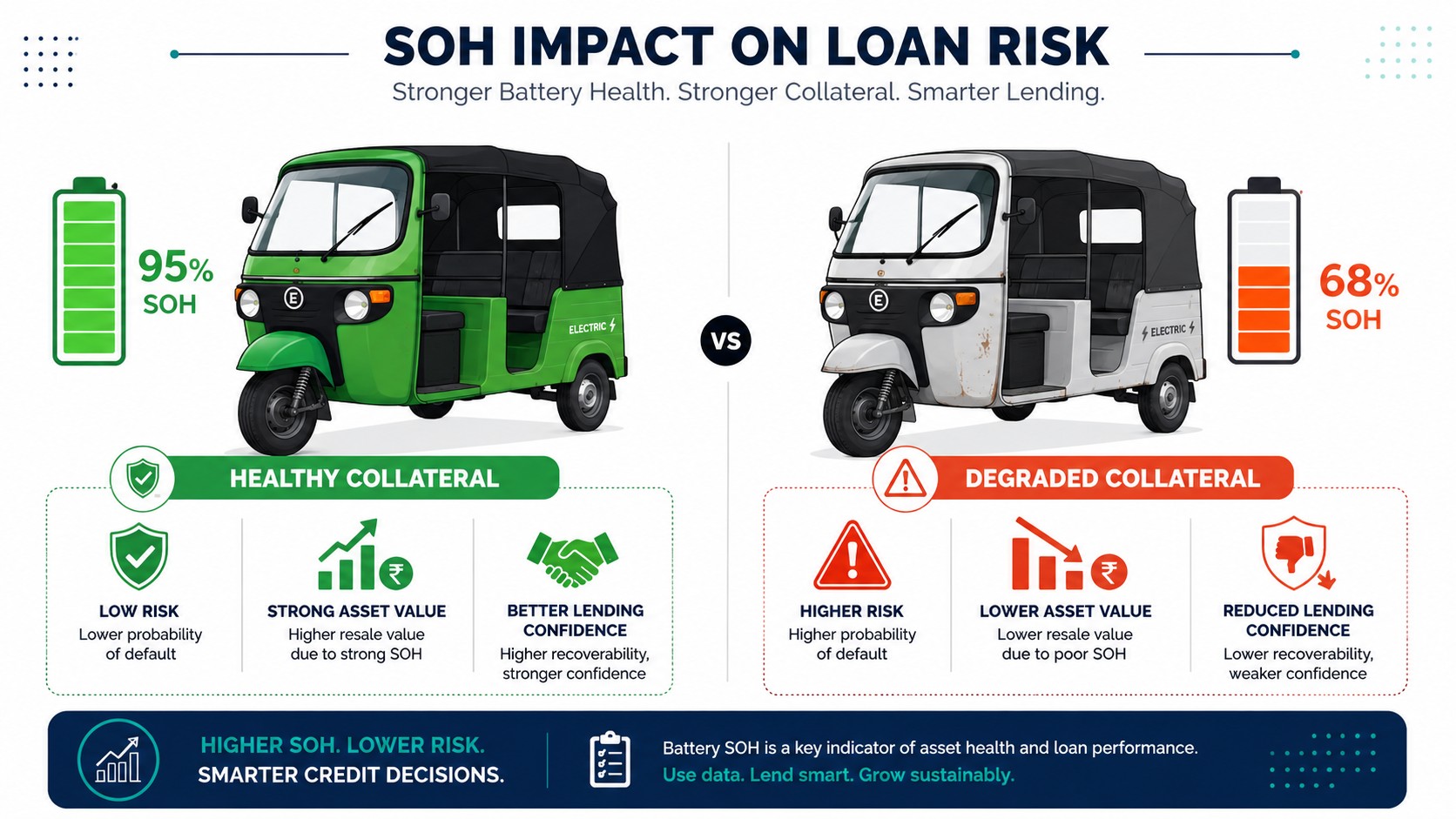
For a lender, this has a direct and measurable consequence. If a financed EV’s battery deteriorates beyond the point of reliable operation during the loan tenure, the borrower’s ability to generate income from that vehicle collapses. Default risk rises. Recovery value falls. The collateral is no longer worth what the lender assumed it was at disbursement.
What Traditional Disbursement Assessment Cannot See
The challenge with battery health is that it is invisible from the outside. A vehicle with a battery at 68% SOH looks and drives identically to one at 95% SOH during a routine inspection. The dashboard may show a full charge. The vehicle moves normally. There are no external signals that alert a field agent, a credit officer, or a collections team.
Standard NBFC disbursement checks are designed around ICE vehicle logic: verify the chassis number, check the registration, assess the borrower’s repayment capacity, and record the vehicle’s market value. These steps are valid but they are blind to the battery entirely. There is no CIBIL score for a battery. There is no inspection checklist that surfaces internal cell voltage divergence or thermal anomalies. Without a structured battery diagnostic at disbursement, the lender is essentially approving a loan against an asset whose most critical and most expensive component has never been assessed.
This matters most in the used EV segment, which is growing rapidly as India’s early EV adopters from 2019 to 2022 begin to trade in their vehicles. A used electric three-wheeler or delivery vehicle may have three to four years of hard commercial use behind it. A credit check tells you about the borrower. Only a battery diagnostic tells you about the asset.
“Until standardized battery health certificates and residual value benchmarks are developed, financing risk will remain elevated.”
GrowthJockey EV Financing Analysis, 2025
What a Battery Health Score Actually Tells a Lender
A battery health score, derived from live BMS data, gives a lender three things that no traditional disbursement check can provide.
A credible collateral valuation at the time of disbursement. If the battery forms 40% of the vehicle’s cost, then the vehicle’s actual value on the day of loan approval cannot be accurately assessed without knowing the battery’s current condition. A vehicle with a battery at 72% SOH is not worth its invoice price. A lender approving a loan on invoice value without that information has already miscalculated their loan-to-value ratio before the first EMI is paid.
A forward-looking risk signal. SOH is not just a point-in-time snapshot. The rate at which SOH is declining, visible through trend data from a BMS device, tells a lender whether the battery is aging normally or deteriorating faster than expected. A battery that has lost 12% SOH in 18 months of use is a fundamentally different credit risk than one that has lost 4% over the same period. This is the kind of forward indicator that supports proactive portfolio management rather than reactive default handling.
A usage-based risk classifier for the borrower. Charging behaviour, depth of discharge, thermal stress patterns, and daily utilisation intensity all leave a measurable footprint in BMS data. An operator running the vehicle for 14 hours a day and fast-charging twice daily is a different risk profile from one running eight hours on standard AC charging. These signals exist in the data. They are simply not being read today.
How Navionyx Brings Battery Intelligence Into the Loan Lifecycle
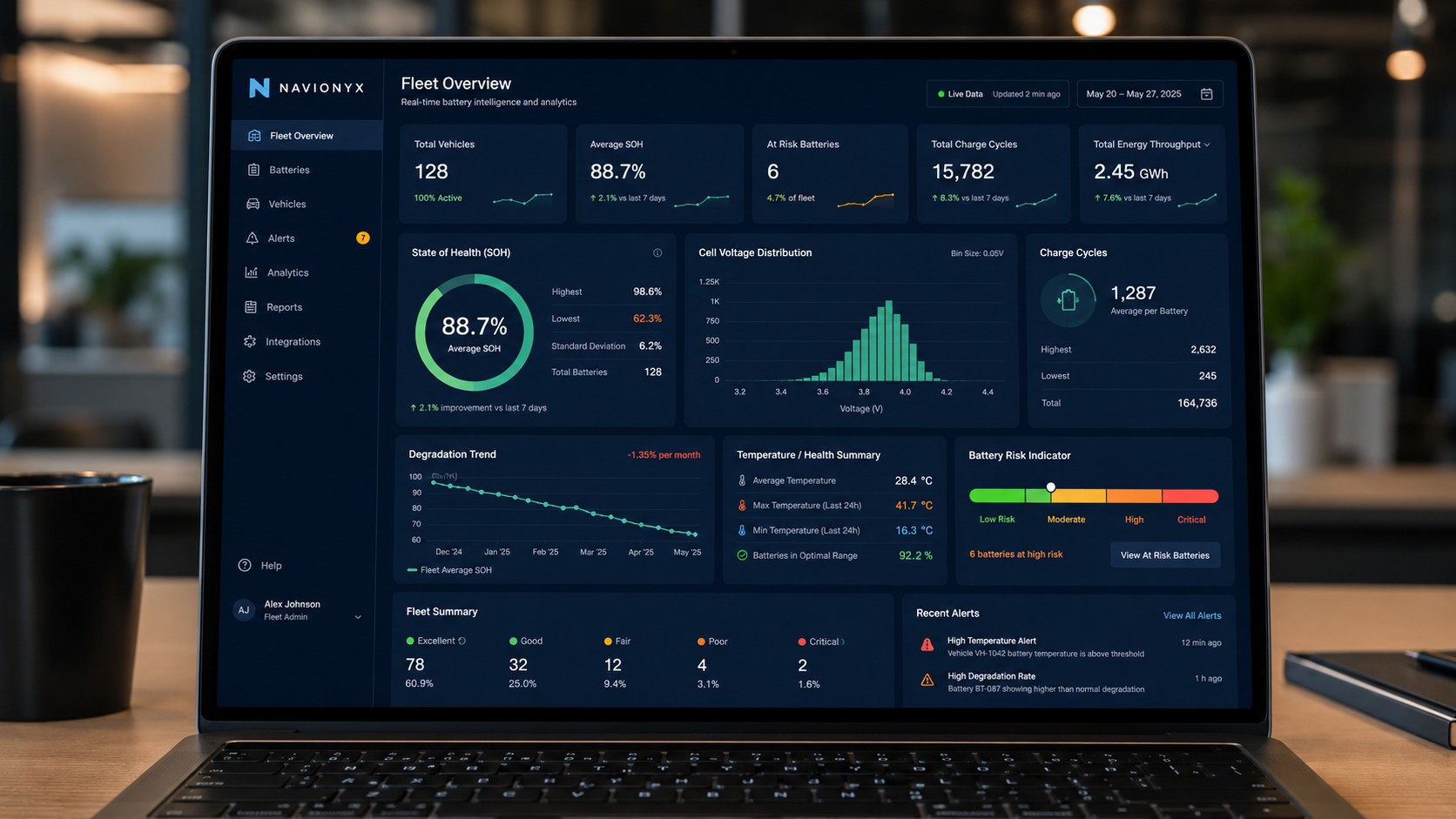
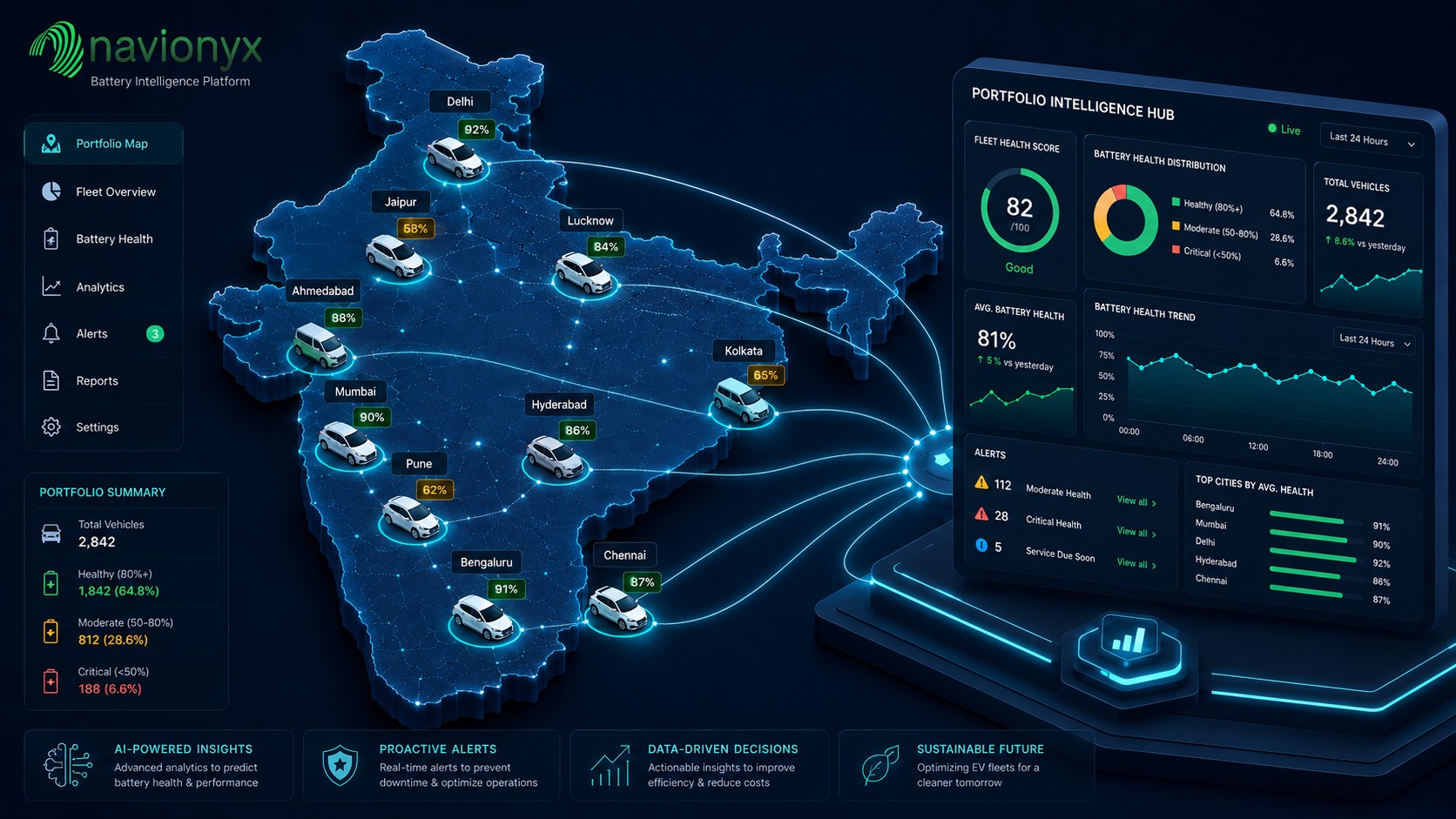
Navionyx is already deployed across thousands of EVs for several of India’s leading NBFCs in the commercial vehicle financing space. The platform combines hardware-level BMS integration with a software layer that translates raw cell data into lender-readable intelligence.
At the disbursement stage, Navionyx generates a battery health score from live BMS readings: current SOH, cell voltage divergence, charge cycle count, temperature behaviour, and degradation trend. This gives the credit team a factual basis for asset valuation that the invoice cannot provide. For used EV loans specifically, the Navionyx EV Certificate formalises this into a QR-verifiable document that can be attached to the loan file as evidence of condition at the time of sanction.
Post-disbursement, the platform continues monitoring the asset across the full loan tenure. Lenders receive alerts when battery health crosses defined thresholds, when charging behaviour signals elevated stress, or when usage patterns shift in ways that increase default probability. This continuous intelligence layer supports the collections team before a default occurs, not after.
When an account does move into default, Navionyx supports recovery through live GPS location tracking and remote immobilization capability. Every action is logged with a timestamp and user ID, creating a full audit trail for policy documentation.
Navionyx Platform Capabilities for NBFCs
Battery health scoring for pre-disbursement risk assessment · Continuous asset monitoring across the loan portfolio · Remote vehicle immobilization for defaulter management · Live GPS location data for physical recovery when required · LMS integration for direct data flow into existing credit systems · Full audit logs with timestamps for every action taken
View all Navionyx solutions for lenders and fleets →The Portfolio-Level Case: Why This Compounds at Scale
Individual loan risk is one dimension. Portfolio risk is another, and it is where the absence of battery intelligence becomes most consequential for NBFCs scaling their EV books.
Consider an NBFC with a portfolio of 5,000 financed EVs, a scale well within reach for any mid-sized lender expanding into green finance. If even 8% of those vehicles carry batteries already degraded beyond 75% SOH at disbursement, that is 400 loans where the collateral has been systematically overvalued from day one. The financial exposure is not just in defaults. It is in recovery shortfalls: the vehicle on paper is worth Rs 1.2 lakh, but the battery is already at end-of-life, so actual recovery value at seizure is materially lower.
At the portfolio level, battery health data also enables lenders to segment risk in ways that were previously impossible. Vehicles showing normal degradation and healthy charging patterns can be treated as lower-risk positions. Vehicles showing accelerated degradation or high-stress usage patterns can be flagged for earlier intervention. This granularity supports smarter provisioning, sharper pricing, and earlier collections engagement, all of which directly protect the portfolio’s NPA performance.
The NITI Aayog, World Bank, and SIDBI have been working on a USD 1 billion guarantee fund for EV loan defaults, acknowledging at the policy level that EV credit risk is currently mispriced. The structural answer to mispriced risk is not just a guarantee fund. It is better data at the point of origination. Battery health scoring is that data.
The Standard Is Shifting. The Question Is Whether Lenders Move Before Their Portfolios Do.
The NBFCs that are building durable EV lending businesses in India are the ones that are treating the battery not as a component but as the central collateral variable. One major NBFC has committed to a Rs 5,000 crore green finance AUM target. The ADB has backed that commitment with a USD 150 million facility specifically aimed at EV credit expansion. These are not speculative positions. They are calculated bets on an asset class, and they require asset intelligence that matches the scale of the commitment.
A battery health score at disbursement is not an operational enhancement. It is a risk management requirement for any NBFC that is serious about building a profitable EV loan book. The data infrastructure to deliver it exists today. The question is which lenders integrate it before rising NPAs in EV portfolios make the case for them.
Navionyx was built precisely for this problem, combining hardware-level BMS intelligence with a platform designed around the operational realities of lenders. The tools to price EV credit accurately, monitor collateral across a portfolio, and act decisively at default are available now. Explore the full Navionyx solutions suite to see how each capability fits into a lender’s workflow. The lenders who use them will simply have better numbers than the ones who do not.
This article was researched and written with AI assistance and reviewed by the Navionyx team. Data sources include energy finance think tanks, market research firms, mobility finance associations, fleet analytics providers, business publications, and Asian Development Bank press releases.
See how Navionyx supports NBFC EV lending decisions
From pre-disbursement battery health scoring to portfolio-wide asset monitoring and remote immobilization, Navionyx gives lenders the intelligence layer their EV book requires.
Request a Demo