Battery Intelligence · EV Deep Dive
One Cell Is Lying to You. Here Is How We Know
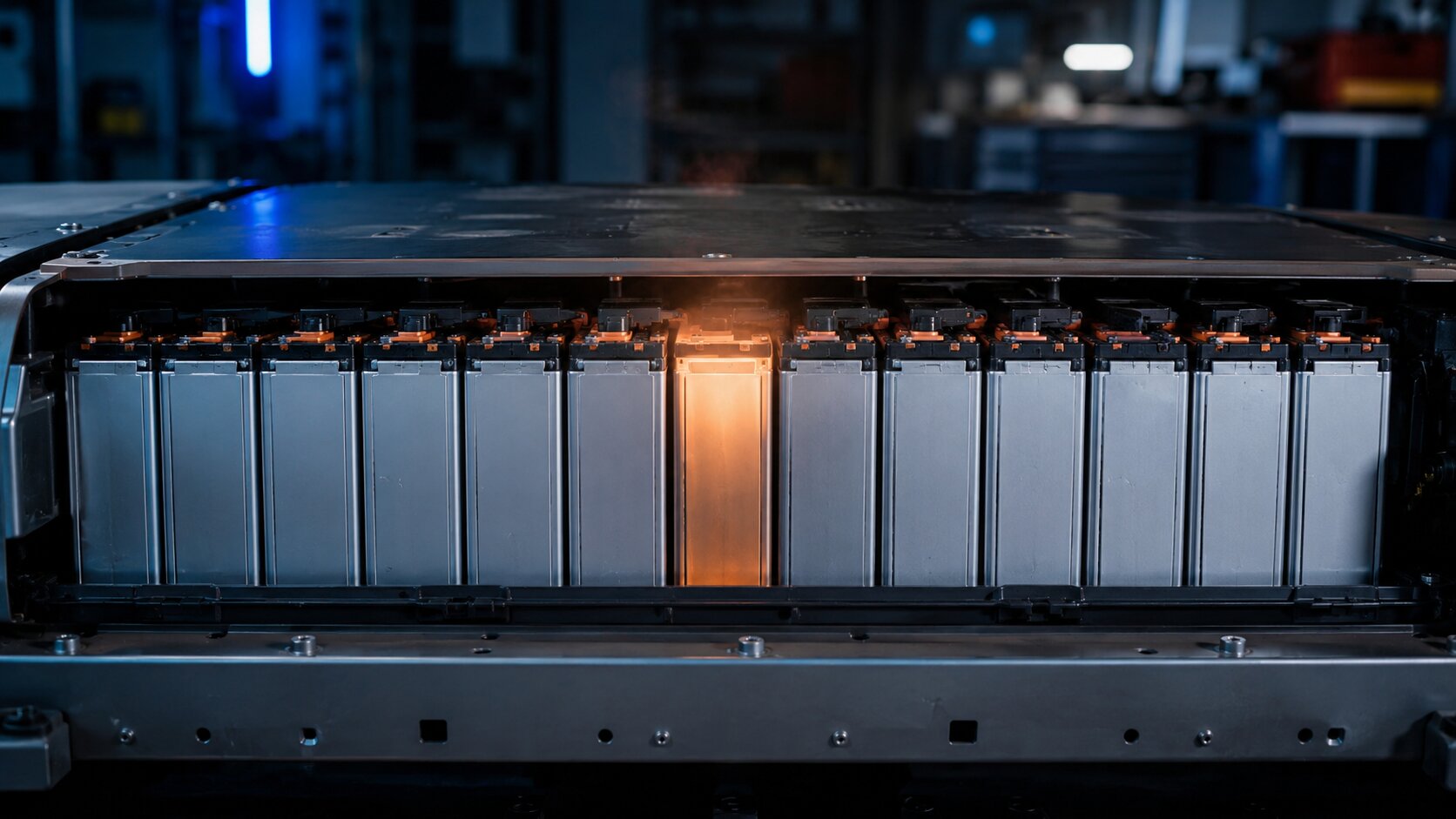
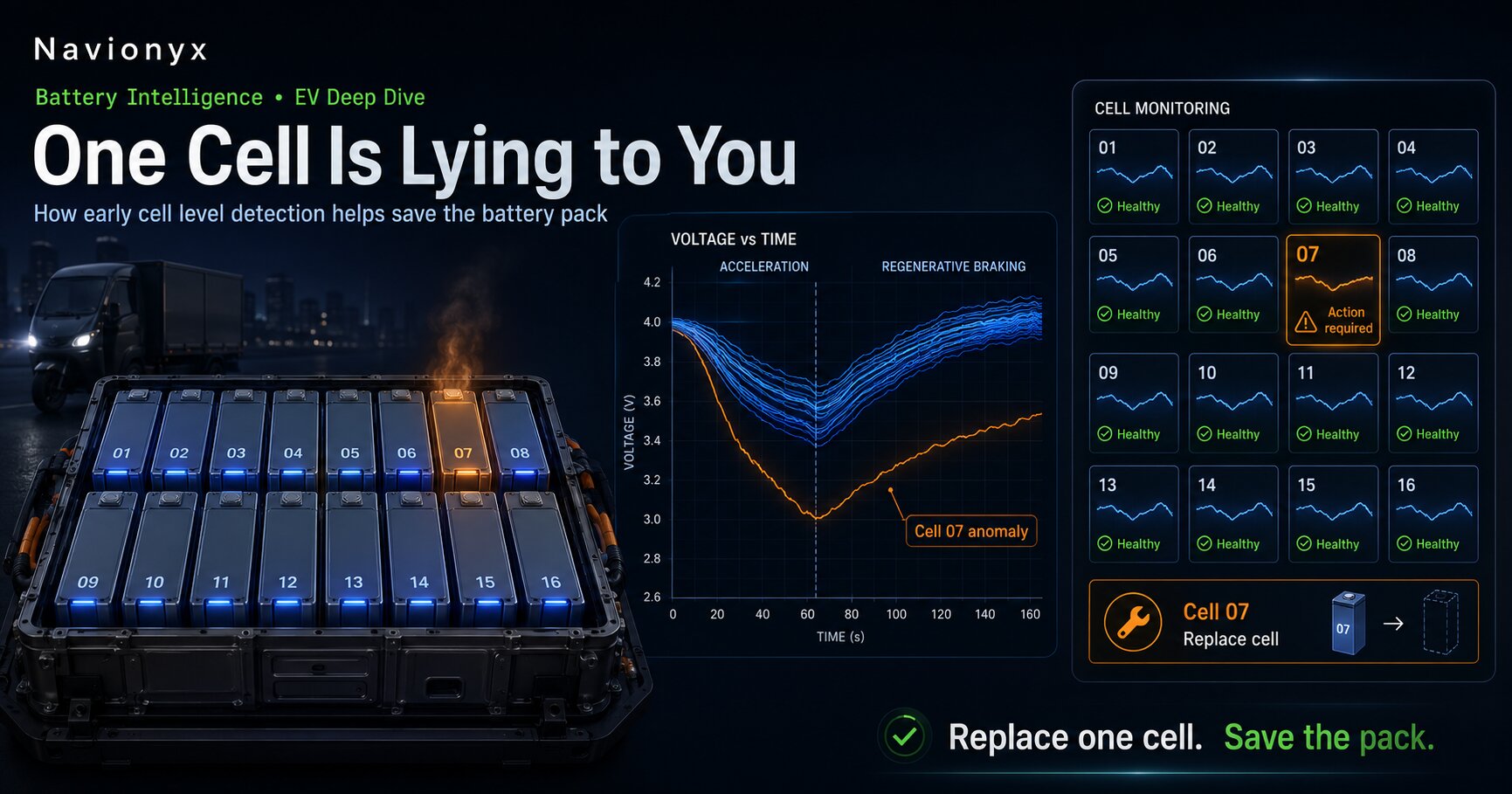
Picture a delivery three-wheeler leaving a logistics hub in Pune at 7 AM. The driver accelerates onto the highway. Inside the battery pack, bolted beneath the cargo bed and invisible to everyone, sixteen lithium-ion cells wake up together. Current flows. Voltage drops across each cell. The battery management system records every number, every millisecond.
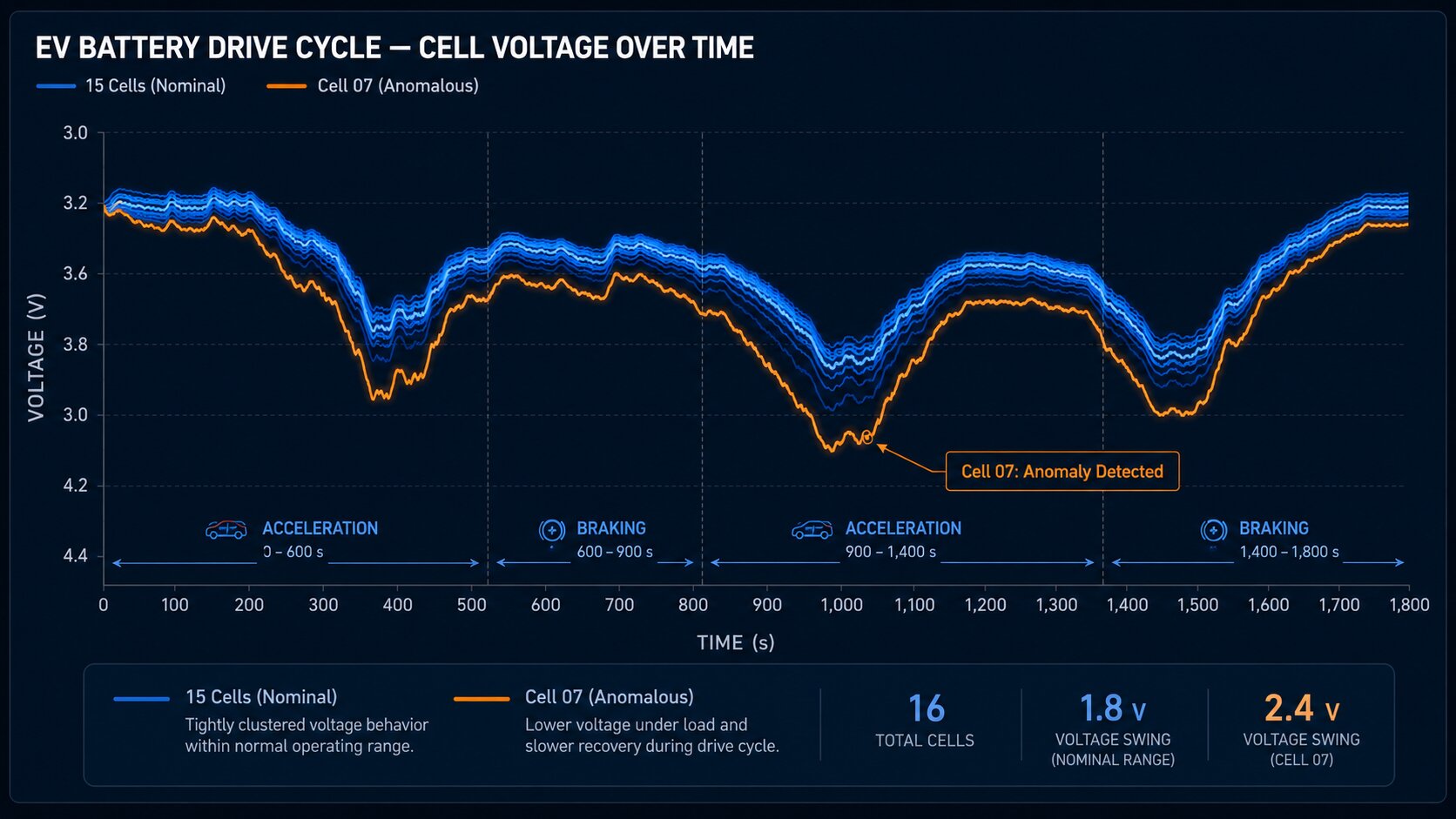
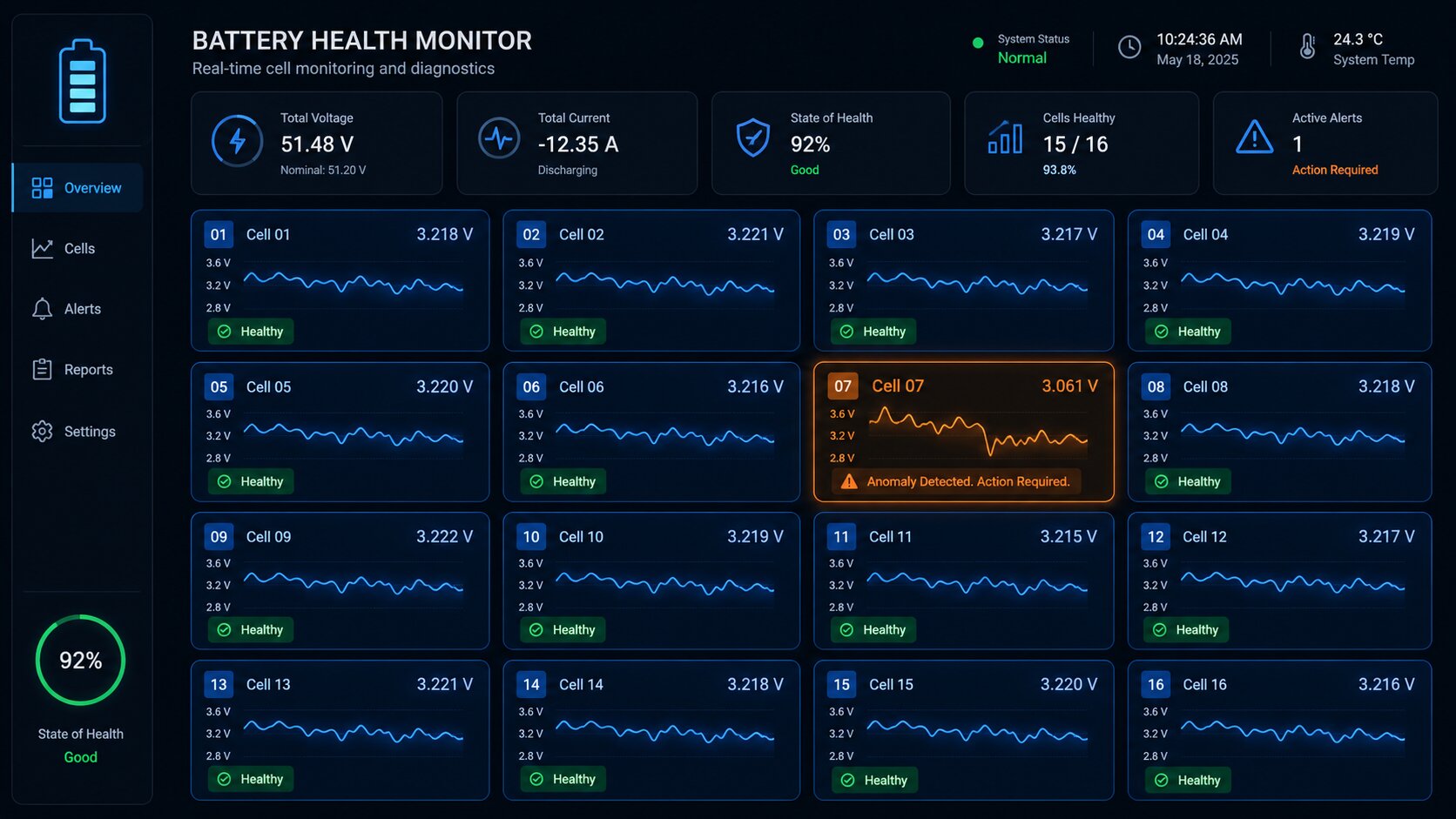
Fifteen of those sixteen cells behave almost identically. Their voltage curves rise and fall in near-perfect unison as the vehicle speeds up, slows down, and navigates traffic. If you plotted them on a graph, they would look like a single bold line with fifteen traces running so close together they are practically indistinguishable.
But cell number seven is telling a different story.
Its voltage dips a little faster under load. When the driver brakes and regenerative current spikes back into the pack, cell seven recovers a little slower. The gap is small. A few millivolts at first. Nothing that triggers a dashboard warning. Nothing the driver feels. Nothing the fleet manager sees on a basic telematics dashboard.
But the gap is there. And it is growing.
Why Your Battery Pack Speaks in Voltage, and What It Is Saying
A standard EV battery pack used in Indian commercial electric vehicles is built by connecting cells in series. Sixteen cells, each operating at roughly 3.2 to 3.7 volts, combined to deliver the pack voltage the motor controller needs. They share the same current path. The same charge goes in; the same discharge goes out. This is the fundamental constraint of a series circuit.
Because every cell carries the same current, the only variable that distinguishes a healthy cell from a degraded one is how it responds to that current. Specifically, how its voltage behaves under dynamic load. And that is exactly what happens every time the vehicle accelerates or brakes.
Acceleration is a current spike. The motor demands power, current surges through all sixteen cells simultaneously, and each cell’s voltage drops in response. A healthy cell with low internal resistance drops a small amount and recovers quickly. A degraded cell, one whose internal resistance has climbed due to SEI layer growth, lithium plating, or electrolyte breakdown, drops further and recovers more slowly. The harder the acceleration, the more pronounced the difference.
Braking is the reverse. Regenerative charging pushes current back into the pack. All sixteen cells begin absorbing it. The degraded cell, with reduced active material capacity, hits its upper voltage limit faster than the rest. It is full before its neighbours have had a proper meal.
This is not a subtle phenomenon. On a voltage-vs-time graph during a real drive cycle, fifteen cells draw lines that follow each other like synchronized swimmers. The degraded cell breaks formation. It is the one line that does not belong.
What Happens When Nobody Acts on That Signal
Here is where the story gets expensive.
The battery management system is designed to protect the pack. It watches every cell voltage and enforces hard limits: no cell goes above its maximum charge voltage, no cell goes below its minimum discharge cutoff. The moment any single cell hits either limit, the BMS cuts off the entire pack. Charging stops, or discharge stops, regardless of what the other fifteen cells still have to offer.
So as cell seven continues to degrade, two things happen in parallel. First, the pack’s effective range shrinks. Not because all sixteen cells are tired, but because cell seven hits its floor before the others do, and the BMS calls time on the whole pack. The driver complains that the vehicle used to cover 90 kilometres on a charge and now struggles to reach 70. The battery is not fully drained. Fifteen cells still have charge in them. That charge is simply inaccessible, stranded above the cutoff line that cell seven’s weakness set.
Second, and this is the part that most OEMs miss, the fifteen healthy cells begin to compensate. Because cell seven can no longer carry its share of the current load efficiently, the remaining cells absorb a slightly higher burden on every discharge. They cycle harder than they were designed to. They age faster than they would have if cell seven had been identified and replaced early. The degradation of one cell quietly accelerates the degradation of all the others.
What the research confirms
Data from in-warranty EV battery pack failures shows that restoring a pack to optimal condition requires replacing just 1.1 modules on average. On average, 92% of modules within a failed pack remain fully functional at the time of failure. The conclusion is stark: whole batteries are not failing. Individual cells are, and they are taking the rest of the pack down with them when nobody intervenes in time. [Battery Tech Online, 2025]
What begins as a single underperforming cell becomes a progressively imbalanced pack. The BMS works harder to compensate, passive balancing circuits burn off excess charge as heat, and the remaining healthy cells cycle outside their ideal operating envelope. The pack that could have been repaired with a single targeted cell replacement eventually reaches a state where the damage is widespread, and now a full replacement is genuinely the only option.
The window for a cheap fix closed quietly, hundreds of charge cycles ago.
How Navionyx Reads the Graph and Tells You Exactly Which Cell to Replace
The BMS in every modern EV already collects the data that reveals a degrading cell. Individual cell voltages, measured multiple times per second. Pack current during every acceleration and braking event. Temperature at multiple points across the pack. The raw signal is there. What has been missing is the intelligence layer that knows what to look for inside that signal, along with the alerting system that tells someone before it is too late.
This is what Navionyx does.
Our platform ingests real-time cell-level voltage and current telemetry from the vehicle as it operates. We do not wait for a monthly diagnostic report or a scheduled service visit. We watch the graph on every trip. During acceleration events, when current spikes and each cell’s voltage response is most revealing, our algorithms compare the behaviour of all sixteen cells against each other. During braking, when regenerative current flows back in, we track which cells recover in step with the group and which ones deviate.
When cell seven’s voltage curve begins to consistently separate from the cluster, not once, not on a hot day anomaly, but pattern after pattern across dozens of drive cycles, Navionyx flags it. The alert we send to the OEM service team is not a vague “battery health degraded” warning. It is specific: Cell 07 is underperforming. Voltage deviation under load has crossed the intervention threshold. This cell should be assessed for replacement before it begins stressing adjacent cells.
The difference between a 12,000-rupee targeted cell replacement and a 90,000-rupee full pack swap is often just one thing: knowing which cell to replace, and knowing it three months before the pack fails completely.
The OEM service team can now act on a specific instruction rather than a vague symptom. They schedule the vehicle for cell-level inspection. They match and source a replacement cell with the appropriate chemistry and capacity grade. They swap cell seven. They recalibrate the BMS. The vehicle goes back to the fleet the next morning with its original range restored, and the other fifteen healthy cells continue their intended service life, undisturbed.
That is the repair that saves the pack. And it only becomes possible when someone is watching the voltage graphs on every trip, not just at the service centre every six months.
Why the Timing of the Alert Is Everything
There is a narrow window in which a degrading cell can be replaced with full benefit to the pack. Act too late, and the imbalance has already forced the surrounding cells into abnormal cycling patterns. The healthy cells have aged unevenly. Even after cell seven is replaced with a fresh unit, the pack is no longer a team of equals, and the new cell, cycling in a pack of older, harder-used cells, will itself age faster than its chemistry was designed to allow.
Navionyx’s early detection is designed to catch the deviation before it reaches that point. The voltage signatures of gradual internal resistance growth are visible in the data long before the cell causes range loss perceptible to the driver. A healthy pack shows cell voltage spread within plus or minus 10 to 20 millivolts under load. Once a cell begins pushing beyond 30 millivolts of deviation consistently, the intervention clock has started. By the time that deviation reaches 50 to 80 millivolts, the cascading stress on neighbouring cells is already underway.
We alert at the 30-millivolt threshold. Not the 80.
The Battery You Are About to Replace Might Only Need One Cell
Every EV battery pack that gets condemned and replaced in full is a story that did not have to end that way. Somewhere in the weeks or months before the fleet manager made the call, the voltage graphs on one cell had already started telling a different story from the other fifteen. The signal was there. It just was not being watched.
For OEMs, the business case is straightforward. Cell-level monitoring turns a reactive warranty cost into a predictive service offering. Instead of replacing a full pack under warranty pressure, you offer the fleet customer a targeted repair: one cell identified, one cell replaced, full range restored. The customer gets a better outcome. You retain the pack revenue. The vehicle returns to service faster. And the remaining fifteen healthy cells get to live out their full designed life, which is what they were always supposed to do.
The graph is already telling you which cell to replace. You just need a platform that knows how to read it.
See Cell-Level Battery Intelligence in Action
Navionyx monitors every cell in your fleet’s battery packs in real time: voltage, current response, deviation trends. We tell your service team exactly when and where to act. Before the pack fails. Before the warranty claim. Before the full replacement.
Request a Battery Intelligence Demo →Get EV Battery Health Report
A real sample of the report buyers, dealers, and platforms use to verify battery condition before an EV resale transaction.
Get EV Battery Report →