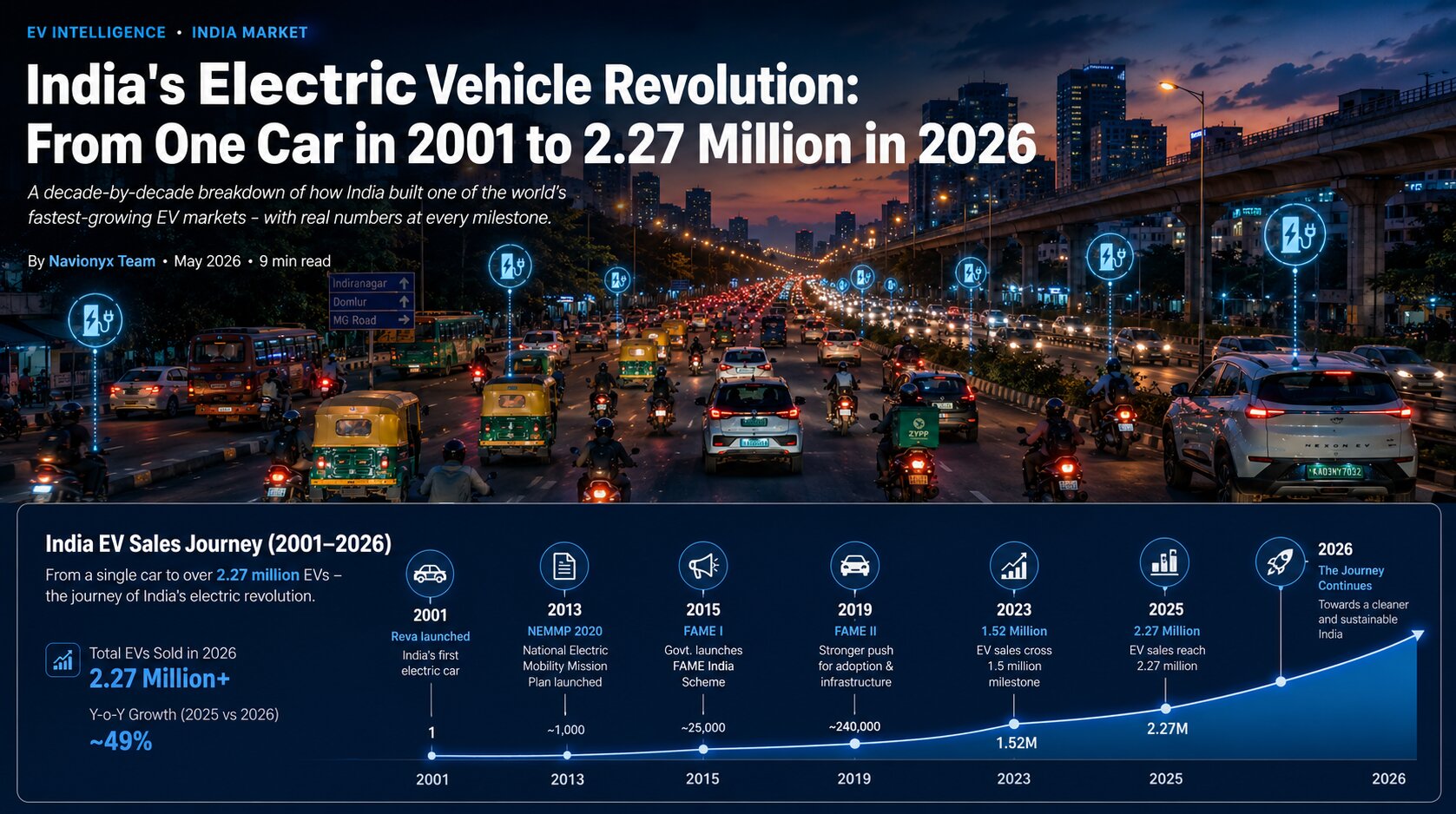
A decade-by-decade breakdown of how India built one of the world’s fastest-growing EV markets – with real numbers at every milestone.
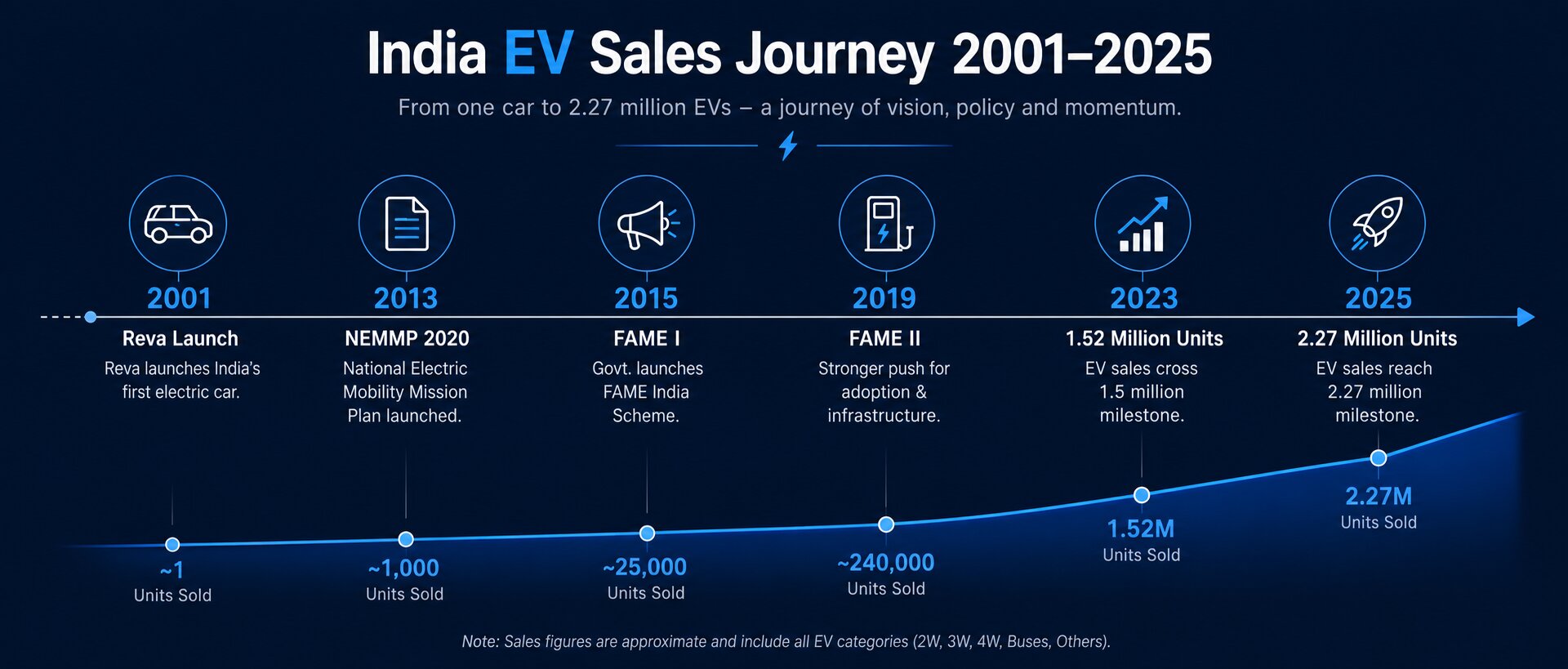
India didn’t arrive at the electric vehicle revolution overnight. The country that today sells more than two million EVs a year started with a single quirky hatchback from Bangalore, sold in tiny volumes to environmentalists willing to bet on a long-term future. That car was the Reva. The year was 2001. And almost nothing that followed went to plan – until, quite suddenly, it did.
Between 2022 and 2025, India sold 5.75 million electric vehicles – representing 75% of every EV the country had ever sold across its entire history. The numbers aren’t just impressive; they mark a fundamental shift in how India moves people and goods. This article traces the full arc: the false starts, the policy pivots, and the years where the data finally caught up with the ambition.
The False Start: 2001–2013
India’s first electric car was technically ahead of its time. The Reva – a compact two-seater manufactured by the Bangalore-based Reva Electric Car Company – launched in 2001 and became one of the world’s earliest commercially available EVs. It found modest success domestically and even exported to the UK, where it sold under the name G-Wiz. A larger automaker acquired the company in 2010, continuing the platform under new ownership.
But Reva remained an outlier, not a signal. The market had no ecosystem: no charging infrastructure, no domestic battery manufacturing, no public awareness, and very little government urgency. India was still in the throes of a middle-class aspiration for petrol-powered personal mobility, and EVs were seen as compromise vehicles for a niche audience.
In 2010, the Ministry of New and Renewable Energy introduced a modest subsidy scheme – a gesture more than a strategy. The real turning point in policy thinking came in 2013, when the government launched the National Electric Mobility Mission Plan (NEMMP) 2020. It set an audacious target: 6–7 million EV sales per year by 2020. The infrastructure and industrial base to achieve that goal did not exist. The target was missed by a wide margin. But NEMMP mattered because it marked the first time India treated EVs as a national priority rather than a curiosity.
“India set a target of 6–7 million EV sales per year by 2020. It was missed completely. But it planted the seed that made everything after possible.”
FAME I – The Government Makes Its First Real Bet: 2015–2019
In April 2015, the Department of Heavy Industries launched the FAME India Scheme (Faster Adoption and Manufacturing of Hybrid and Electric Vehicles). Phase I ran for four years with a budget of ₹895 crore, targeting four areas: demand incentives, technology development, pilot projects, and charging infrastructure.
The results were real but modest. By the end of FAME I, approximately 2.8 lakh hybrid and electric vehicles had been supported under demand incentives, with ₹359 crore disbursed. The Ministry of Heavy Industries sanctioned 520 charging stations. These were meaningful first steps – but the market was still far from self-sustaining. Most buyers needed the subsidy to consider an EV at all, and the available models were limited in range, variety, and affordability.
FAME I at a Glance (2015–2019)
📋 Budget: ₹895 crore over 4 years
🚗 Vehicles supported: ~2.8 lakh (hybrid + electric)
💰 Incentives disbursed: ₹359 crore
⚡ Charging stations sanctioned: 520
FAME II – Turning Up the Volume: 2019–2024
March 2019 marked a step-change in ambition. The government launched FAME II with a ₹10,000 crore budget – more than 11 times the outlay of FAME I. This phase was laser-focused on public and commercial transport: 7,090 electric buses, 5 lakh e-three-wheelers, 55,000 electric four-wheelers, and 10 lakh electric two-wheelers were targeted for subsidy support.
Alongside FAME II, a series of complementary policy moves shifted the economics of EVs significantly. GST on electric vehicles was cut from 12% to 5%. GST on chargers and charging stations dropped from 18% to 5%. Battery-operated vehicles were granted green number plates and exempted from permit requirements. States were advised to waive road tax on EVs entirely – with Delhi, Maharashtra, Tamil Nadu, and Karnataka responding with waivers delivering a 15–25% on-road price advantage over equivalent ICE vehicles.
By the time FAME II concluded in March 2024, it had disbursed ₹5,633 crore in demand incentives and supported the sale of over 1.17 million EVs. The public charging network had grown from 520 sanctioned stations under FAME I to 12,146 operational stations nationwide by February 2024. The Production Linked Incentive (PLI) scheme for Advanced Chemistry Cell batteries, approved in May 2021 with a ₹18,100 crore outlay, began laying the foundation for domestic battery manufacturing.
The Numbers That Tell the Real Story: 2022–2025
Policy creates conditions. Markets create momentum. The period from 2022 to 2025 is where India’s EV story stopped being about government targets and started being about genuine consumer demand. Here is what the data shows:
| Year | Total EV Sales | YoY Growth | Market Penetration |
|---|---|---|---|
| 2022 | ~1.02 million | – | ~4% |
| 2023 | 1.52 million | +50% | 6.5% |
| 2024 | 2.0+ million | +24% | ~8% |
| 2025 | 2.27 million | +16% | Record highs across all segments |
Sources: industry trade publications, EV research firms, industry trade bodies, VAHAN Dashboard
The 2023 jump – a 50% surge to 1.52 million units – was the market’s first sign of genuine liftoff. This wasn’t subsidy-driven distortion; it reflected a broader shift in consumer acceptance, driven by falling prices, a widening model lineup, and the simple fact that more Indians knew someone who owned an EV. In 2024, the two-million milestone was crossed for the first time, with electric two-wheelers leading at 1.2 million units and the three-wheeler cargo segment posting a remarkable 45% YoY growth on the back of booming e-commerce logistics.
The 2025 breakdown reveals where the real acceleration is happening. Electric passenger vehicles – cars and SUVs – grew 77% year-on-year to 176,980 units. Electric commercial vehicles grew 57%. India also consolidated its position as the world’s largest market for electric three-wheelers, surpassing China in 2023 and extending that lead every year since.
2025 EV Sales: Segment Breakdown
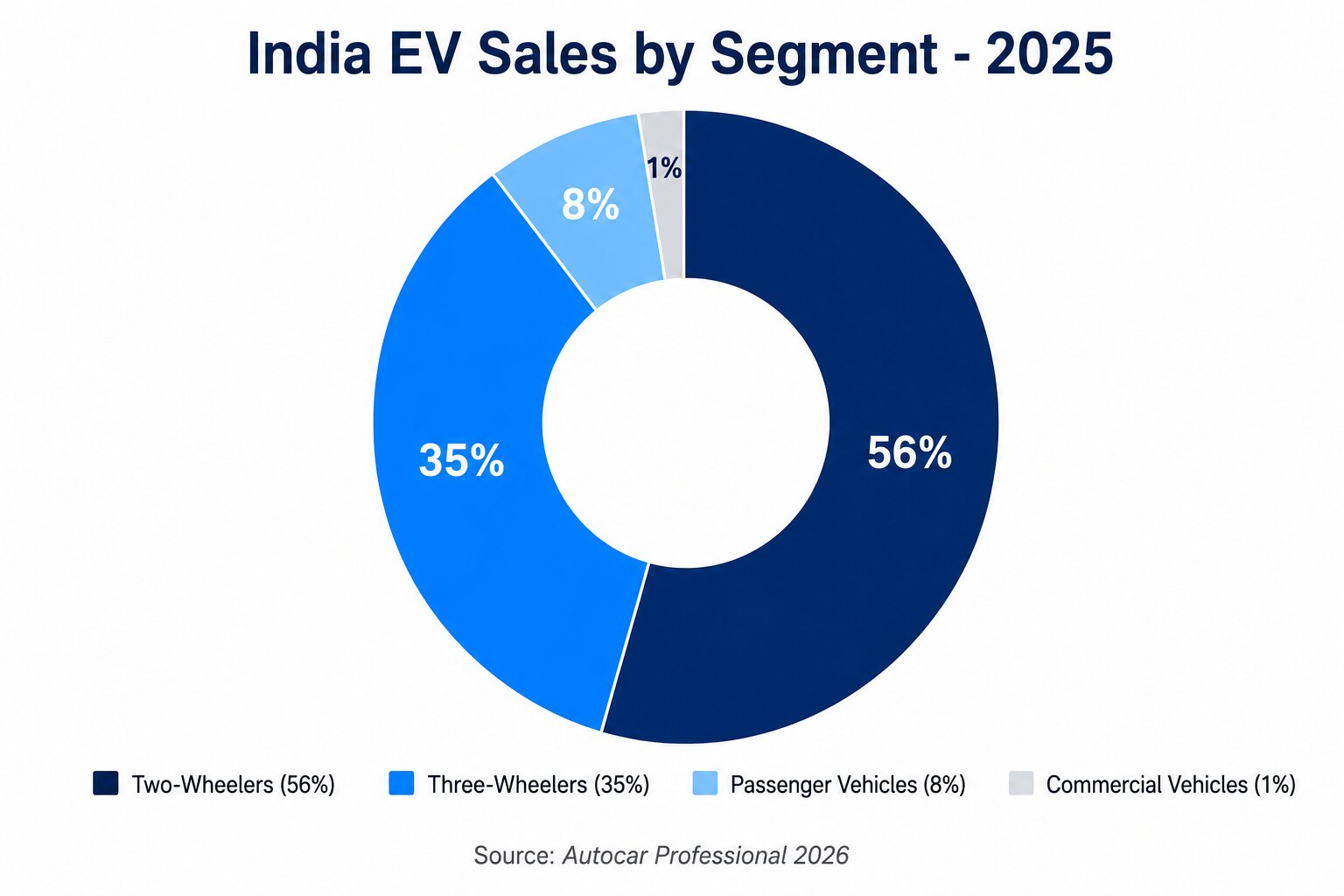
🛵 Electric Two-Wheelers: 1.28 million units (+11% YoY)
🛺 Electric Three-Wheelers: 797,727 units (+15% YoY)
🚗 Electric Passenger Vehicles: 176,980 units (+77% YoY)
🚛 Electric Commercial Vehicles: 15,798 units (+57% YoY)
Where India Stands Today: 2026
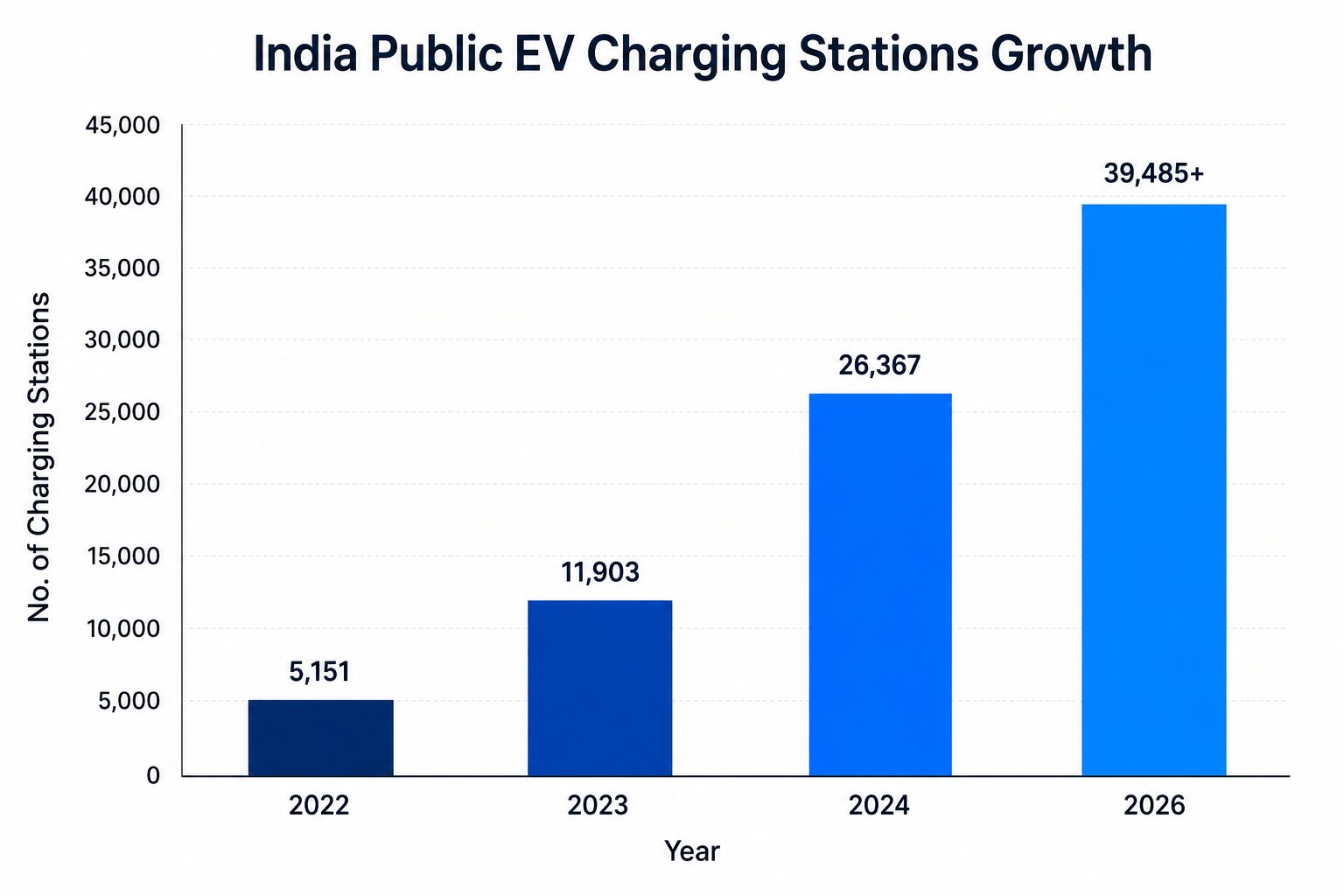
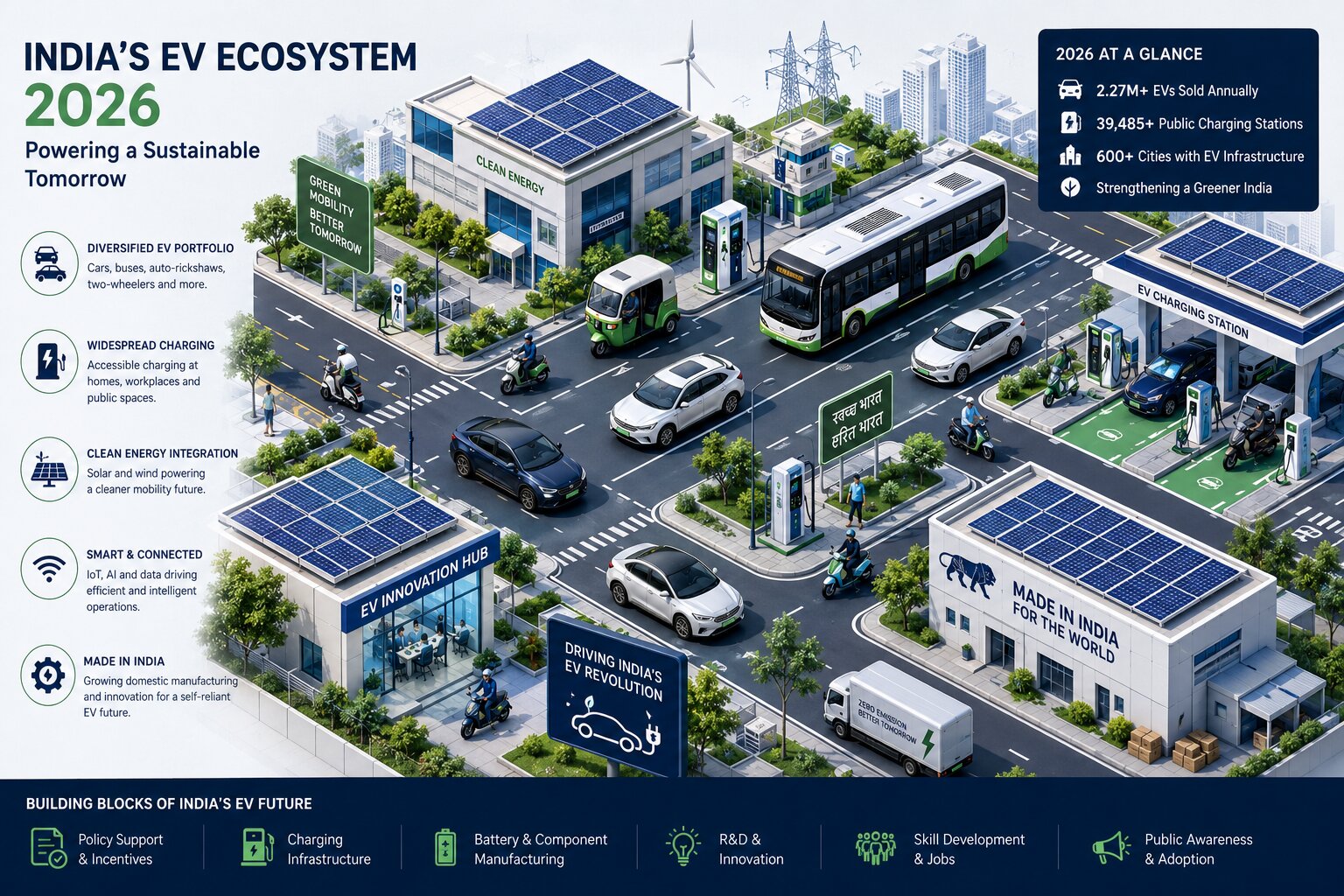
As of 2026, India’s EV market is valued at approximately $18.79 billion, projected to reach $31.09 billion by the end of this year. In FY 2025–26 alone, electric passenger vehicle registrations crossed 1,99,923 units – an 83.63% year-on-year jump. The charging infrastructure footprint has expanded from 5,151 public stations in 2022 to 39,485 operational stations under PM E-Drive as of March 2026.
In October 2024, the government replaced FAME II with the PM E-Drive scheme – a ₹10,900 crore commitment focused specifically on commercial EVs and charging infrastructure expansion into rural areas. Battery localisation is finally gaining traction: under the ACC Battery PLI scheme, 40 GWh of cell manufacturing capacity has been awarded, with 1 GWh already commissioned by March 2026.
On the manufacturing side, 2025 and early 2026 saw a wave of fresh launches: a major automaker’s first mass-market EV, another leading automaker’s extended long-range portfolio, a global automaker’s electric SUV entering road testing, and a domestic automaker pledging ₹12,000 crore to its electric arm over three years. The product lineup has never been broader, and the price compression has never been steeper.
The Honest Take: How Far India Still Has to Go
The progress is real. The challenges are equally real. India’s government target of 30% EV market penetration by 2030 – roughly 80 million EVs on Indian roads – requires the country to more than triple its current pace of adoption. At 8% overall penetration in 2024, the gap is significant.
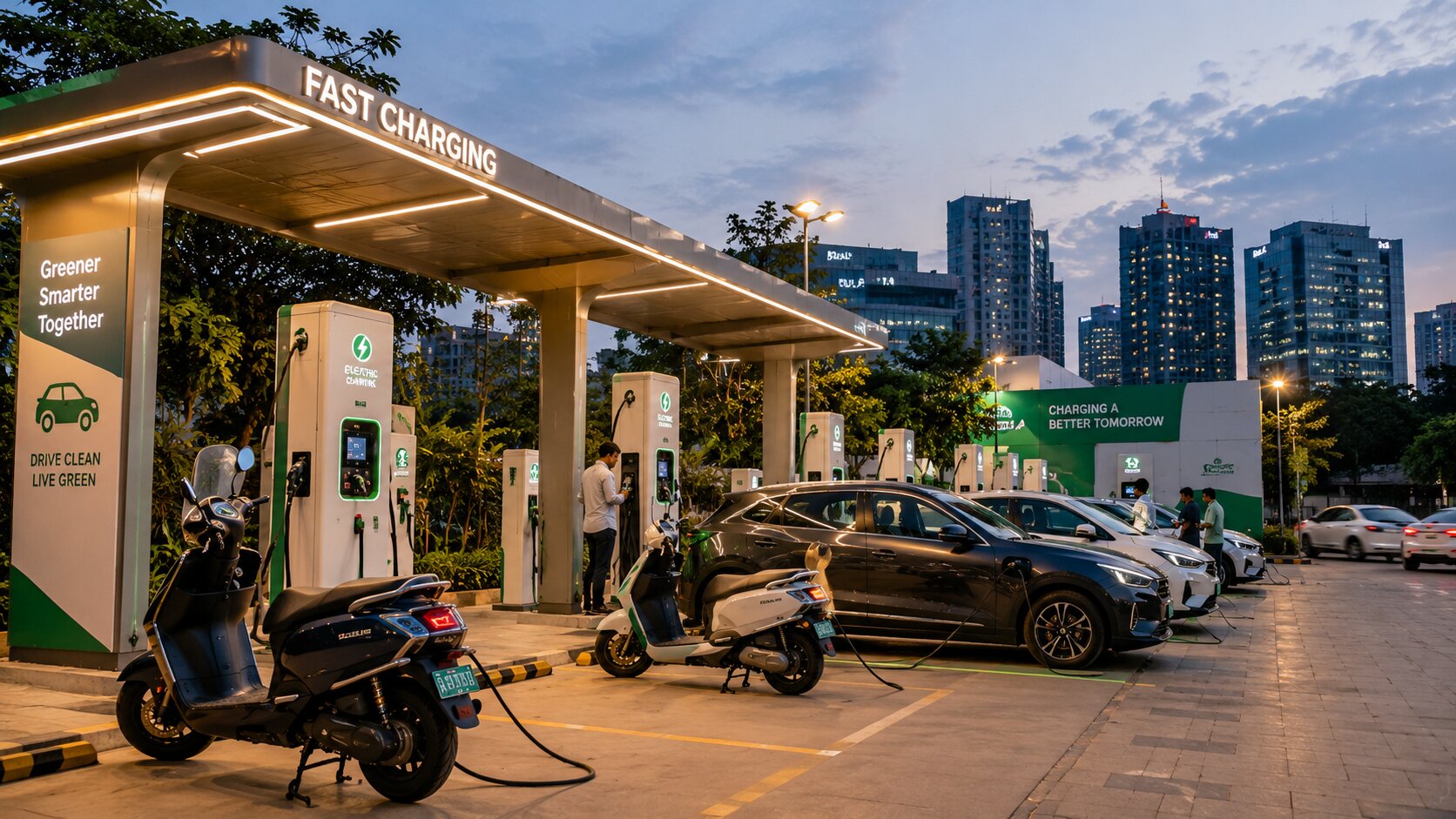
Charging infrastructure, while growing rapidly, remains heavily concentrated in metro cities. Karnataka leads with approximately 6,097 public charging stations as of July 2025, followed by Maharashtra and Delhi – but rural and Tier 2 connectivity remains sparse. For fleet operators running inter-city routes, range planning is still a daily operational challenge rather than a software problem to be solved.
Battery costs are falling but the supply chain remains fragile. India still imports over 90% of its lithium-ion cells, leaving the market exposed to global commodity and geopolitical shocks. The ACC PLI scheme is the government’s answer – but scale takes time. Domestic cell production at meaningful volumes is a 2027–2028 story at the earliest.
Finally, the segment mix matters. Electric two-wheelers and three-wheelers account for over 90% of EV sales. The electric passenger car segment – the one most people picture when they think “EV market” – is at 8% of total EV volumes. India has built an EV market on the back of last-mile and urban commuter vehicles. Translating that into mainstream passenger car adoption at scale is the next chapter, and it is not guaranteed to write itself.
“5.75 million EVs were sold in India in just the last three years – representing 75% of every EV the country had ever sold in its entire history.”
What This Means for Fleet Operators – and Why Telematics Changes Everything
For businesses running commercial fleets, India’s EV trajectory is not a background story to monitor – it is an operational reality to manage today. Electric three-wheeler cargo vehicles grew 45% in 2024, driven almost entirely by e-commerce last-mile delivery. Electric bus deployment is accelerating under PM E-Drive. Logistics companies that have not begun piloting EVs in their fleets are already behind their competitors.
But EV fleet management is categorically different from managing a petrol or diesel fleet. Battery state-of-charge, energy consumption per trip, charging session efficiency, range prediction under load – these are data streams that traditional GPS tracking platforms were never designed to handle. A standard telematics system tells you where a vehicle is. An EV telematics platform tells you whether it can complete its next route, when it needs to charge, which driver is degrading battery health through aggressive regeneration behaviour, and which charging station is available on that corridor.
India’s EV market is no longer early. It crossed two million annual sales in 2024. It is adding charging stations at a 72% compounded annual growth rate. The question for fleet operators is not whether to electrify – it is whether their software infrastructure is ready for the data complexity that electrification brings.
The Arc: From Reva to Revolution
In 2001, India’s entire electric vehicle market was one small hatchback that could barely reach highway speeds. In 2025, the country sold 2.27 million electric vehicles across four segments, became the world’s largest e-three-wheeler market, and commissioned its first domestic battery cell manufacturing line. In 24 years, India went from EV novelty to EV economy.
The next decade will be decided not by how many EVs India sells, but by how intelligently those vehicles are managed – by the telematics, the analytics, and the operational intelligence that turns raw battery data into competitive advantage. The market is ready. The question is whether the software powering it is ready too.
Managing an EV Fleet in India?
Navionyx gives you real-time intelligence on every battery, every route, and every charge session – built specifically for the EV era. See how fleet operators across India are using Navionyx to stay ahead.
Get a Free Demo →