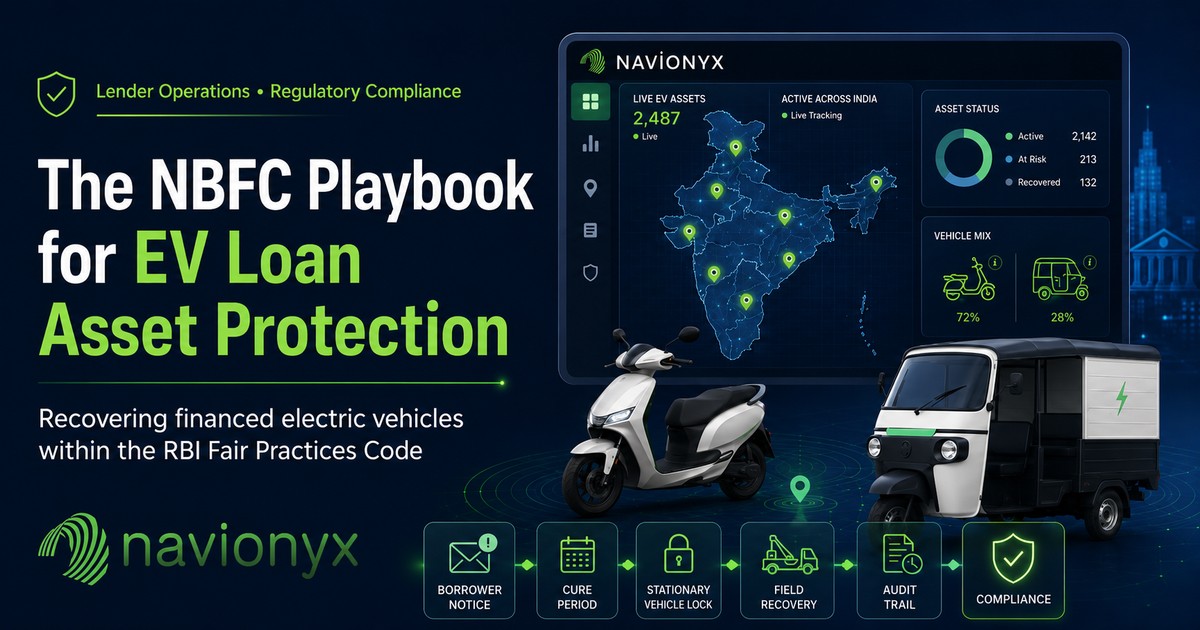
Lender Operations · Regulatory Compliance
An operational and regulatory reference for credit, collections, and compliance leaders building financed EV portfolios in India.
By Navionyx Team · June 2026 · 18 min read
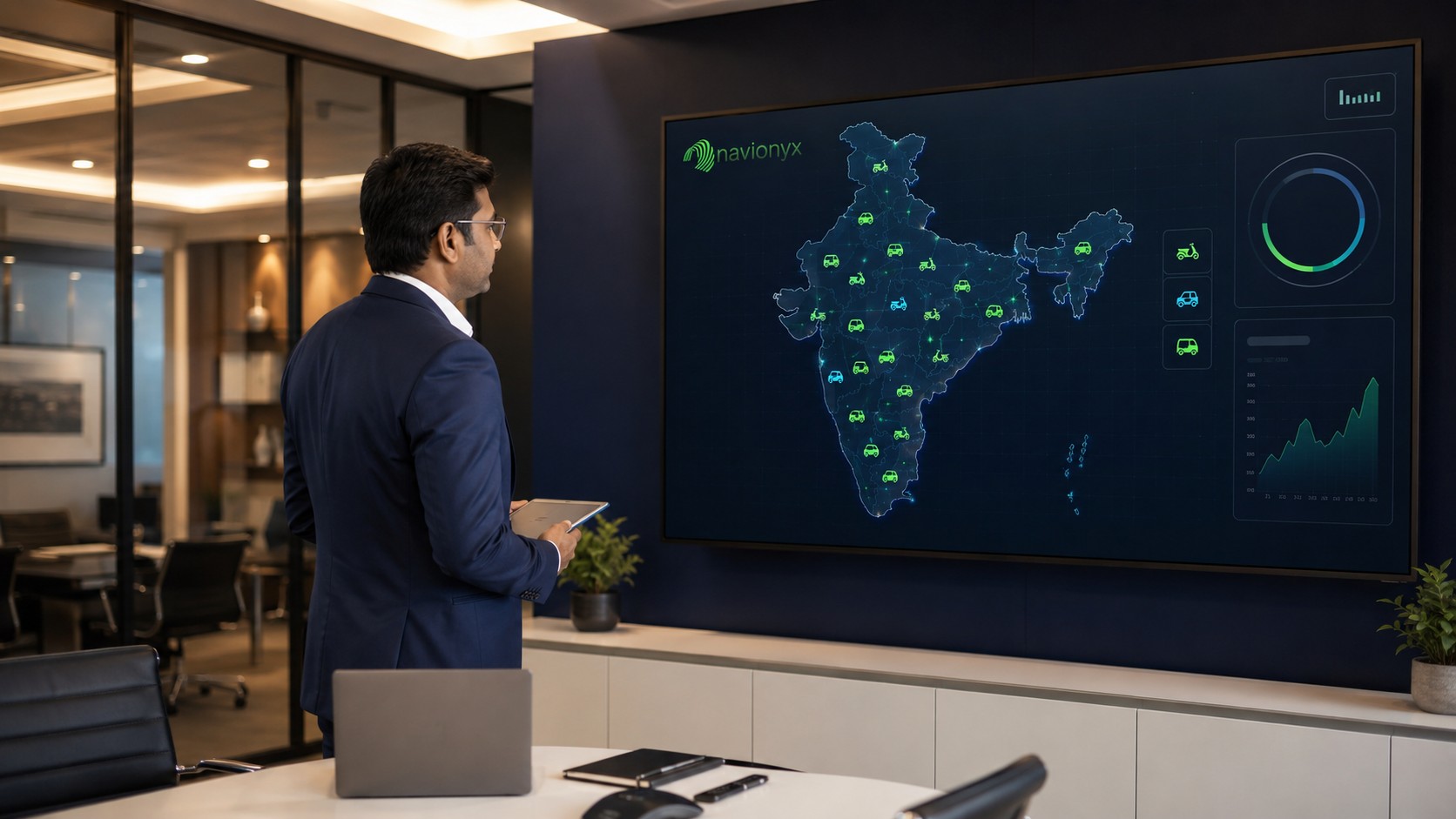
India’s EV financing market sits at one of the strangest inflection points the country’s lending sector has seen in two decades. The portfolio is small enough that most NBFCs still treat it as a side product, but growing fast enough that the operational risk is no longer theoretical. Industry analysis projects the market to grow from USD 2.37 billion in 2025 to USD 28.79 billion by 2031, a compounded growth rate north of 51 percent [1]. A separate credit rating agency expects NBFC two wheeler portfolios alone to grow 18 to 19 percent in FY26, even as asset quality stress rises [2].
Yet the playbook most lenders are using for recovery was written for internal combustion vehicles. It assumed a borrower with a fixed address, a vehicle whose value declined predictably with odometer reading, a field agent who could trace the asset through fuel stations and service records, and a regulatory environment that had not yet been redefined by the events of 2022.
None of that is true for a financed electric three wheeler operating in Gorakhpur, a financed electric two wheeler being used for gig delivery in Pune, or a fleet of e three wheelers running last mile logistics out of a single Bengaluru hub. This is an attempt to set down, in operational detail, what a compliant EV loan asset protection workflow looks like in 2026, what the RBI Fair Practices Code actually says about repossession, what the Supreme Court has already ruled on, and what role telematics now plays as a compliance layer rather than a tracking convenience.
The shape of the financed EV portfolio in 2026
Three structural changes have reshaped this segment in the last 36 months. First, in September 2023, the RBI revised its Priority Sector Lending Master Directions to make loans for electric vehicles eligible under the renewable energy category, subject to the per borrower cap. This single move pulled EV financing from a discretionary lending bucket into a regulator preferred one. Banks that had been reluctant to underwrite e rickshaws began running pilot programs. Captive NBFCs of OEMs scaled rapidly.
Second, the borrower profile changed. A 2024 review of electric two and three wheeler financing noted that EV loans carry interest rates 5 to 14 percent higher than equivalent ICE loans, partly because lenders are still pricing in unfamiliar collateral risk and partly because the borrower base skews toward first time formal credit users in the gig economy [3]. These are not the same borrowers who walked into a dealership in 2015 to finance a commuter motorcycle. They are delivery riders, e rickshaw operators, and last mile drivers, many of whom rely on the financed vehicle for daily livelihood income.
Third, the asset itself behaves differently. An ICE two wheeler depreciates on a curve a credit team has seen for thirty years. An electric two wheeler depreciates on two curves at once: the vehicle and the battery, and the battery’s state of health is the larger lever. A financed EV that sits unused for sixty days because the borrower has stopped earning is not just a payment default. It is a collateral that may have lost five to twelve percent of its resale value to calendar aging and idle discharge before a recovery agent reaches the spot.
The portfolio math has changed. Lenders are now writing larger ticket sizes to less credit experienced borrowers against an asset whose recovery value decays during the default window itself. The recovery operating model has to change with it.
Why EV loan recovery breaks the ICE era playbook
Traditional auto loan recovery rested on a few quiet assumptions. The borrower’s registered address was usually current. The vehicle could be located through fuel station ANPR networks, dealer service records, or a paid informant within a defined geography. The asset’s value was predictable. The collections team had weeks, sometimes months, between SMA 1 and the point at which physical recovery became necessary.
An EV loan inverts most of these assumptions in measurable ways:
- Mobility patterns are wider and faster. A financed e three wheeler in Lucknow can cross into a neighbouring district within a single charging cycle. Cross district movement during default is now common rather than exceptional.
- There is no fuel paper trail. The ICE recovery industry’s informal network of petrol pump ANPR contacts, dealer alerts, and service centre notifications does not exist for EVs. Charging happens at home, at small private points, or at occasional public stations that do not share data with lenders.
- Borrower contactability degrades faster. Gig economy borrowers change phone numbers, employers, and operating cities more frequently than salaried borrowers. The address on the loan file is often stale within twelve months.
- Components are removable. Battery packs, controllers, and motors can be stripped and resold to the secondary market within a week of default. By the time a field agent reaches the registered address, the chassis may be all that remains.
- The asset value is partly software defined. Two physically identical e three wheelers can have very different recovery values if one has been deep discharged repeatedly and the other has not. Without battery telemetry, the lender is blind to this.
A traditional collections team operating on outdated location data, with no visibility into the asset’s physical state, working a borrower base that is geographically mobile and digitally fluent, is structurally outgunned. This is not a sales argument for telematics. It is a description of the operating environment.
What the RBI Fair Practices Code actually requires for repossession
The Fair Practices Code framework for NBFCs has been built up through a series of RBI circulars since 2006, most consolidated under the Master Direction on Non Banking Financial Company Scale Based Regulation and the various Fair Practices Code circulars that NBFCs are required to publish on their websites [4]. The repossession specific provisions can be summarised in five non negotiable requirements:
| Requirement | Description |
|---|---|
| 1. Enforceable Loan Agreement Clause | The loan agreement must contain a clearly worded repossession clause that the borrower has signed and received a copy of. This clause must specify the circumstances for possession, notice period, procedure, provision for final repayment, and procedure for return or sale. |
| 2. Notice Period Before Repossession | The borrower must be given written notice with a clear cure period before any recovery action. Circumstances under which the notice period can be waived must themselves be specified in the agreement. |
| 3. Peaceful Possession Only | Possession must be taken peacefully. Forcible seizure, intimidation, or possession by use of force exposes the lender to civil liability, regulatory action, and increasingly to criminal prosecution. |
| 4. Recovery Agent Code of Conduct | Authorised recovery personnel must carry identification and authorisation letters. Contact with the borrower is restricted to the window between 8 AM and 7 PM. Calls or visits outside this window, threats, abuse, public humiliation, or disclosure of loan information to third parties are all explicit violations. |
| 5. Documented Grievance Redressal Mechanism | The lender must publish a grievance redressal officer’s contact details and provide the borrower with a route to escalate to the RBI Ombudsman. |
The technology a lender deploys does not exempt it from these requirements. It is one of the few mechanisms available to provide auditable evidence that each of these requirements was met at every step. That distinction is the entire compliance argument for lender focused telematics.
The precedent that reset the line every lender now lives behind
In September 2022, a 27 year old pregnant woman was killed during a tractor repossession in Hazaribagh district of Jharkhand. The vehicle was financed by a major NBFC. The recovery had been outsourced to a third party agent. Within weeks, the RBI directed the NBFC to stop using third party agents for recovery and repossession activities [5]. The ban was lifted later, but the operational signal was unambiguous and permanent: a lender is fully responsible for the conduct of every agent acting on its behalf, and the regulator will use its supervisory powers without hesitation when that conduct crosses the line.
Two Supreme Court rulings frame the legal context this incident reinforced. In ICICI Bank Ltd vs Prakash Kaur (2007), the Court held that financiers cannot resort to musclemen for recovery and that physical seizure without due process is illegal [6]. In Citicorp Maruti Finance Ltd vs S. Vijayalaxmi (2012), the Court reiterated that even when a hypothecation agreement permits repossession, the lender must follow the procedure set out in the agreement and the RBI guidelines, and any unilateral forceful action is impermissible [7].
The combined practical effect is that every NBFC running a vehicle finance book in 2026 is operating under a regulator that has demonstrated willingness to use prohibition as a supervisory tool, and under jurisprudence that places the entire risk of agent misconduct on the lender. The cost of an uncontrolled field recovery on a financed EV is no longer just the cost of the asset. It is the option value of the entire portfolio.
The legal architecture: contract, notice, peaceful possession, and arbitration
There is a common misconception in vendor literature that NBFCs can rely on the SARFAESI Act for vehicle recovery. For two wheeler and three wheeler EV loans, this is almost always incorrect. The legal architecture for EV loan recovery is primarily governed by the hypothecation agreement, the RBI Fair Practices Code, and the Arbitration and Conciliation Act, 1996. Key elements include:
- The hypothecation agreement. The loan agreement, signed by the borrower at disbursement, contains the lender’s right to take possession of the hypothecated asset on default. This is the primary source of authority for recovery. Every operational step a lender takes must be traceable to a clause in this agreement.
- The pre-repossession notice. This is the written communication, sent in accordance with the agreement and the Fair Practices Code, that establishes default, gives the borrower a final cure window, and warns of impending repossession.
- Peaceful possession. Possession is taken physically by an authorised agent without force, intimidation, or breach of peace, after the notice period has expired and any cure window has closed.
- Arbitration under Section 9 of the Arbitration and Conciliation Act, 1996. Where a contested repossession is anticipated, or where a borrower disputes the lender’s right to possession, NBFCs commonly approach the relevant court under Section 9 for interim measures. This is the actual judicial route most EV loan disputes will travel, not SARFAESI and not DRT (which only entertains amounts above ₹20 lakh).
A remote immobilization command, applied to the financed asset before physical possession, occupies a specific position within this architecture. It is not repossession. It is a contractual remedy permitted under the hypothecation agreement, applied after the agreement’s notice procedure has been followed, and reversible if the borrower cures the default. Treating it as anything more legally aggressive than that is both inaccurate and operationally risky.
The cost arithmetic of manual EV recovery
Most NBFC collections teams have a clear sense of recovery cost on conventional vehicle portfolios. The unit economics of EV recovery are still emerging, and the early data is uncomfortable. Based on the working assumptions Navionyx sees across active NBFC deployments, a manual recovery cycle on a financed electric three wheeler typically incurs cost in five buckets:
- Field visit cost. Each physical visit to a borrower’s registered address or last known location costs the lender between ₹400 and ₹1,200 in agent time, travel, and coordination. Average recoveries on EV portfolios require 2.5 to 4 visits before the asset is physically located, against 1.5 to 2 visits on equivalent ICE portfolios.
- Asset discovery delay. The longer a vehicle sits unlocated after default, the higher the probability of component removal, battery degradation from deep discharge, or onward sale by the borrower. A 30 day delay between default and possession can reduce realisable resale value by 8 to 15 percent on an e three wheeler whose battery accounts for 40 percent of asset value.
- Compliance and dispute cost. Every recovery that triggers a borrower grievance, an ombudsman notice, or a magistrate’s complaint carries direct legal cost and indirect reputational cost. Even resolved disputes consume internal compliance team hours and create supervisory attention.
- Vehicle reconditioning cost. A recovered EV typically requires battery health assessment, controller diagnostics, and basic reconditioning before resale or redeployment. Recoveries that arrive with damaged or stripped batteries push this cost from ₹3,000 to ₹4,000 per asset to upwards of ₹25,000.
- Opportunity cost on the loan book. Every day a defaulted vehicle remains unrecovered, the lender is paying cost of funds on a non earning asset. On a ₹1.5 lakh principal, the cost of funds alone is roughly ₹50 to ₹70 per day. Across a 1,000 vehicle book with even a 4 percent recovery pipeline, this compounds into material P&L drag.
The compounded recovery cost on a financed EV that goes through a fully manual cycle can run between ₹18,000 and ₹35,000 per asset, before any haircut on resale. This is the baseline against which any technology investment in asset protection must be measured.
Telematics as a compliance layer, not a tracking convenience
The framing that has held back proper deployment of telematics in NBFC operations is that it is sold, and procured, as a tracking product. Tracking is the smallest part of what it does for a lender. The more useful framing is that it is a compliance and evidence layer that sits between the loan management system and the physical asset, and that produces the documentation a lender needs to defend every recovery action.
When a lender adopts a telematics platform purpose built for financed vehicles, four capabilities matter more than the live map:
- Role based authorisation and reason coded actions. Every action taken on the asset, whether a location query, a soft immobilization command, a reverse unlock, or a tamper acknowledgment, is recorded with the user identity, timestamp, IP address, and a reason code tied to the loan account and default stage. This is the foundation of evidence ready audit logs.
- Configurable notice and cure period workflows. The platform enforces a wait period after default flag and notice reference are recorded, before a soft lock command is even available to the collections user. The control is not a recommendation. It is a hardcoded gate.
- Safety constrained firmware. The immobilization relay is locked out of engaging while the vehicle is in motion or its ignition is on. The lock applies only at the next stationary, ignition off event. This is the engineering implementation of the Supreme Court’s peaceful possession doctrine, expressed in firmware.
- Battery and BMS telemetry. Where the EV’s BMS exposes cell level voltage and state of health data, the lender gains continuous visibility into the asset’s recovery value, not just its location. A borrower whose vehicle is showing rapid SoH degradation is a borrower whose loan to value ratio is silently deteriorating, even before any EMI is missed.
Read together, these capabilities reframe telematics from an operations tool into something the compliance officer and the audit committee can actually defend in an RBI inspection. That is the shift NBFCs running scale EV books have already begun making.
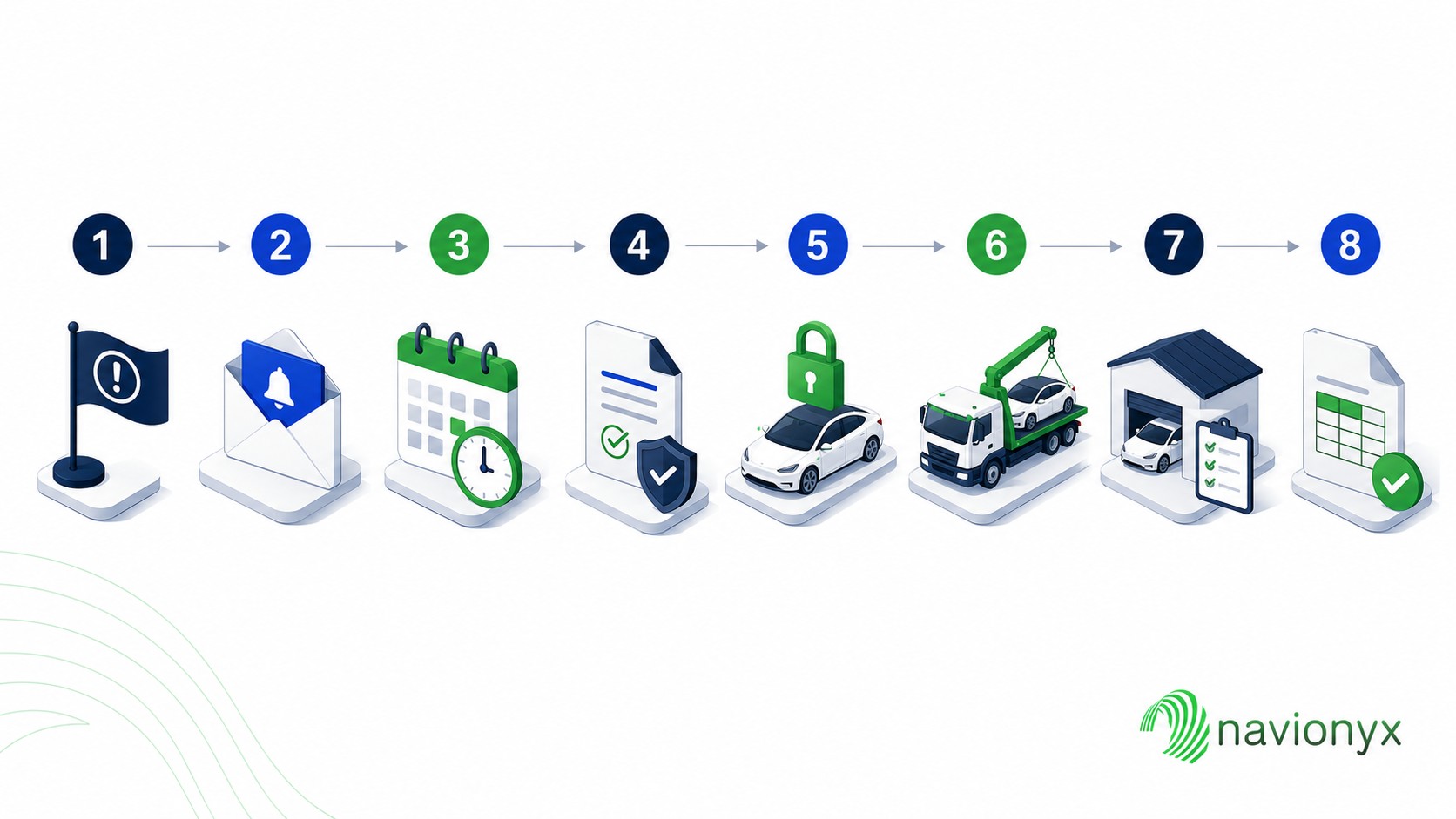
The eight stage compliant EV recovery workflow
The following workflow has been validated in active NBFC deployments and aligns with the Fair Practices Code requirements set out above. Each stage carries its own evidence artefact, and at each stage the lender’s compliance team should be able to produce the relevant log on demand.
STAGE 1 · EARLY RISK SIGNAL
Telematics or LMS data identifies portfolio stress before formal default. Triggers include extended device disconnection, vehicle inactivity during normal earning hours, repeated deep discharge events, deteriorating battery SoH, or geofence breaches. The collections team prioritises borrower outreach. No restrictive action is taken on the asset.
STAGE 2 · BORROWER ENGAGEMENT
The lender follows its approved collections protocol. Calls and visits stay within the 8 AM to 7 PM window. In app notifications, payment reminders, and offered restructuring options are documented. The audit log records the contact attempts, including any failures to reach the borrower.
STAGE 3 · DEFAULT FLAG AND NOTICE RECORD
The loan account is moved to the appropriate default stage in the LMS. The pre repossession notice is generated, dispatched per the agreement terms, and the notice reference is recorded inside the telematics platform alongside the cure period clock.
STAGE 4 · INTERNAL AUTHORISATION
An authorised user from the collections risk team reviews the case file after the cure period expires. The reviewer confirms that the notice was served, that the cure window has lapsed without payment, and that no live restructuring negotiation is open. The authorisation is recorded with user ID, timestamp, IP, and reason code.
STAGE 5 · STATIONARY SOFT IMMOBILIZATION
The lock command is issued. The firmware delays engagement until the vehicle is stationary with ignition off. The borrower’s next cold start attempt fails. A reverse unlock remains available to the same authorised role if the borrower cures the default or recovery is no longer required.
STAGE 6 · FIELD RECOVERY
The recovery agent receives live location, recent route history, and current vehicle state on their mobile dashboard. The agent identifies themselves with carrying ID and authorisation, contacts the borrower during permitted hours, and takes peaceful possession under the loan agreement. The intake action is logged.
STAGE 7 · INTAKE, INSPECTION, AND RELEASE
At the lender’s yard or partner intake centre, an authorised technician releases the lock for inspection. Battery health, controller status, and physical condition are assessed and recorded. The borrower’s final opportunity to clear dues before auction is communicated in writing as required.
STAGE 8 · AUDIT EXPORT
The full action history for the loan account is exported in PDF and CSV form. Location queries, lock and unlock events, user actions, timestamps, IPs, notice references, and reason codes are all included. The export is retained for the period mandated by the lender’s data retention policy, typically five to ten years.
For lenders running this workflow on the Navionyx platform, the lock command and audit export functions are documented under our EV loan asset protection and controlled vehicle immobilization solution for NBFCs, with LMS integration through REST APIs covered separately under the white label fleet platform and API integration documentation.
The audit trail: what an RBI inspector or ombudsman will ask for
During an RBI thematic inspection of an NBFC’s vehicle loan portfolio, or in response to an Ombudsman complaint, the documentation that will be sought follows a predictable pattern. A lender that has the following ready in exportable form is in a defensible position. A lender that does not is exposed.
- The loan agreement with the repossession clause, signed by the borrower, with proof of borrower copy delivery.
- The pre-repossession notice with dispatch evidence and the cure period clock.
- The complete call and visit log within Fair Practices Code permitted hours, with no entries outside the 8 AM to 7 PM window.
- The internal authorisation record showing which user authorised the lock command, against which loan account, with what reason code, at what timestamp.
- The firmware safety log proving the lock did not engage while the vehicle was in motion.
- The field agent’s identification and authorisation record at the point of intake.
- The borrower’s grievance redressal route, with the nodal officer’s contact detail, demonstrably communicated.
- The final notice giving the borrower an opportunity to clear dues before sale or auction.
- The sale or auction record, with the surplus return to the borrower if applicable.
Across the NBFCs we have worked with, the single largest source of inspection friction has not been the underlying recovery action. It has been the inability to produce a coherent, time stamped record of why and how each step was taken. A telematics platform that does not produce this record automatically is not a compliance asset. It is just a tracker.
Selecting a lender grade EV telematics platform
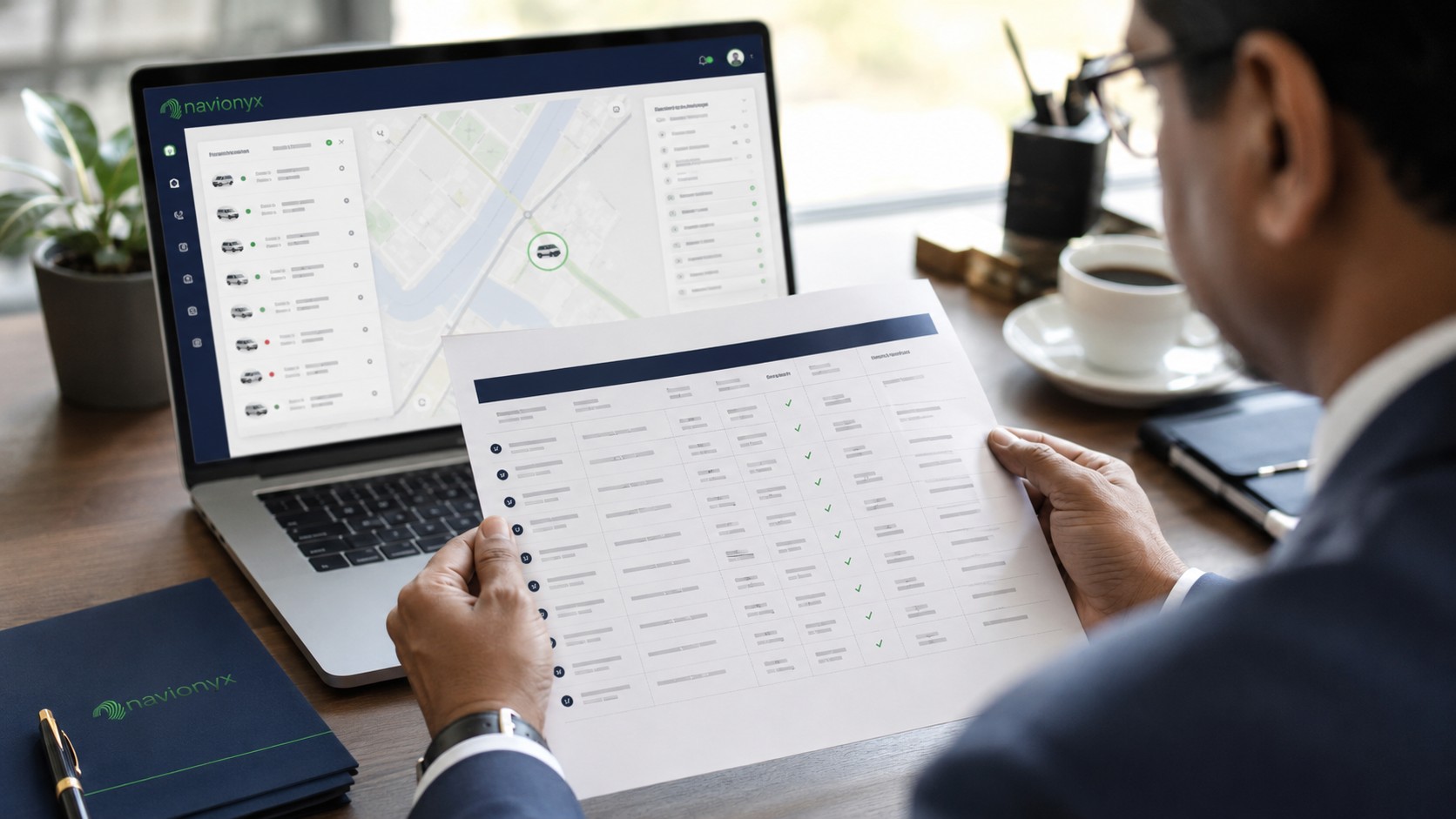
Most consumer or fleet operator telematics products are not built for lenders. The procurement criteria for an NBFC are narrower and stricter than for a delivery fleet, and a few of them are easy to overlook until the first RBI inspection or borrower dispute arrives. The following checklist captures what credit operations leaders should be testing for during vendor evaluation.
- ✓Hardware support across 12V to 96V architectures covering electric two wheelers, three wheelers, and small fleet four wheelers on a single device SKU.
- ✓AIS 140 certification for the underlying tracking unit, with documentary evidence.
- ✓Stationary only relay firmware with hardcoded protection against mid trip immobilization.
- ✓Configurable notice and cure period workflow built into the lock command path.
- ✓Role based access control with separate permissions for credit, collections, audit, and field roles.
- ✓Reason code capture on every location query, lock, unlock, and release action.
- ✓Tamper and power disconnect alerts with last known location preservation.
- ✓BMS and CAN bus integration depth validated model by model for the lender’s preferred OEM partners.
- ✓REST API integration with the LMS for bidirectional default flags, notice dates, and lock commands.
- ✓Exportable audit trails in PDF and CSV with five to ten year retention configurability.
- ✓A borrower facing app that surfaces battery SoH, charging history, and lender contact context, reducing ghost defaults before they become recovery cases.
- ✓Compliance with RBI’s 2022 Outsourcing of IT Services Direction and the Digital Personal Data Protection Act, given that borrower data will flow between the lender, the vendor, and downstream collection partners.
The borrower facing piece is the one that is most commonly missed in lender procurement. A borrower who can see their own battery health, charging history, and maintenance reminders inside an app that also carries their lender’s contact details is structurally less likely to default in the first place, and structurally more likely to communicate during stress. This is the cheapest form of asset protection a lender ever buys, and it has nothing to do with relays or locks. We cover the supporting analytics for this in our EV charging intelligence and battery health certification workflows.
Conclusion: the EV book that survives the next supervisory cycle
The NBFCs that will run successful EV financing books through the next supervisory cycle are not the ones with the lowest interest rates or the most aggressive disbursement targets. They are the ones whose recovery operations can defend every action in an RBI inspection, can produce a complete time stamped audit trail on demand, can show that every lock command was applied to a stationary vehicle after a documented notice and cure period, and can demonstrate that no field agent ever stepped outside the 8 AM to 7 PM contact window without recorded justification.
This is no longer a software discussion. It is a regulatory survival discussion. The lenders who treat asset protection as compliance infrastructure rather than as a tracker procurement decision will be the lenders whose books grow through the FY27 and FY28 stress cycles. The lenders who do not will spend those cycles managing inspection findings, ombudsman matters, and the kind of supervisory action that no NBFC board ever wants to see in a Monday morning agenda.
Navionyx has built its lender focused stack around this thesis. We work with NBFC credit and collections teams to install AIS 140 certified telematics across financed two and three wheeler EV portfolios, deliver configurable notice workflows, soft immobilization with safety constrained firmware, and exportable audit logs designed to be read by an RBI inspector. We are live with several leading NBFCs today, and the operational playbook in this article is the same one we run with them.
See your EV loan book on a lender focused dashboard
A 30 minute working session with the Navionyx solutions team. We will walk through live financed vehicle tracking, the eight stage compliant recovery workflow, sample audit exports, and the LMS integration path your collections team would actually use.
Book a Lender Demo →By the Navionyx Team. Navionyx is a DPIIT recognised, AIS 140 certified EV telematics and fleet intelligence platform. This article was researched and written with AI assistance and reviewed by the Navionyx team.
References
- [1] A market research firm. (n.d.). India Electric Vehicle Financing Market Size & Share Analysis – Growth Trends & Forecasts (2024 – 2029). Retrieved from https://www.mordorintelligence.com/industry-reports/india-electric-vehicle-financing-market
- [2] A business publication. (2025, October 27). NBFCs’ two-wheeler loan portfolio to grow 18-19% in FY26: CareEdge. Retrieved from https://www.business-standard.com/industry/auto/nbfcs-two-wheeler-loan-portfolio-to-grow-18-19-in-fy26-careedge-125102701120_1.html
- [3] A policy research institute. (2024). Financing Electric Two- and Three-Wheelers in India. Retrieved from https://rmi.org/financing-electric-two-and-three-wheelers-in-india/
- [4] Reserve Bank of India. (n.d.). Master Direction – Non-Banking Financial Company – Scale Based Regulation (Reserve Bank) Directions, 2023. Retrieved from https://www.rbi.org.in/ (Note: Specific circulars on FPC are typically linked from the main RBI site or published separately.)
- [5] Indian Kanoon. (n.d.). ICICI Bank Ltd vs Prakash Kaur on 26 September, 2007. Retrieved from https://indiankanoon.org/doc/1360094/
- [6] Indian Kanoon. (n.d.). Citicorp Maruti Finance Ltd vs S. Vijayalaxmi on 17 April, 2012. Retrieved from https://indiankanoon.org/doc/1702999/