EV Resale · Industry Analysis
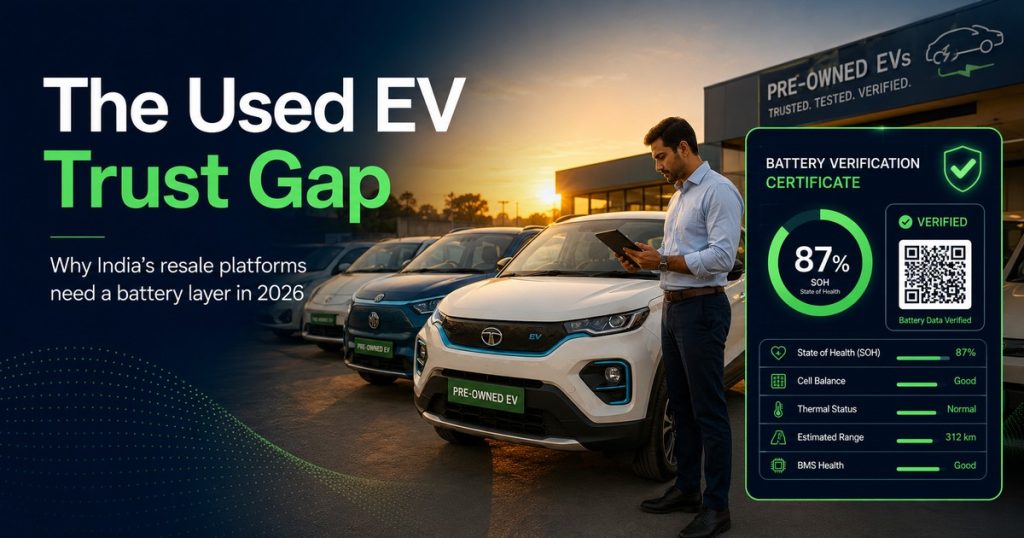
India’s used car market is racing toward 70 billion dollars. The used EV slice is growing at 30 percent CAGR. But every platform pricing those EVs today is doing it half blind. Here is the gap, the playbook, and what happens to the platforms that move first.
June 2026 · 18 min read
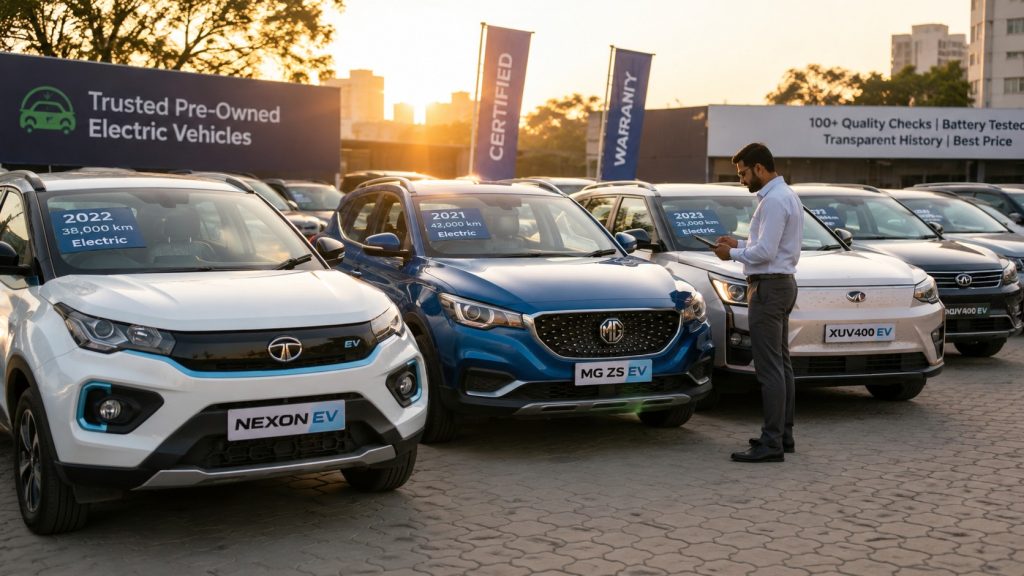
Picture a dealer in Pune standing in front of a 2022 electric SUV that has done 38,000 kilometres. He knows the listing should sit around nine lakh rupees. He prices it at eight lakh twenty thousand. When asked why, he shrugs. The buyer’s cousin works at the OEM’s service centre. Something was said. The number was cut.
That eighty thousand rupee gap is not about paint, tyres, suspension, or service history. It is not about the dealer’s margin discipline either. It is the entire used EV market in India compressed into one number. Buyers are uncertain about the battery. Sellers cannot prove otherwise. So every offer becomes a discount for ignorance, and every platform pricing used EV inventory in India is currently absorbing that discount whether they realise it or not.
This is not a niche problem. India’s used car market is on track to grow from roughly 35 billion dollars in FY26 to 70 billion dollars by FY31, climbing to the world’s third largest used car market by 2030, according to industry analysis. Inside that volume, the used EV slice has already grown fivefold in two years, from 0.08 percent of used car sales in 2022 to 0.43 percent in 2024 (industry joint report). Global research projects the used EV segment to expand at 25 to 30 percent CAGR through 2030 (per a market research firm, 2026).
The platforms that solve the verification problem before that wave lands will define the resale standard for the next decade. The ones that do not will spend the rest of the decade pricing inventory on guesswork while their margins quietly bleed out. This article is for the heads of category, inventory, pricing, and partnerships at every player in this space. It lays out the gap, the existing solutions that fall short, the economics of a verified approach, and the battery verified resale playbook by platform archetype.
The Used EV Wave About to Hit India’s Resale Industry
The first mainstream Indian EV cohort is now cycling. Popular electric SUVs and hatchbacks from 2020 to 2023, along with early fleet stock from several OEMs, are all hitting dealer lots and marketplaces. Resale platforms currently list hundreds of used electric cars across India. On most aggregator platforms, a small handful of mass-market models make up the majority of used EV inventory, a reflection of how concentrated the first wave actually is (used EV buying guide, April 2026).
The geography mirrors the early adopter map. Maharashtra leads the broader used car market with a 20 percent share, followed by Karnataka at 16 percent and Gujarat at 13 percent. Used EV listings are even more concentrated in these states plus Delhi NCR, where charging access and customer familiarity are highest. As ownership cycles compress from the historical 7 to 8 years to 4 to 5 years by FY31, the resupply rhythm accelerates further.
The numbers shaping the next 36 months
5.41 million used cars sold in India in 2024. EVs were 2 to 3 percent of that pool.
10.8 million projected annual used car volume by 2030 at 13 percent CAGR.
25 to 30 percent CAGR projected for the used EV segment specifically through 2030.
4 to 5 years expected ownership cycle by FY31, down from 7 to 8 years in FY21.
Stack these together and the picture sharpens. Every used car platform operating in India will carry 5 to 20 times more EV inventory inside 36 months than they do today. The platforms that have not built a verification capability by then will be pricing those vehicles by analogy to ICE methodology. That methodology was built for engines, transmissions, and odometers. None of those are what determines used EV value.
One resale platform’s founder and CEO said as much in a recent interview: the industry’s valuation models currently factor in age, kilometres, brand perception, and category trends, but the direction of travel has to be toward “standardised, data led pricing intelligence that any buyer, seller, or financier can rely on.” The same platform’s CMO told a business publication that residual values for used EVs entering the market from 2026 onwards will be “increasingly shaped by battery health, software support, and certification standards.” Both quotes name the gap. Neither company has publicly shipped the solution.
Why Every Existing Verification Method Falls Short
Walk through what an Indian used EV buyer is actually shown today on any platform, and the gap becomes obvious. There are five common signals in use, and each one has a known failure mode.
The dashboard range estimate. This is the number most sellers point to first. It is also the least reliable. Dashboard range is computed from recent driving conditions. A Nexon EV that just spent two hours in Bandra traffic with air conditioning at full blast will show a meaningfully different range estimate than the same vehicle after a steady highway run from Mumbai to Pune. The number tells you almost nothing about the underlying pack.
The seller’s verbal claim. Unauditable by definition. Even honest sellers tend to recall the best range they have ever seen on the vehicle, not the median. Dealers know this. NBFCs know this. Buyers learn it the hard way.
A single State of Health percentage from a basic OBD scan. Better than the previous two, but still incomplete. SoH measures remaining usable capacity against original capacity. It does not capture cell imbalance, voltage response under load, thermal stability, BMS fault history, or regen behaviour. A pack reading 85 percent SoH can be operationally riskier than one reading 78 percent if the higher reading is hiding imbalance or fault windows. Resale pricing needs to separate those cases. A single number cannot.
A battery at 85 percent State of Health can be riskier than one at 78 percent. SoH alone is not a pricing input. It is an opening question.
The 300 point inspection. One major resale platform ran more than 250 used EVs through this process last year. The 300 point inspection is excellent for ICE vehicles. It covers engine health, transmission, brakes, suspension, paint, electricals, and emissions. It is largely blind to the inside of a lithium ion pack. The pack is sealed, structural, integrated into the chassis on most modern EVs, and not designed to be opened by an inspection technician. A 300 point inspection on an EV is a 300 point inspection of everything except the most valuable component.
The brand backed certified pre owned programme. Certified pre-owned networks run by individual OEMs offer brand certification for vehicles they retail through their own channels. These programmes work well within their own ecosystem. They do not solve the cross brand problem that every multi brand marketplace and independent dealer faces. An OEM’s own certificate on one electric SUV does not help a resale platform’s inventory team in Bengaluru pricing a different electric SUV taken in on trade.
The OEM authorised service centre scan. Several OEMs can pull battery diagnostics through their own service infrastructure. The scan typically takes 15 to 20 minutes and costs 300 to 500 rupees (per a used EV buying guide). The output is reliable for that specific vehicle, but it is brand limited, dealer slow, and not designed to be shared with a buyer, an insurer, or an NBFC underwriter. The certificate stays inside the OEM workflow.
The result of all five methods operating side by side is a market where the data exists in fragments but nobody can assemble a single pricing grade that survives external scrutiny. One platform lists used electric inventory with a clean photo set and a certified badge. Another assigns its own trust score. Others rely on dealer level disclosures. Every platform is asking the buyer to trust the brand promise. None of them ship a battery evidence layer that an NBFC analyst, an insurance underwriter, or a buyer’s mechanic can independently verify.
That is the gap. And it is not a gap a 301st inspection point will close.
What Battery Verified Resale Actually Means
A resale grade that holds up under buyer negotiation, dealer scrutiny, NBFC underwriting, and insurance review has to be measured rather than estimated. It has to combine multiple battery signals into a single number that means something. And it has to be independently verifiable by anyone with a phone.
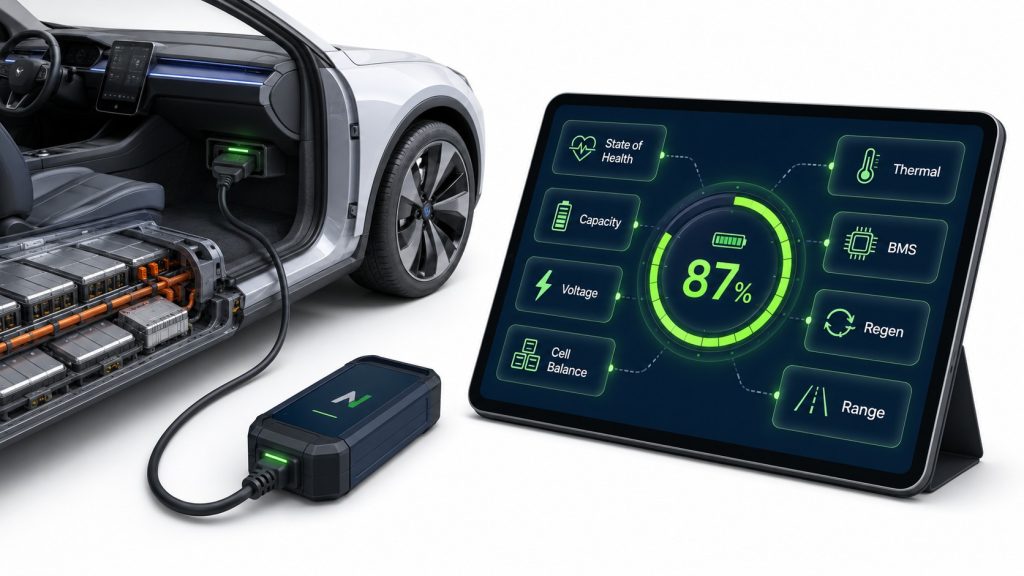
Navionyx built the EV Resale Value Intelligence layer around exactly this requirement. The diagnostic device reads the vehicle’s battery management system directly. A guided test cycle runs the pack through city, steady speed, load, regen, and idle phases over a 15 to 25 kilometre route. The output combines eight measured signals into one resale grade.
The eight signals are State of Health (remaining usable capacity against original), usable capacity under realistic discharge, voltage response under load, cell balance across the pack, thermal stability through the test cycle, BMS status including any historical fault windows, regen behaviour during deceleration, and estimated real world range at the current state of the pack. No single signal carries the grade. Each is weighted, and the combined score is what gets printed on the certificate.
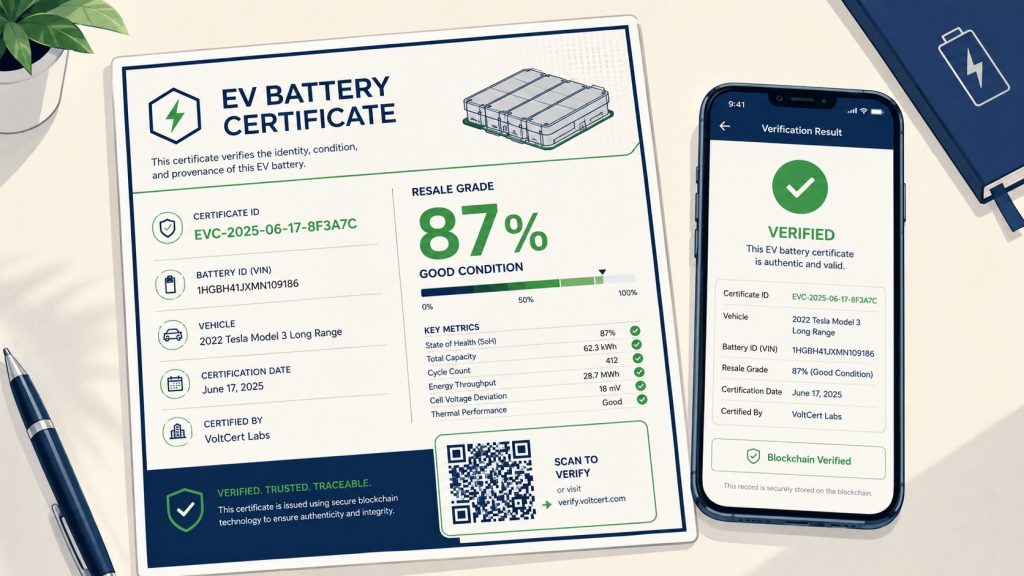
Every certificate carries a unique identifier, a QR code, a digital signature, and a live verification status. A buyer scans the QR from any phone, sees the certificate ID, the resale rating, and confirmation that the document is authentic and current. No app install. No login. No friction in the sale conversation. The certificate becomes a portable, tamper evident proof point that travels with the vehicle through every channel: dealer to platform, platform to buyer, buyer to NBFC, NBFC to insurance.
For the platforms and dealers operating this layer, the dashboard side handles the rest. Bulk testing workflows, inventory level views, listing badge exports to the public marketplace, API access for direct integration into existing systems, and white label options for platforms that want to keep their own brand on the certificate while running on Navionyx infrastructure underneath.
The point is not the product. The point is what the product makes possible. For the first time in the Indian used EV market, a pricing conversation can begin with measured evidence instead of with discount for uncertainty.
From Plug In to Verified Certificate in Under 45 Minutes
The certification process was built for a busy dealer lot, not a laboratory. Six steps. One technician. Roughly 30 minutes of active work per vehicle including a guided test drive.
Step 1. Connect the device
The Navionyx diagnostic device plugs into the vehicle and validates BMS communication. If the handshake fails on a model the system has not seen, the technician is alerted before the test begins. No wasted time later.
Step 2. Charge to 100 percent
A clean baseline is essential for usable capacity and real world range interpretation. The system reads the charge profile during the top up itself, which adds another signal to the eventual grade.
Step 3. Start the guided test
The app confirms vehicle details, BMS connection, and charge status before the run begins. The technician follows on screen prompts. No interpretation required.
Step 4. Run the test drive
A 15 to 25 kilometre route covering city traffic, steady speed cruising, load conditions, regen behaviour, and idle phases. Each phase is mapped to specific battery signals. The system flags if any phase needs to be repeated for a clean reading.
Step 5. Score the battery
All eight signals are combined into one resale grade calibrated for buyer and lender scrutiny. The grade is generated automatically, not negotiated by the technician.
Step 6. Issue the certificate
A unique certificate ID, QR code, digital signature, and shareable verification link are generated. The certificate is immediately live and verifiable from any phone.
A trained technician can run the full process on five to eight vehicles per day. A multi technician hub at a metro auction yard can clear 30 to 50 certifications per day. The throughput is engineered for inventory operations at platform scale, not for boutique single vehicle workflows.
The Playbook by Platform Archetype
Battery verified resale is not a single product. It is a verification layer that plugs into very different business models. Six archetypes cover the Indian resale industry as it stands today. Each one captures a different slice of the value the certification creates.
1. Full stack used car platforms
These are the platforms that take vehicles into inventory, inspect them, refurbish them, list them, finance them, and warranty them end to end. They control the entire transaction. The verification layer plugs in at the procurement stage. Every EV that enters inventory is certified on arrival. The grade feeds the listing badge, the public pricing, the in house finance arm’s underwriting, and the optional extended warranty offer. The platform’s existing 300 point inspection continues for everything else. The battery verification fills the gap where that inspection is structurally blind. White label options keep the certificate branded as the platform’s own, with Navionyx running as infrastructure underneath. API access pulls certificate data directly into the platform’s existing inventory dashboard. The conversion lift on certified EV inventory is meaningful enough to pay for the verification cost many times over within the first sale cycle.
2. Marketplace and aggregator platforms
These platforms list third party inventory from dealers and private sellers. They do not take ownership of vehicles. Their value proposition is reach and discovery, not refurbishment. For this archetype, certification works as an optional trust layer that the listing party pays for. The platform offers it as a premium upgrade. Certified listings carry a verified battery badge. They appear higher in search results or receive promoted placement. Buyers filter for certified inventory. The platform shares revenue on the certification fee with Navionyx and keeps the trust differentiation that pure aggregators cannot otherwise build. API integration ensures certificate data flows automatically into listing pages without manual data entry.
3. OEM aligned certified pre owned networks
Brand backed pre owned programmes operate within single OEM ecosystems. Their existing brand certification is strong inside the dealer network but does not travel well outside it. A battery verified layer adds an independently verifiable proof point that strengthens the brand certificate rather than competing with it. The certificate carries the OEM brand and the third party verification together. Buyers see brand backing for the vehicle and independent measurement for the pack. NBFCs accept the package without additional underwriting friction. Insurance partners price residual risk more accurately. Post sale disputes drop because the battery condition was documented at sale, not contested afterwards.
4. Independent dealer groups and luxury used EV retailers
Multi brand dealers from regional networks to the luxury end of the market sit between the OEM ecosystem and the marketplace platforms. The luxury segment in particular has seen roughly 25 percent growth in EV and hybrid inventory over the past 18 to 24 months, concentrated in the 70 lakh to 2.5 crore band per dealer reports. For dealers in this segment, certification is a procurement tool and a sale enablement tool at once. The plug and play diagnostic kit travels with the buying team to evaluate prospective inventory before purchase. The same kit certifies inventory at the showroom for retail listing. The certificate carries the dealer’s brand and adds an independently verifiable proof point that high value buyers expect by default at this price level.
5. Fleet remarketing and decommissioning operations
Ride hailing operators, last mile delivery fleets, corporate transport companies, and e commerce logistics arms are all building up cohorts of EVs that will need to be remarketed at end of service life. For this archetype, the certification works at cohort scale. Bulk audit workflows run hundreds of vehicles through standardised testing. The output is valuation grade reporting that finance and insurance teams can use directly for asset disposal accounting and resale pricing. Where the fleet was running on Navionyx telematics during its operating life, the resale certificate connects to the full battery history. The lifecycle data continuity is something no inspection at point of sale can replicate.
6. NBFCs, banks, and insurance partners
This archetype does not sell vehicles. It finances them and insures them. But the value of a battery verified certificate is arguably highest here. Forward looking NBFCs are already requesting SoH reports as part of used EV loan underwriting. A vehicle presenting with a verified resale grade is substantially less risky than one without. The risk premium on the loan drops. Loan to value ratios improve. Default loss on repossession scenarios is more predictable because the residual value is anchored in measured battery condition. On the insurance side, standard comprehensive motor policies in India do not currently cover battery degradation, ageing, or gradual SoH decline (per an insurance comparison platform). A verified certificate gives carriers a starting point for pricing battery specific products and for handling claims where battery condition is in dispute.
Across all six archetypes, the underlying logic is the same. The certificate is portable, independently verifiable, and machine readable. It travels with the vehicle through every transaction in its second life. Each archetype captures a different slice of the trust dividend that creates.
The Economic Case: What a Certificate Is Actually Worth
The case for verification is not philosophical. It is unit economic. Below are the measurable outcomes from early partner deployments, followed by a worked example that shows how the math lands on a single vehicle.
Measured outcomes from certified used EV inventory
38 percent faster sale cycles on certified listings versus uncertified.
22 percent higher realised resale value backed by a verified certificate.
92 percent buyer trust uplift reported by dealers after introducing certified listings.
65 percent reduction in post sale battery condition disputes.
Now apply that to a real listing. Take a 2022 electric SUV with the 40.5 kWh Max battery, 38,000 kilometres on the odometer, listed in Pune in mid 2026. Market reference pricing per a used EV guide’s April 2026 report puts comparable Max variants in the 11 to 15 lakh range. Without a verified certificate, a typical platform listing in this band ends up transacting at around 12 lakh after the usual battery uncertainty discount. The vehicle sits on the lot for an average of 28 to 35 days before sale.
With a verified certificate showing a resale grade of 87 and confirmation that the battery is performing within healthy parameters, the same vehicle commands closer to 13.5 to 14 lakh. Cycle time compresses to roughly 18 to 22 days. The platform captures an additional one and a half to two lakh in realised value per vehicle. The certification cost per vehicle is a small fraction of that uplift. The net contribution to platform margin on every certified used EV is material.
From the NBFC side, the same certificate changes the loan economics. A used EV loan written against a verified pack carries an effective risk premium that is 100 to 200 basis points lower than the same loan written blind. On a five lakh loan over four years, that translates to a borrower side cost difference of several thousand rupees and a lender side risk adjusted return improvement that compounds across the portfolio. NBFCs that build the certificate requirement into their used EV underwriting process will originate cleaner books than those that do not.
These figures reflect early partner deployments. Outcomes vary by inventory mix, listing platform, buyer segment, and test volume. The directional story is consistent across every channel where the verification has been run at scale.
The Counterfactual: What Happens If the Industry Does Nothing
It is worth spending a moment on the alternative. What does the Indian used EV market look like in 2028 if no major platform builds a battery verification layer?
First, the 15 point retention gap between ICE and EV resale values calcifies into a permanent EV discount. Buyers continue to price uncertainty into every offer. The discount becomes a baseline assumption rather than a temporary friction. Sellers internalise it. Dealers internalise it. The whole asset class trades at a structural mark down that nobody can fully explain because the underlying cause was never directly addressed.
Second, NBFCs derate the entire used EV book. Without a reliable way to underwrite battery condition, lenders apply a blanket risk premium across every used EV loan. Interest rates stay elevated. Loan to value ratios stay conservative. Used EV finance penetration plateaus well below what the volume should support. The compounding effect on the resale market is that fewer buyers can finance the purchase, which pushes more inventory toward cash buyers, which keeps prices suppressed.
Third, insurance carriers continue treating battery degradation as an uninsurable grey zone. An insurance comparison platform already notes that standard comprehensive motor policies do not cover inherent battery degradation, natural ageing, or gradual SoH decline. Without verified condition data at point of sale, carriers cannot price battery specific products. The protection gap stays open. Total cost of ownership for used EVs stays higher than it needs to be.
Fourth, the trust vacuum gets filled by bad faith brokers. Where verification is absent, opportunists thrive. Every reported case of a misrepresented used EV battery condition that surfaces in the press pulls down sentiment for the entire segment. The platforms that did the most to standardise inspection on the ICE side will find themselves associated with the EV trust problem regardless of whose vehicle was actually misrepresented.
None of these outcomes are inevitable. All of them are the default path if no platform moves first.
How This Plugs Into the Rest of the Stack
For platforms and fleets that already run telematics, dashcams, or predictive maintenance infrastructure, the verification layer is the natural exit point of a lifecycle data trail that begins at first deployment. The Navionyx platform was built to support this end to end view rather than as a point solution.
Predictive Maintenance for EV Fleets captures degradation trends, alert histories, and operating context throughout the vehicle’s primary life. When that vehicle eventually reaches second life, the resale certificate inherits the full battery history rather than starting from a single point in time scan. For fleet remarketing in particular, this lifecycle continuity is decisive. A vehicle that comes out of a Navionyx telematics deployment carries five years of measured battery behaviour into its resale evaluation.
EV Fleet Management provides the operational dashboard where decommissioning decisions are made. The same platform that ran the fleet decides when to retire a vehicle, exports the lifecycle data, runs the resale certification, and lists the asset for sale. No data handoffs. No interpretation gaps between vendors.
EV Battery Certification as a standalone process handles vehicles that did not come through a Navionyx telematics deployment. The same eight signal grade is generated through the device based test cycle. Whether the data trail begins at first deployment or at resale, the output certificate is identical and equally verifiable.
The AI Dashcam and broader platform layer add driver behaviour visibility for fleets where buyer concerns extend beyond the pack to how the vehicle was driven. White label dashboards and API integrations across the platform mean that partner businesses can present the entire trust stack under their own brand if needed.
The point of this integration is not bundling for its own sake. The point is that resale value on an EV is a function of how that vehicle was operated, maintained, and certified across its lifecycle. The platforms that present that full story to buyers will outperform the ones that show up at point of sale with a single data point.
Where the Market Is Headed and What to Do This Quarter
Regulatory direction is becoming clearer. India still has no mandatory battery State of Health disclosure standard at ownership transfer. The Ministry of Road Transport and Highways has not yet notified used EV certification rules under the Central Motor Vehicle Rules. State level discussions have begun in Maharashtra and Gujarat. Industry observers expect movement on national standards in the 2027 to 2028 window (per market analysis, 2026).
First movers on dealer side certification will shape the de facto standard before the de jure one arrives. This is how every adjacent market has evolved. The platforms that built mandatory inspection processes for ICE vehicles in the early 2010s defined what “certified used” meant in India long before any regulator codified it. The same opportunity exists now for battery verification on used EVs. The window is roughly 12 to 18 months.
Concrete next steps for any platform reading this:
Pilot 50 to 100 vehicles. Pick a single metro hub. Certify every used EV that enters inventory over a 60 day window using the Navionyx EV Resale Value Intelligence workflow. Measure cycle time, realised price, buyer trust feedback, and post sale dispute volume against an uncertified control group from the previous quarter.
Publish the case study. Whatever the numbers show, share them. The platforms that lead the verification conversation in trade press, industry conferences, and partner channels will define the standard regardless of who builds the underlying infrastructure.
Integrate into the existing inventory and listing workflow. Treat certification as a procurement step rather than an afterthought. API access into the inventory dashboard means certificate data flows automatically into pricing models, listing pages, and finance partner systems.
Train the dealer network or hub staff. A trained technician handles the full certification process in roughly 30 minutes. The training itself takes half a day. Throughput scales linearly from there.
The Standard Buyers Will Eventually Demand
There is a version of 2028 in which every used EV listed on every major Indian platform carries a verified battery certificate by default. Buyers expect it the same way they expect a vehicle history report on a used Toyota Camry in the United States or an HPI check on a used vehicle in the United Kingdom. The certificate is no longer a premium feature. It is the price of entry.
The platforms that lead the transition to that standard will define what counts as a trustworthy used EV listing in India. The ones that follow will spend the next decade catching up. The economics, the regulatory direction, the buyer survey data, and the lender behaviour all point in the same direction. The only open question is who moves first.
The 15 point retention gap between ICE and EV resale values exists because nobody has measured what is inside the pack. The platforms that close that gap first will not just earn the trust dividend. They will earn the right to set the standard that everyone else in the market eventually accepts.
Start pricing used EVs on data, not doubt
Join the dealers, marketplaces, NBFCs, and remarketing teams building the new standard of trust in India’s used EV market. Explore EV Resale Value Intelligence or talk to the Navionyx team about a pilot deployment, the dealer dashboard, white label options, or API integration into your existing inventory stack.
Request a Demo →Sources and References
- An industry research firm, India Used Car Market Outlook FY26 to FY31 (2026)
- A joint used car market report (2025)
- A market research firm, Resale Value of Used EV Cars in India 2025 to 2030 (May 2026)
- A used EV buying guide, Used EV Buying Guide India 2026 (April 2026)
- An industry publication, Battery Blind Spots Cloud India’s Used EV Market (June 2026), platform CEO interview
- A business publication, The Second Hand Test (October 2025), platform CMO interview
- An EV market analysis firm, Used EV Market Challenges India 2026 Analysis
- A used EV buying guide, Used EV Buying Guide India
- An insurance comparison platform, Motor Insurance Coverage Notes on EV Battery Degradation
- Ministry of Road Transport and Highways, Central Motor Vehicle Rules (Current Status)
- A market research firm, India Used Car Market Analysis (May 2026)
This article was researched and written with AI assistance and reviewed by the Navionyx team. Statistics referenced are drawn from publicly available 2025 to 2026 industry sources cited above. Outcome figures from certified deployments reflect early partner results and individual results vary by inventory mix, listing platform, buyer segment, and test volume.