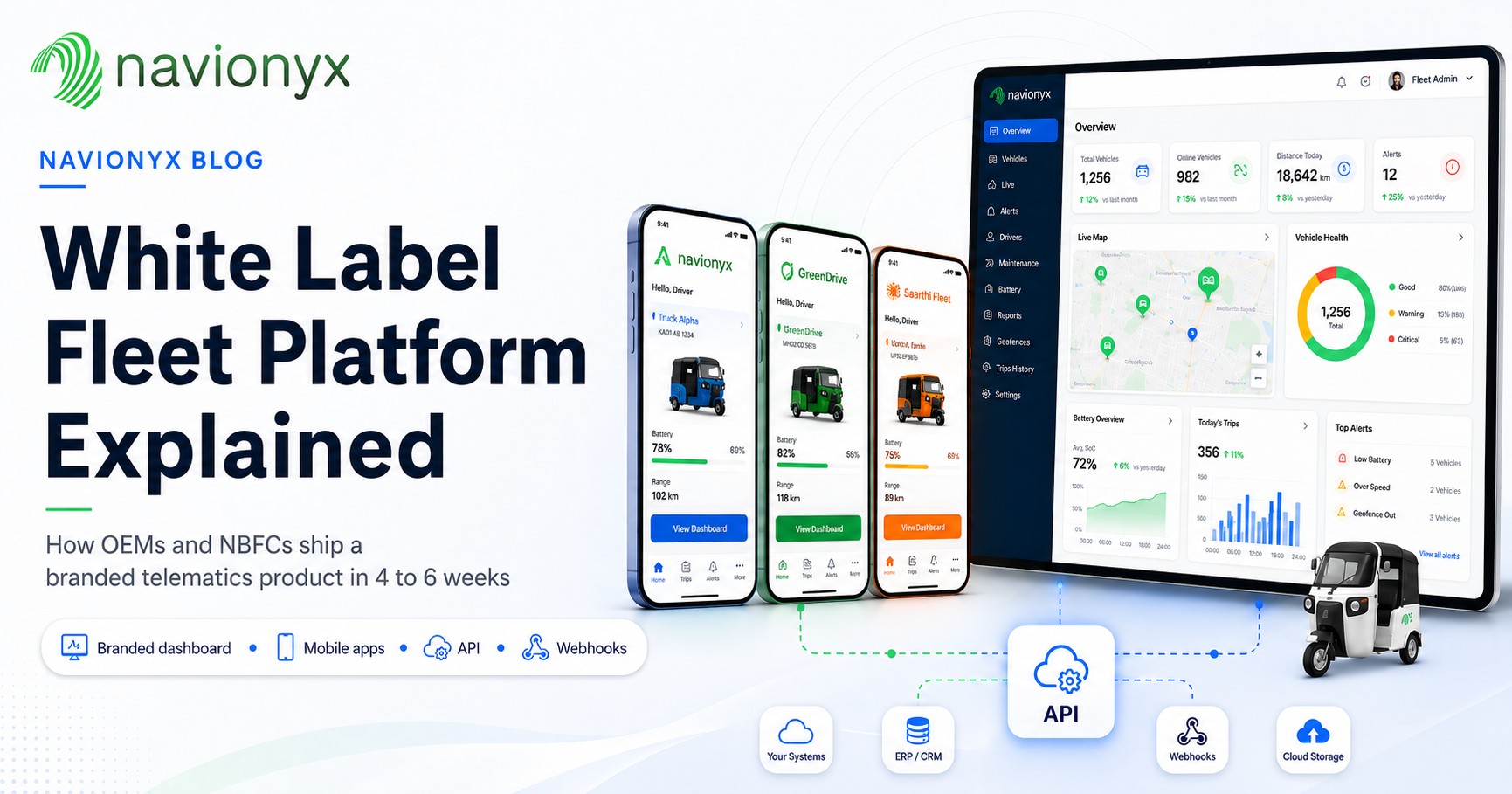
Fleet Management · White Label Platform
A practical guide for EV manufacturers, NBFC product leaders, and fleet aggregators on what a true white label telematics stack looks like, how the integration layer actually works, and why a four to six week launch window is realistic today.
By Navionyx Team · June 2026 · 18 min read
An EV manufacturer has just delivered five hundred electric three wheelers to a city operator. An NBFC has disbursed loans on two thousand commercial electric vehicles across four states. A logistics aggregator has onboarded ten partner fleets and now needs a single intelligence layer across all of them. Every one of these businesses faces the same operational reality. They cannot send their customers to a vendor branded dashboard. They cannot wait twelve to eighteen months for an in house telematics team to deliver. And they cannot accept telemetry data that lives in a separate silo from the loan account, the ERP, or the dealer service workflow.
This is the gap a white label fleet platform is designed to close. In this guide we will unpack what white label telematics actually means in the Indian context, why off the shelf fleet tools break down at the enterprise scale, how the integration layer plugs into an LMS or ERP without forcing teams to learn a new dashboard, and what a realistic four to six week launch timeline looks like end to end. The goal is to give EV OEM product heads, NBFC business leaders, and fleet aggregator founders a working mental model of how this category fits their operating model.
What a White Label Fleet Platform Actually Means
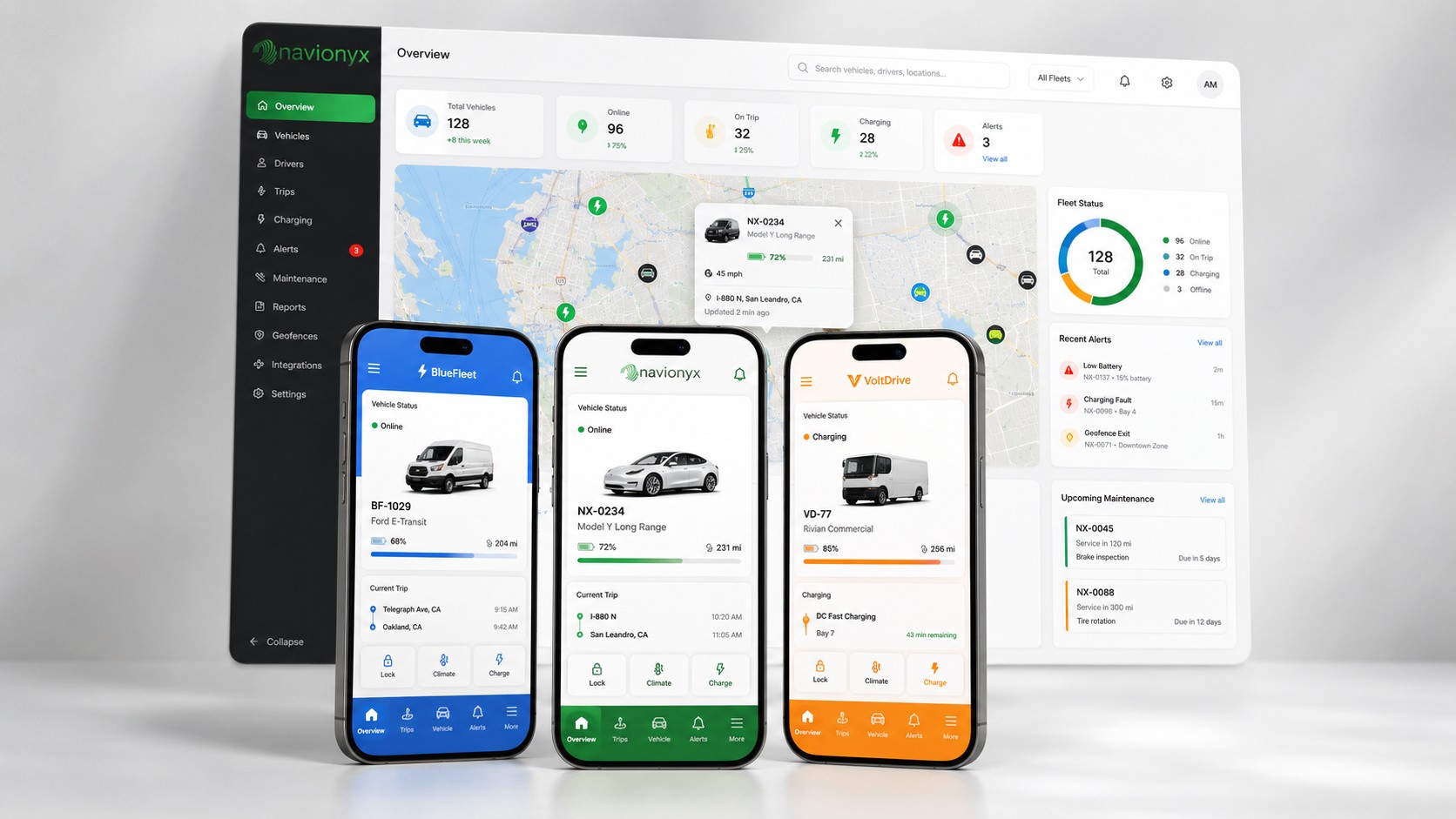
The phrase white label is used loosely in the telematics industry. A reseller panel where you can change the logo in the top left corner is not the same product as a fully branded fleet platform that ships on the Google Play Store and the Apple App Store under your own developer account. The distinction matters because what an enterprise buyer needs is not a cosmetic skin. It needs a launchable product line.
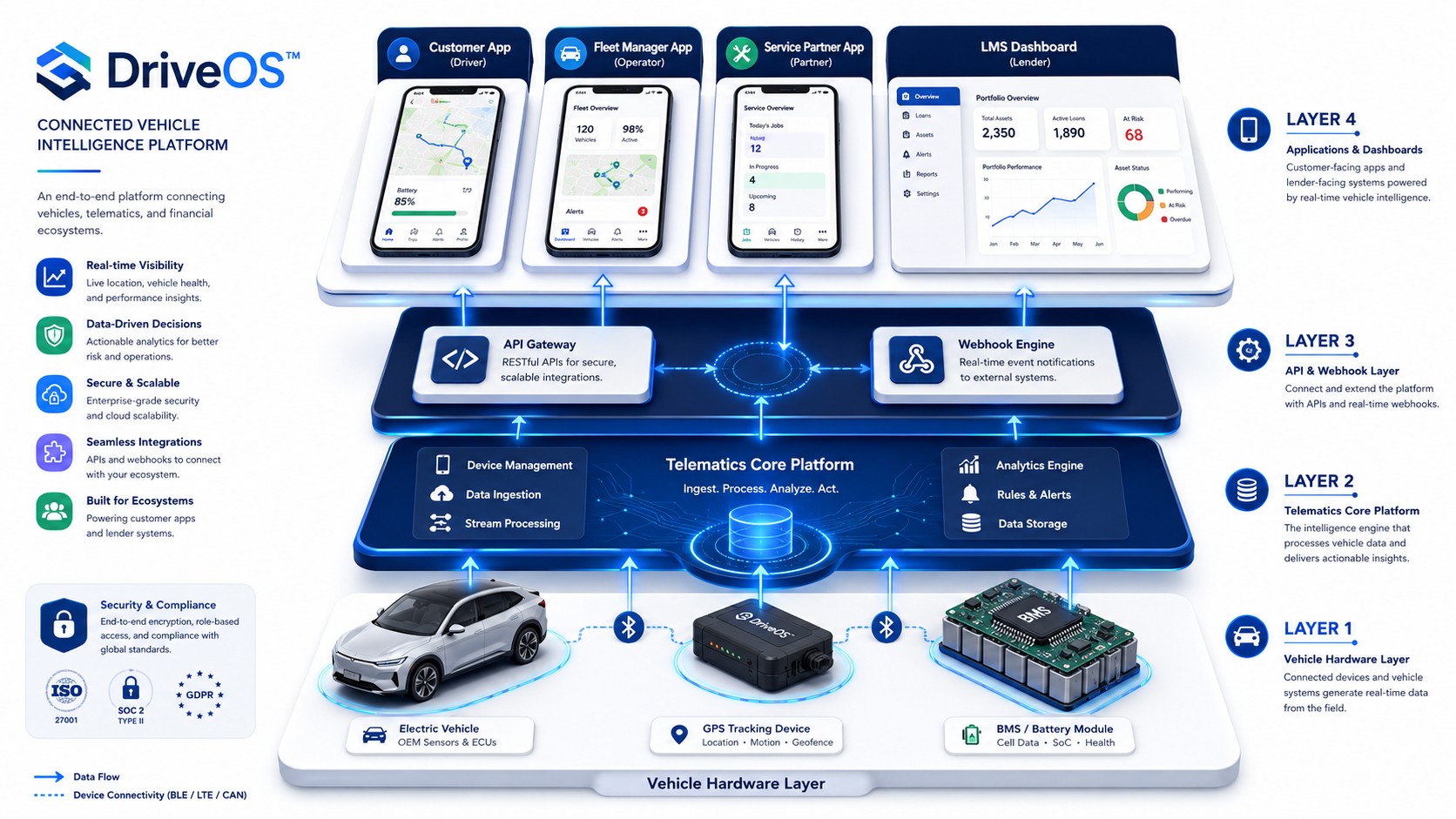
A true white label fleet platform delivers four layers in parallel. The first layer is a branded web dashboard hosted on your own subdomain with your colour palette, typography, and product naming. The second layer is a pair of native mobile applications, one for Android and one for iOS, published under your brand on the public app stores with your developer credentials. The third layer is a full API surface that lets your engineering team pull vehicle data, write back control commands, and stream events into the systems you already operate. The fourth layer is the integration scaffolding that maps vehicle identifiers to loan accounts, customer IDs, or partner accounts inside the LMS, ERP, or CRM where your operations team already lives all day.
A reseller panel changes what the customer sees. A white label fleet platform changes who the customer believes they are buying from. That distinction is the entire point.
When all four layers are delivered together, the customer experience becomes seamless. The end user downloads your app, logs in with your branded credentials, sees your colour scheme, receives push notifications from your domain, and never encounters the underlying telematics vendor at any point in the journey. From a regulatory standpoint, the platform still rides on a compliant AIS-140 reporting backbone. From a commercial standpoint, the entire customer relationship belongs to you.
Why Off the Shelf Telematics Breaks for Enterprise Buyers
Most telematics products in the Indian market were originally built for a single buyer profile: the fleet owner. A logistics company with one hundred trucks, a transport operator with fifty buses, or a taxi aggregator running its own vehicles. The product was designed around that user. Login to a vendor branded dashboard. View your fleet on a map. Pull a trip report. Set up a geofence. That model works for the operator who owns the vehicles and the operations.
The model breaks the moment the buyer is not the operator. An EV OEM that sells vehicles to dealers and end customers does not own the fleet. It needs visibility into vehicles in the wild for warranty, service, and customer engagement, but it cannot send its customers to a vendor branded screen. An NBFC that finances commercial EVs does not operate the vehicles either. It needs telemetry to flow into the loan account so collections and underwriting teams can see battery health, daily kilometres, and geofence breach events alongside the EMI schedule. A fleet aggregator with multiple partner fleets needs role based access, sub admin views, and the ability to expose downstream API access to its own partners.
None of these workflows are served well by a single tenant fleet owner product. Three structural problems show up immediately.
The data fragmentation problem
Vehicle data sits in the telematics vendor. The loan account sits in the LMS. The dispatch plan sits in the TMS. The dealer service ticket sits in the CRM. Every reconciliation between these systems becomes a manual export, a spreadsheet, and a fragile process.
The brand dilution problem
Your customer paid for an electric three wheeler from your brand. The first time they open the connected vehicle app, they see a vendor name they have never heard of. The brand equity you spent years building is undermined in a single login screen.
The integration tax
Even when a vendor offers an API, it is typically thin. Location and trip endpoints, no battery depth, no webhook engine, no clean way to bind a vehicle to a loan account or a customer record. Your engineering team ends up building glue code for every workflow that should have been wired in.
A white label fleet platform with deep API access fixes the data flow problem and the branding problem at the same time. That is the category we are talking about.
The Three Buyer Personas and What Each One Actually Needs
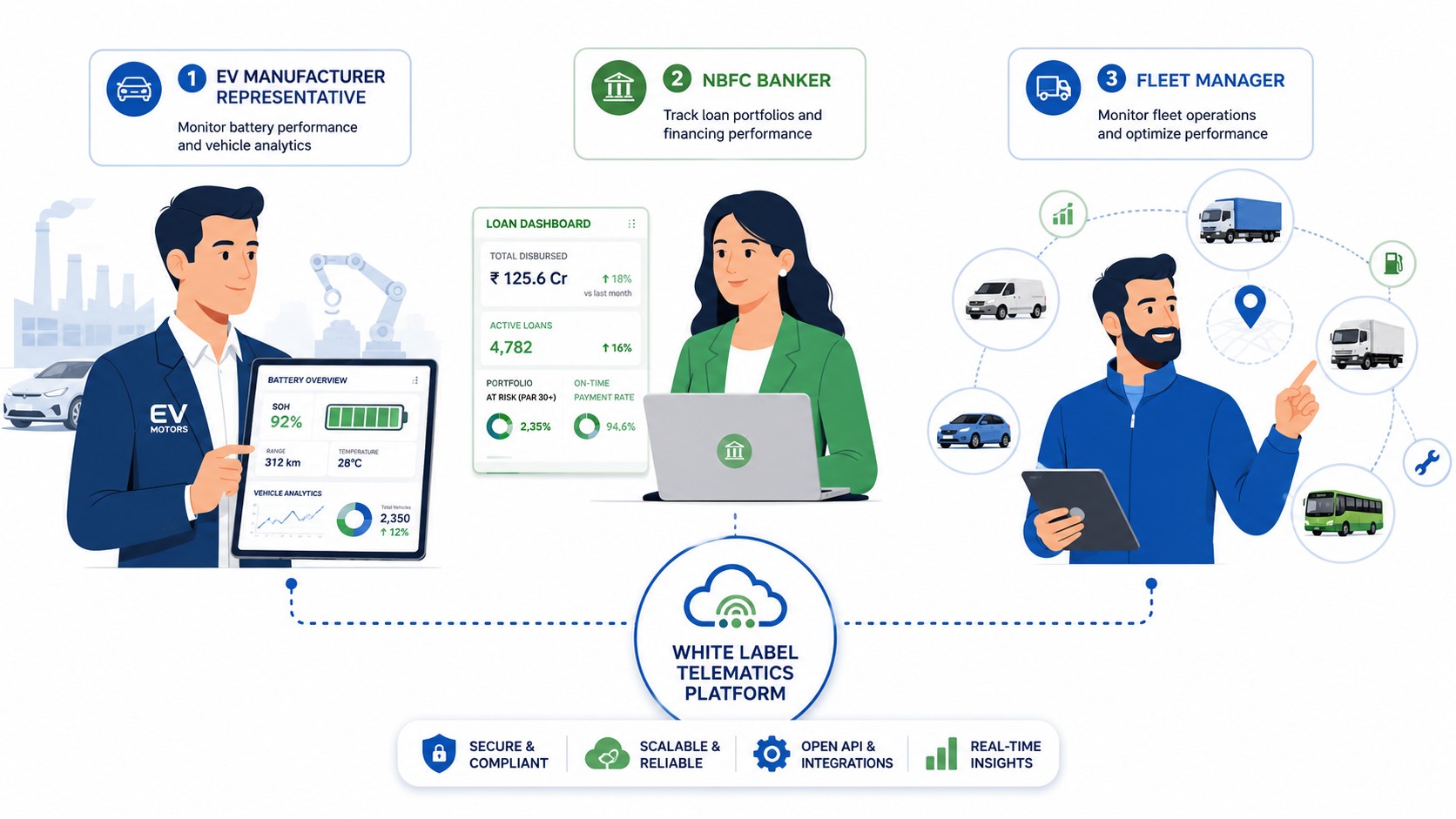
A white label fleet platform is not a one size fits all product. The reason it works across very different buyer types is that the underlying telematics core is shared while the integration surface and the customer experience are tailored. Understanding the three primary personas makes the rest of this guide easier to follow.
EV OEMs that need a connected vehicle experience under their own brand
For an EV original equipment manufacturer, the question is not whether to offer a connected vehicle app. It is whether to build one in house or partner. Building from scratch typically means a twelve to eighteen month engineering investment, dedicated hardware integration work, an AIS-140 certification process, and an ongoing operations team to keep the backend running. Most OEM product groups would rather spend that capacity on the vehicle itself.
What the OEM actually needs is a branded customer app that exposes battery health, charging sessions, service alerts, and battery passport data, plus a dealer portal that shows fleet level visibility for warranty and service workflows. The platform should also expose vehicle state data to the OEM cloud so post sale engagement, predictive maintenance, and warranty analytics can run on the OEM data lake.
NBFCs financing electric vehicles
For an NBFC, the financing equation for electric vehicles is structurally different from a diesel three wheeler or a petrol two wheeler. The battery is the highest cost component, its health degrades over time, and residual value depends heavily on how the vehicle was used. Without telemetry, the lender is underwriting blind. With telemetry, the loan management system can pull live battery health scores, daily kilometres, charging behaviour, and geofence breach events into the same loan account where the EMI schedule and collections workflow already live.
The NBFC does not want a separate fleet dashboard. It wants the vehicle intelligence to appear inside the loan account screen its collections agents already use every day. That is an integration problem, not a dashboard problem, which is why the API and webhook layer matters far more than the UI for this persona.
Large fleet platforms and system integrators
Fleet aggregators, transport platforms, and system integrators sit one level above individual fleet operators. They are typically managing multiple downstream fleets, each of which may have its own administrator and its own set of vehicles. The platform requirement here is multi tenancy with proper role based access, sub admin views, white labelled customer apps for downstream brands, and full API access for the aggregator to build its own product layer on top.
For this persona, the platform is closer to infrastructure than to a tool. The aggregator is building a product business of its own, and the white label platform is the building block underneath.
Anatomy of the Navionyx White Label Stack
When we say white label fleet platform, we mean a specific set of layers that ship together. Each layer is designed to be brandable, configurable, and consumable through an API where relevant. Here is what each piece does in production.
Branded web dashboard
The web dashboard runs on a subdomain you control, with your brand applied across the navigation, theme, and product naming. It carries live vehicle tracking, trip history, geofencing, alert configuration, EV battery analytics, certificate downloads, and reporting. For most enterprise customers, the dashboard is the primary surface for internal operations teams, while the mobile apps are the surface for end customers and field staff.
Branded mobile apps on Android and iOS
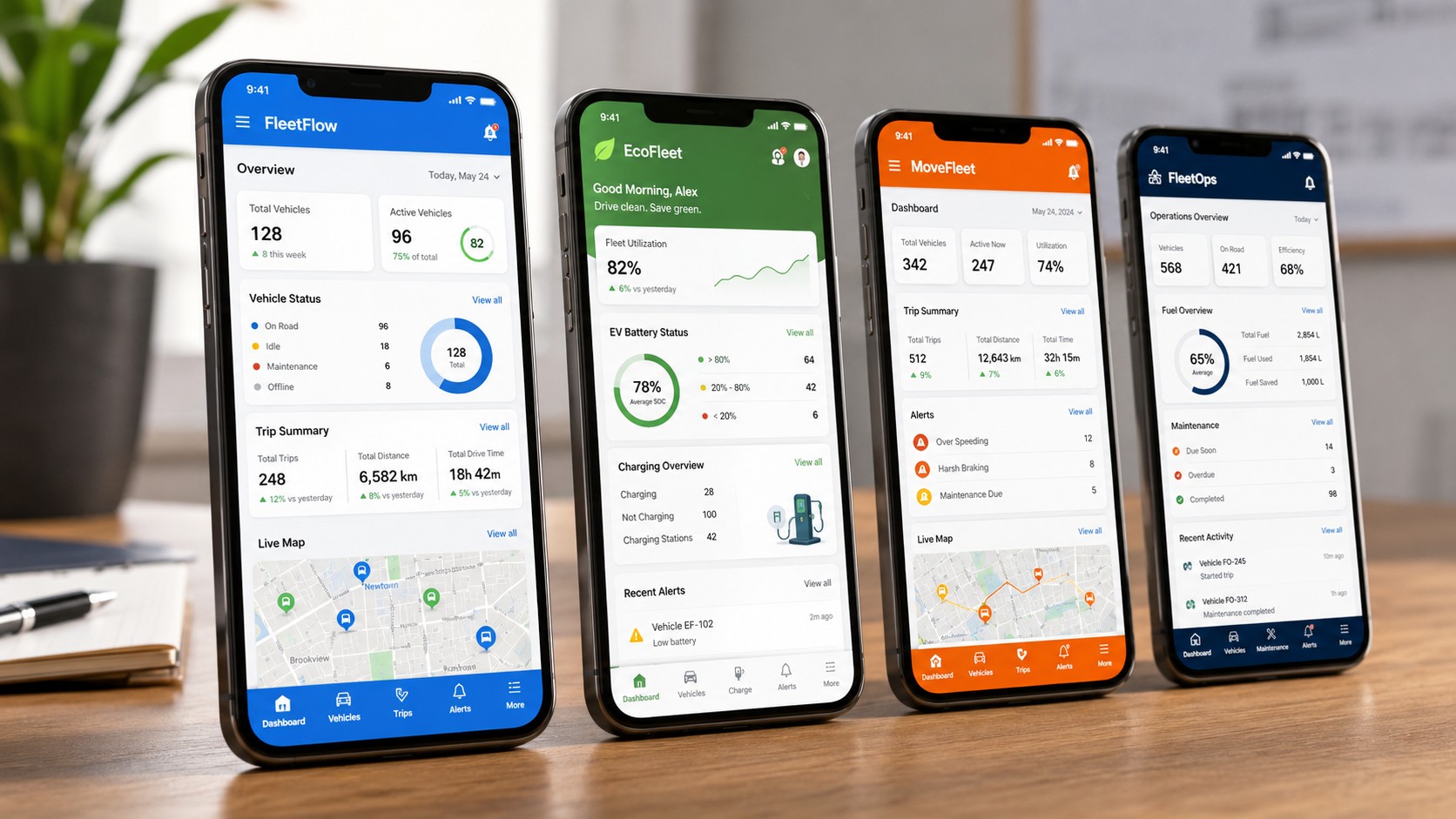
The mobile applications are published under your developer account on the Google Play Store and the Apple App Store. They are not reskinned web views. They are native applications with separate fleet manager and driver experiences, configurable push notification journeys, deep linking, biometric login, and the full feature surface required for app store approval. The core engineering remains shared across all white label deployments, which is what allows the four to six week launch timeline to be realistic.
Telematics API for vehicles, trips, and alerts
The fleet management API is the layer that makes a white label platform actually integrate with the rest of the business. Documented endpoints cover vehicles, trips, locations, geofences, alerts, certificates, and reports, with token based authentication and standard pagination. Engineering teams on the customer side can query and write back without learning a proprietary SDK.
EV battery and BMS API
This is the layer that separates a serious EV telematics product from a GPS tracker with a battery percentage field. A generic CAN bus integration returns a state of charge value. A direct BMS protocol integration returns per cell voltages, per cell temperatures, state of health, charging cycle counts, and battery passport data. These signals are what allow underwriters to build credit models, OEMs to manage warranty risk, and battery as a service operators to track cell level performance across a deployed fleet.
Why cell level data matters: A battery pack that reports eighty percent state of charge at the pack level can hide a single weak cell that is degrading three times faster than the rest. Without cell level telemetry, that cell is invisible until it fails. With cell level telemetry, it shows up in a degradation report weeks earlier.
Webhook engine for real time alerts
Polling an API every five minutes for ignition events is the wrong pattern. The right pattern is a webhook callback that fires the instant a vehicle ignition is detected, a geofence is breached, a panic button is pressed, a charging session starts, a harsh driving event is recorded, or an AIS-140 event is generated. Partner systems subscribe to the events they care about and receive signed payloads at their callback URL. This is what allows downstream systems like the LMS or the ERP to react in real time rather than running batch reconciliations overnight.
LMS and ERP integration layer
The final layer is the reference integration scaffolding for the systems your business already runs. Vehicle bind endpoints map a vehicle ID to a loan account or a customer record. Scheduled syncs push trip summaries and daily aggregates into the ERP. Webhook events stream into the event bus the operations team already monitors. Reference implementations for common LMS and ERP platforms shorten the integration timeline significantly.
How NBFC LMS Integration Actually Works in Production
NBFC integrations are worth explaining step by step because this is the workflow that most product teams underestimate. The loan management system is the source of truth for the borrower, the vehicle identification number, the EMI schedule, and the collections process. The telematics platform is the source of truth for live vehicle behaviour. The integration job is to bring vehicle intelligence into the loan record so credit teams, collections teams, and underwriting teams see one combined view.
Here is how the flow runs end to end.
Step 1: Loan disbursement triggers vehicle binding
When the loan is disbursed and the vehicle is delivered to the borrower, the LMS calls the Vehicle Bind API with the vehicle ID, the loan account ID, and the borrower reference. The telematics platform stores this mapping and now knows which loan account every vehicle event belongs to.
Step 2: Daily aggregate posting
Every day, the platform computes vehicle level aggregates and posts them to the NBFC callback URL. These include daily kilometres, charging cycles, battery health score, average state of charge, and any geofence or theft events recorded during the day. The NBFC stores these aggregates against the loan account.
Step 3: Real time event streaming
High priority events do not wait for the daily batch. Theft alerts, geofence breach events, prolonged idle states, and panic button presses stream to the NBFC webhook endpoint within seconds. Signed payloads allow the receiving system to verify authenticity before triggering any downstream action.
Step 4: Visibility inside the loan account
Collections agents, underwriters, and product managers see the vehicle intelligence inside the existing loan account screen they already use. No new dashboard, no second login, no separate workflow. The telematics layer becomes invisible because it is exactly where the team already works.
The downstream business impact of this flow is meaningful. Underwriting teams can use battery health and daily usage patterns as inputs to credit decisions on subsequent loans. Collections teams can prioritise outreach based on usage signals that correlate with repayment risk. Residual value teams can build accurate end of tenure valuations because they have actual cell level health data rather than an assumption based on age alone.
How OEM Customer Apps and ERP Integrations Work
The integration patterns for EV OEMs and for ERP based fleet platforms are different in shape but share the same philosophy: deliver data where the user already is, not where the vendor wants them to be.
OEM customer apps
An OEM customer app is downloaded by the end vehicle owner. They log in with credentials issued by the OEM, see the OEM brand throughout, and access only the vehicles assigned to their account. Behind the scenes, the app calls the OEM partner API with a scoped token that limits the response to vehicles and data fields the customer is authorised to see. Charging history, battery health, service alerts, and certificate downloads are all rendered inside the OEM brand. The customer never sees a vendor name, never installs a second app, and never wonders why their three wheeler brand sent them to an unknown company for telemetry.
For the OEM, this enables a real post sale relationship. Push notifications can come from the OEM brand. Service campaigns can be triggered by service alerts. Warranty claims can be tied to actual cell level battery data. Dealer engagement can be driven by visibility into how many vehicles are active in each dealer catchment area.
ERP and TMS integration for fleet platforms
For logistics aggregators and fleet platforms, the integration target is the ERP, the transport management system, or both. The pattern here has two flows running in parallel. The first flow is a scheduled batch sync that delivers trip summaries, daily kilometres, fuel events, and operational reports into the ERP at predictable intervals. The second flow is real time event streaming through webhooks for events that need immediate operational response, such as trip start, trip end, harsh driving alerts, fuel drop events, and geofence transitions.
The benefit of this split is that batch reporting and real time alerting do not compete for the same channel. Reporting can be reconciled inside the ERP data warehouse on the customer side, while the live event bus handles the urgent operational signals. Operations teams adopt the system faster because the data lands inside the workflow they already trust.
Production Proof: Branded Apps Already Live on the Public Stores
Most telematics vendors promise white labelling in their sales decks. The honest question is whether they have actually shipped white label apps to the public stores under multiple partner brands, with active deployments, today. For Navionyx the answer is yes, and the production evidence sits on the Google Play Store right now.
The flagship reference implementation is the Navionyx app itself, published under our own brand on both Google Play and the Apple App Store. Every white label deployment is forked from the same engineering core. Safetrack is a white label deployment for a partner fleet operation, live on Google Play. Dakshved EV, operating as S Track, is a branded production app for a regional fleet operator using the same telematics core. AJ Solutions is a public store deployment for a partner system integrator rolling out fleet intelligence under its own brand to its own customer base.
Four distinct brands, four separate developer accounts on the Google Play Store, one shared telematics core underneath. That is the difference between a vendor that can theoretically white label and one that ships white label products to public stores every quarter.
Each of these apps uses the same Navionyx telematics core, the same EV battery analytics engine, and the same alert pipeline. What changes between deployments is the brand, the colour theme, the application name, the store listing copy, and the partner specific configuration. The shared core is what makes the four to six week launch timeline realistic. Each new white label deployment is not a fresh engineering project. It is a configuration on top of a stack that has been hardened across multiple live brands.
The 4 to 6 Week Go Live Timeline, Phase by Phase
A four to six week launch sounds aggressive when compared against in house build timelines, but it is achievable because the heavy engineering work has already been completed once and is being configured rather than rebuilt for each deployment. Here is what each week actually looks like.
Week 1: Discovery and brand kit
The first week is mostly working sessions between the customer brand team and the Navionyx product team. The deliverables are the brand kit, the logo files in the required sizes for the app stores, the colour palette, the application name, the store listing copy in English and any required regional languages, the icon set, the push notification copy guidelines, and the scope of the integration. By the end of the week, every input required for configuration is locked.
Week 2: White label configuration
Configuration covers the subdomain setup, the web dashboard theming, the Android and iOS application branding, the push notification certificates, the deep link domains, and the email templates that the platform will send out under the customer brand. Most of this is parametric configuration on top of the core, not custom development. The web dashboard and the mobile applications start carrying the customer brand by the end of this week.
Weeks 2 to 3: API and webhook setup
API and webhook setup runs in parallel with the visual configuration. The customer engineering team receives sandbox credentials, API keys, and the full fleet management API documentation. Webhook endpoints are registered on the customer side, signature verification is tested, and the first reference integration with the LMS or ERP is scoped and started. The goal is to have at least one full end to end event flowing from a test vehicle to the customer system before the end of the third week.
Weeks 3 to 4: Store submission and UAT
The store submission phase has hard external dependencies. Google Play review typically takes two to seven days. Apple App Store review typically takes one to three days for subsequent updates but can be longer for first submissions under a new developer account. To absorb these timelines, store builds are submitted as soon as the configuration is signed off, while user acceptance testing happens on the staged dashboard and the test builds in parallel. UAT covers all the primary workflows the operations team will run on day one.
Weeks 4 to 6: Production go live
Production go live is the final step. Production API keys are issued, the mobile applications are released to public download on both stores, the production webhook endpoints are switched on, and the support handover is completed. The customer team now has access to a runbook, a support channel, and the API documentation needed to operate the platform independently.
What Sets a Production Grade White Label Platform Apart
The market has plenty of GPS vendors offering some flavour of white label. The differences between a generic offering and a production grade enterprise white label platform fall into five clear areas.
AIS-140 certification owned, not resold
A platform that owns its own AIS-140 compliance can control the device protocol, the reporting cadence, and the audit trail. A platform that resells certification from a third party introduces a dependency that the customer cannot fix when something goes wrong.
EV battery telemetry beyond state of charge
Cell level voltage and temperature, state of health, charging cycle counts, and battery passport data are what NBFCs and OEMs actually need. A platform that returns only state of charge from the CAN bus is not equipped to serve the EV financing or warranty use case.
Live white label apps on public stores
Mockups shown during demos are not evidence of capability. Apps live on Google Play and the Apple App Store today under multiple partner brands are.
API depth, not just endpoints
A complete fleet management API covers vehicles, trips, locations, geofences, alerts, battery, certificates, and webhooks with signed payloads. Anything narrower than this leaves engineering teams writing custom glue code.
LMS and ERP integration experience in the field
A vendor that has actually deployed with NBFCs and large fleet platforms brings reference integrations, pre built event mappings, and a body of operational learnings that a first time integrator simply does not have.
Closing Thoughts: A Launch Ready Product Line, Not a Reseller Panel
The reason white label fleet platforms have become a serious category in India is that the buyers have changed. The market is no longer dominated by single tenant fleet operators looking for a dashboard. It is increasingly led by EV OEMs that need a connected vehicle experience, NBFCs that need telemetry inside the loan account, and aggregators that need to operate as platforms in their own right. None of these buyers are well served by a vendor branded product.
A true white label fleet platform is closer to a launch ready B2B product line than a reseller theme. It carries its own AIS-140 backbone, its own EV battery and BMS depth, its own documented API and webhook engine, its own LMS and ERP integration scaffolding, and its own production evidence on the public app stores. The four to six week launch timeline is achievable because the engineering investment was made once, at the core, and every subsequent deployment is configuration on top of a hardened stack.
If you are an OEM evaluating whether to build or partner, an NBFC scoping how to bring telemetry into your LMS, or a fleet aggregator planning your platform layer, the question is no longer whether white label is the right answer. The question is which partner can actually ship it in production. That is the test worth asking of every vendor in the conversation.
Ready to launch your branded fleet product in 4 to 6 weeks?
Talk to the Navionyx team about a white label deployment scoped to your business, or review the full fleet management API documentation to evaluate the integration depth for your engineering team.
Request a Demo View API DocumentationBy the Navionyx Team. AIS-140 certified. DPIIT recognised.
This article was researched and written with AI assistance and reviewed by the Navionyx team. It draws on our active white label deployments with partner brands live on Google Play and the Apple App Store.