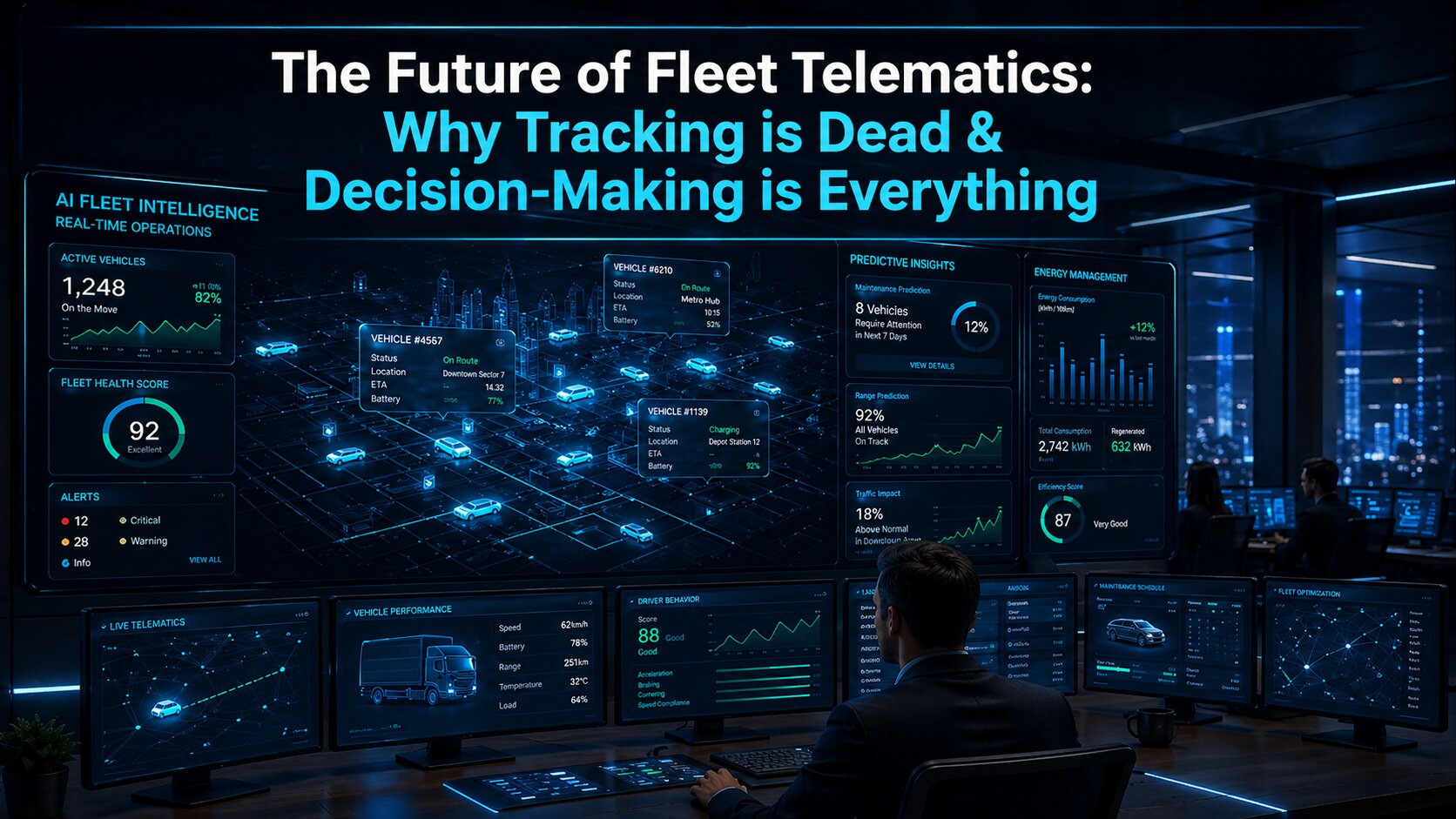
For decades, fleet telematics meant one thing: GPS tracking. Where is the truck? When will it arrive? Basic questions, basic answers. But in 2026, the industry has shifted—seismically. The platforms that will win aren’t the ones that show you what happened. They’re the ones that predict what will happen next and recommend what you should do about it.
This is not incremental change. This is a fundamental reimagining of what telematics means—from a rear-view mirror to an operational control center. AI, connectivity, electric vehicles, and advanced video intelligence have converged to create a new era of fleet operations. The fleets that understand this shift will cut costs by 15–20%, reduce accidents by up to 30%, and operate with precision that older systems cannot match.
Let’s explore what’s really happening in 2026 and what your fleet needs to thrive.
1. The Paradigm Shift: From Tracking to Intelligence
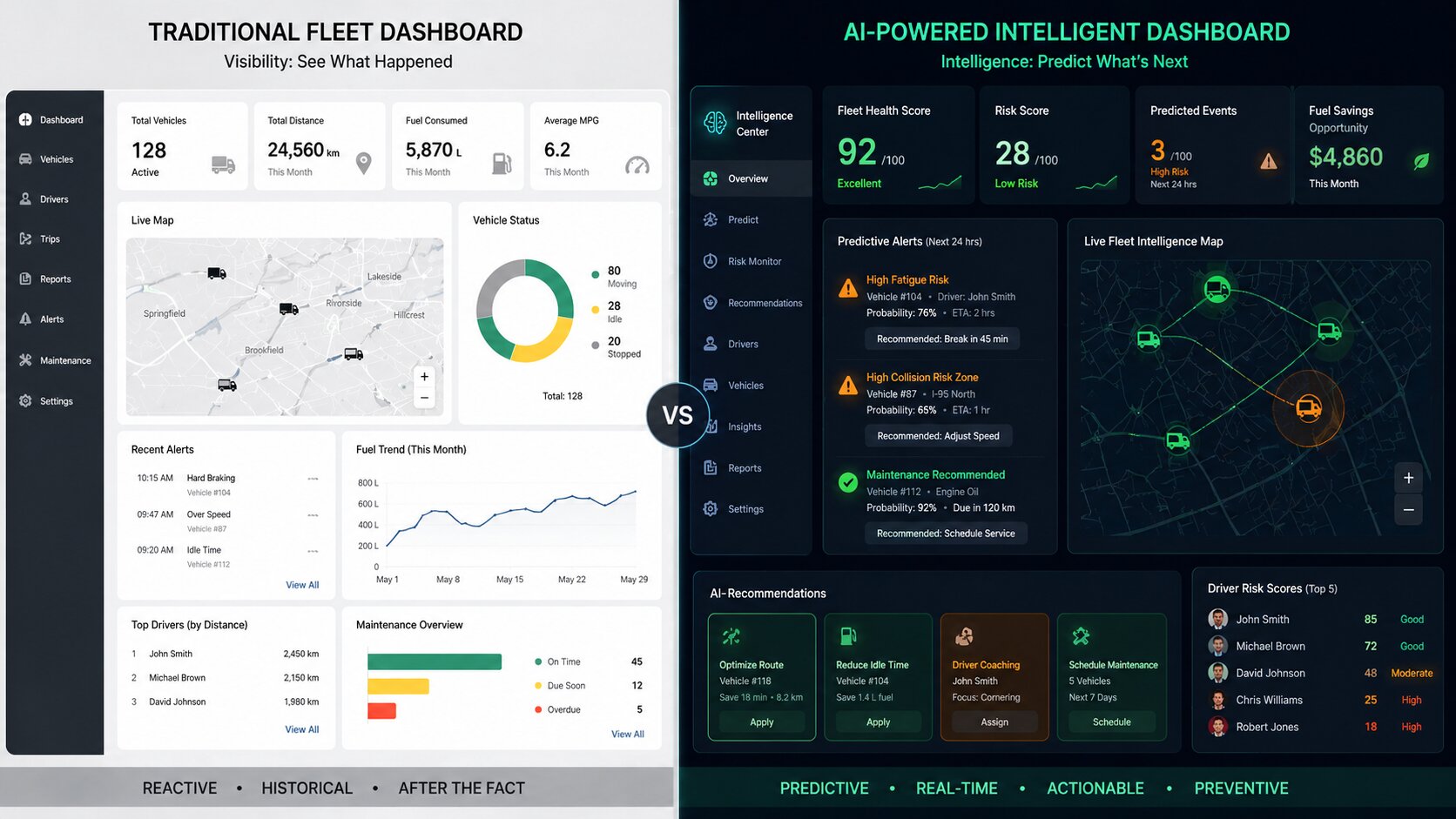
The shift from reactive tracking to proactive intelligence represents one of the biggest changes in fleet technology. For years, telematics platforms were designed around a simple model: collect data, display it, wait for problems. You’d get an alert after a harsh brake event happened. You’d see the accident in a report. You’d identify fuel waste after the fact.
In 2026, the best telematics platforms are predictive, not descriptive. Instead of reporting what happened, they predict what’s about to happen and recommend action before an incident occurs.
The Data Says It All
Fleet managers using AI-powered telematics now report 12–19% reductions in fuel costs, accident costs falling by 19%, and insurance premiums dropping by 11% within the first year of implementation. These aren’t small improvements—they’re transformative.
The difference in thinking is subtle but powerful:
Old Approach: “Your driver had 3 hard braking events yesterday. Here’s the video.”
Reactive. Historical. No prevention.
New Approach: “Driver ABC shows increasing fatigue patterns based on cornering and reaction times. Recommend a break in 45 minutes before risky highway segment. Historical coaching didn’t work—pair this driver with Driver XYZ for mentoring.”
Predictive. Actionable. Prevention-focused.
2. AI Moves from Dashboards to Decisions
AI in fleet management is no longer a nice-to-have visualization tool. It’s now the operational decision engine that fleets depend on daily.
In 2026, AI-powered telematics systems do four critical things that older systems cannot:
✓ Predictive Risk Scoring
AI models analyze historical telematics data to predict which drivers, routes, or vehicles are at elevated risk weeks before traditional diagnostics would catch it. Crash probability scores now combine speeding, hard braking, phone distraction, and cornering data into one actionable score.
✓ Real-Time Recommendations
Instead of batched reports, modern AI telematics deliver real-time recommendations during operations. “Route vehicle ABC around this congestion zone.” “Schedule a break for driver XYZ in 30 minutes.” “Shift this load to vehicle DEF—more efficient battery usage.”
✓ Agentic AI & Automation
The most advanced platforms now feature AI agents that take autonomous actions within defined parameters. These systems don’t just alert you—they make decisions: reroute vehicles automatically, schedule preventive maintenance before failures occur, and optimize charging schedules across the entire fleet in real time.
✓ Natural Language Intelligence
Fleet managers can now query their telematics systems like they’d ask a colleague: “Why did overtime spike last Tuesday?” or “Show me routes with the worst idle time and tell me why.” Generative AI processes the data and delivers insights in seconds, not hours.
The real value isn’t in the AI itself—it’s in operationalizing the data. The fleets cutting costs by 20% aren’t doing it because they have fancy dashboards. They’re doing it because AI is making decisions faster than humans can—and making better decisions based on thousands of data points.
3. Video Telematics: From Optional to Essential
Five years ago, video telematics was a luxury add-on. Today, it’s no longer optional—it’s a core operational requirement.
Adoption Growing Rapidly
46% of fleets now use AI-enabled video telematics—up from 36% in 2023. Among video users, 74% report improved driver safety through AI-powered behavior detection and real-time coaching.
Modern video telematics use AI-powered computer vision to do much more than record accidents. Real-time capabilities now include:
- Distracted Driving Detection: Phone use, eating, fatigue indicators detected in real time, triggering immediate driver alerts
- Event Classification: Hard braking, lane departures, following too closely, running stop signs—all tagged with severity scores within milliseconds
- Driver Coaching: Evidence-based feedback replaces gut feelings. “You had 7 instances of hard braking on Route 42 last week. Here’s what caused them. Here’s the coaching program.”
- Insurance & Legal Defense: In disputed claims, video evidence resolves questions instantly—reducing claim processing time from weeks to days and protecting your drivers from false allegations
The insight driving adoption: high rates of hard braking and excessive speeding significantly increase insurance costs. Fleets that combine video telematics with driver coaching programs report accident cost reductions of up to 30% and insurance premium reductions of 10–15%.
4. Predictive Maintenance Becomes “Predictive Uptime”
Maintenance has always been a major cost center. But 2026 fleets aren’t just predicting what will fail—they’re predicting when it will fail, scheduling service before impact, and keeping vehicles operating with maximum uptime.
The shift: from “fix it when it breaks” to “predict and plan.”
Modern telematics platforms blend three data streams that older systems couldn’t integrate:
✓ Real-Time Sensor Data
Engine temperature, oil pressure, transmission performance, battery health (for EVs), and dozens of other parameters fed continuously into AI models.
✓ Historical Failure Patterns
The AI model learns from your entire fleet’s maintenance history. When transmission temperature shows a specific pattern, it knows from past experience that failure is 8–10 days away.
✓ Parts Availability & Scheduling
The system automatically checks if replacement parts are in stock, whether your mechanic has availability, and schedules service during planned downtime windows—not emergency situations.
The result: fleets implementing predictive maintenance report 15–30% reduction in unplanned downtime and 20–25% lower maintenance costs overall.
5. EV Telematics: A Completely Different Intelligence Layer
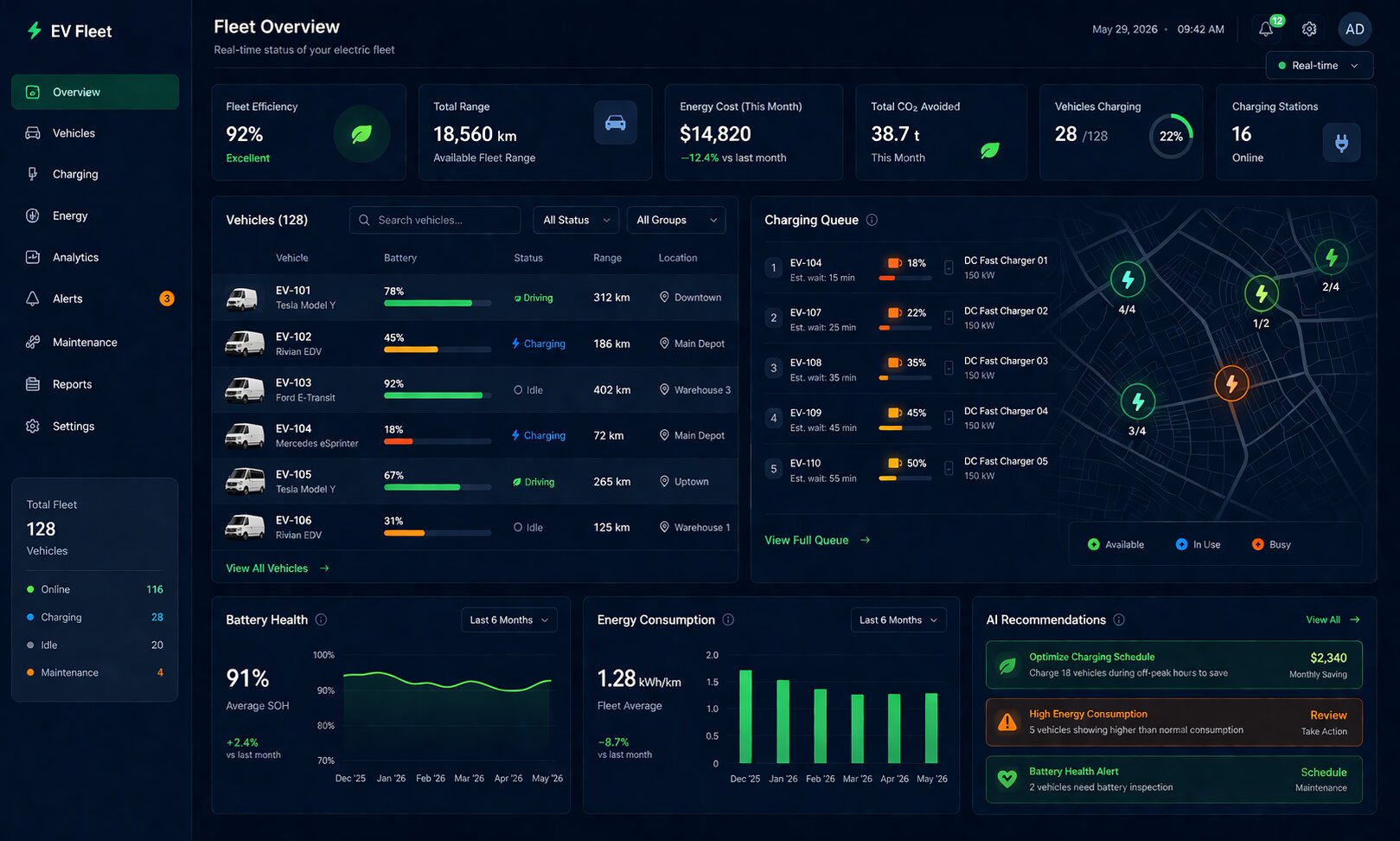
Most fleets are now managing mixed portfolios: electric vehicles, combustion engines, and hybrids operating simultaneously. But EVs don’t follow the same rules as diesel trucks. They need a completely different telematics strategy.
Traditional telematics focuses on engine health and fuel efficiency. EV telematics must track entirely different metrics:
- Battery State of Health: Unlike fuel, battery degradation is non-linear. Telematics must track charge cycles, temperature patterns, and voltage curves to predict when battery capacity will fall below what the vehicle’s assigned routes require
- Real-World Range Prediction: Range varies dramatically by temperature, load, and driving style. Modern EV telematics account for these variables—not just manufacturer specs
- Smart Charging Optimization: When should each vehicle charge? During off-peak hours (saving 30–50% on energy costs)? Between routes? At the depot or at customer sites? Modern systems optimize this across the entire fleet
- Energy Cost Per Mile: Instead of gallons per mile, EV fleets track kWh per mile and optimize based on local electricity rates, vehicle efficiency, and operational windows
EV Efficiency Gains
Fleets implementing dedicated EV telematics with smart charging and range optimization report 60% reductions in electricity costs and 30% improvements in vehicle utilization compared to manual EV management.
For Indian fleet operators specifically, EV telematics is becoming critical as electrification accelerates. Managing a mixed fleet across varied terrain, traffic patterns, and charging infrastructure requires telematics that understands the unique challenges of the Indian roads—not just US highway conditions.
6. Satellite & V2X Connectivity Eliminate Coverage Gaps
For years, telematics had a fundamental weakness: if a vehicle lost cellular coverage, you lost visibility. In remote areas, across borders, or on highways with dead zones, your data stream would simply stop.
In 2026, this problem is solved through two converging technologies:
✓ Satellite Connectivity
When cellular coverage drops, telematics devices automatically switch to satellite communication. This is especially valuable for long-haul operations and operations in rural areas where cell infrastructure is sparse.
✓ Vehicle-to-Everything (V2X)
Vehicles share data with each other and with roadway infrastructure, creating a mesh of continuous visibility and enabling new safety capabilities that were previously impossible. V2X can warn of hazards ahead, optimize traffic flow, and enable platooning efficiency.
The impact: fleets now have reliable, continuous data streams even in operationally challenging environments. This enables time-critical operations (medical supply delivery, perishable goods) to operate with confidence that they’ll maintain visibility throughout their journeys.
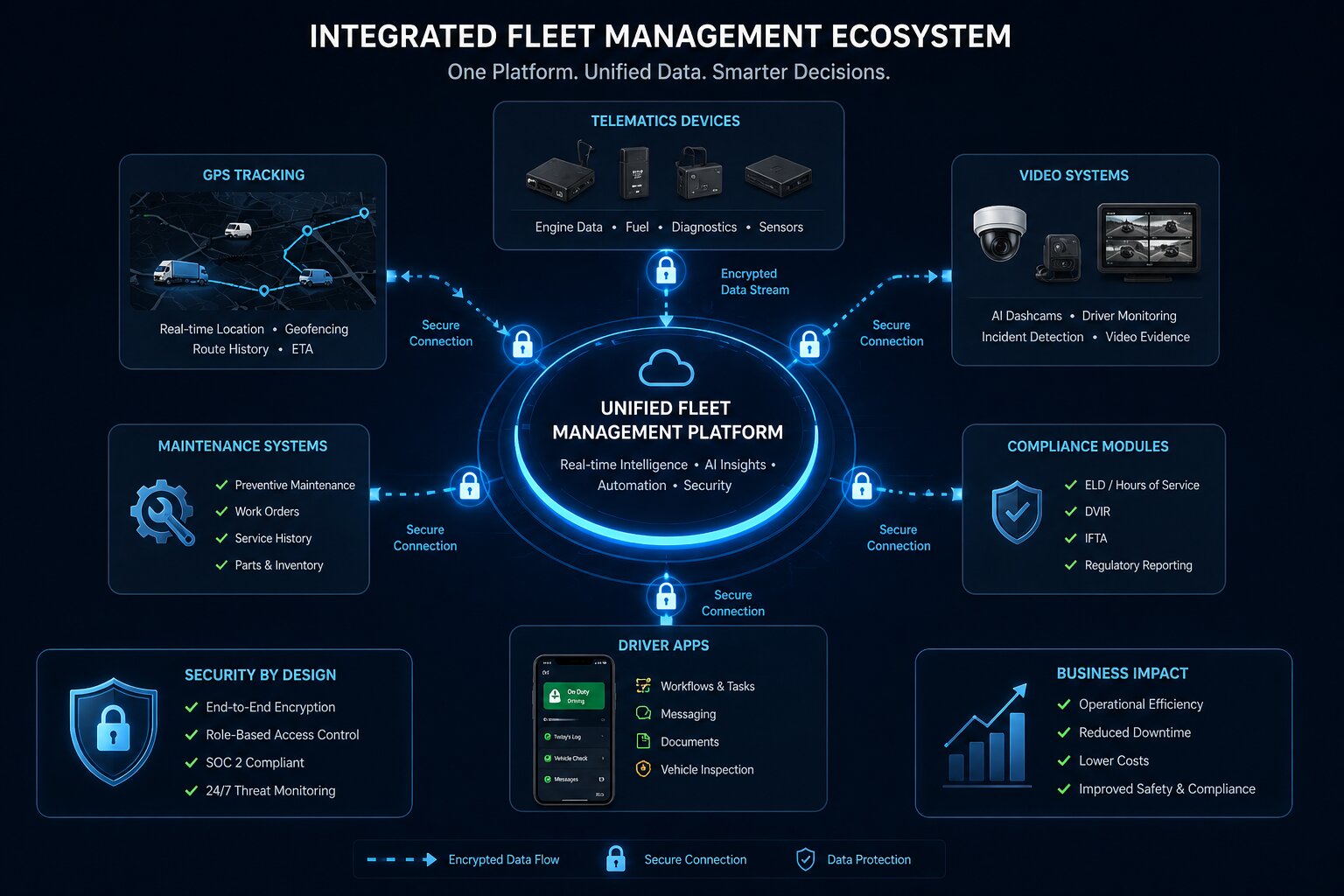
7. The End of Fragmentation: Unified Platforms Win
For the past decade, fleet managers operated with a patchwork of disconnected tools: one system for GPS, another for maintenance, another for compliance, another for driver safety. Each system generated different insights. None of them could talk to each other.
In 2026, this fragmentation is the biggest operational liability. The fleets that will win are consolidating onto unified, all-in-one platforms.
Why does this matter so much? Consider a real scenario:
The Fragmentation Problem
Driver A is flagged in your telematics system for harsh braking. But this information never makes it to your compliance system. Meanwhile, your maintenance system doesn’t know about the braking pattern. And your safety coaching tool isn’t connected to either. So Driver A gets no targeted intervention. Six months later, an accident happens. A unified system would have caught this pattern across all systems and triggered coordinated intervention.
Unified platforms solve this by integrating telematics data with HR systems, compliance tracking, maintenance planning, and safety coaching into one source of truth. This enables holistic, reliable insights that single-purpose tools simply cannot deliver.
8. Data Governance, Security & Privacy Are Now Critical
As telematics collects more data about drivers, vehicles, and operations, governance becomes non-negotiable. Fleets are subject to increasingly strict regulations around data privacy, driver monitoring consent, and cybersecurity.
Modern telematics platforms must provide:
- Clear Data Access Controls: Who can see what data? Which roles have access to driver behavior information? How long is data retained?
- Transparent Driver Policies: Drivers need to understand what is monitored, why, and how the data is used. Platforms that provide this transparency build trust and adoption
- Cybersecurity & Encryption: All data in transit and at rest must be encrypted. APIs must be secure. Attack surfaces must be minimized
- Compliance Automation: Electronic logging devices (ELDs), Hours of Service (HOS), carbon emissions reporting, and other regulatory requirements should be automated within the platform
The best unified platforms consolidate security management within one architecture, reducing your digital attack surface and providing a clear chain of custody for all operational data.
9. Making the Transition: What This Means Practically
If your fleet is still operating on a 2018-era telematics system, the gap between you and forward-moving competitors is widening rapidly. The shift from tracking to intelligence isn’t hypothetical—it’s happening now, and it’s creating measurable competitive advantages.
Here’s what you should be evaluating in 2026:
1. AI & Predictive Capabilities
Does your platform predict failures before they happen, or just report them after? Can it recommend actions, or just show you data? Real AI platforms don’t just display information—they make and defend recommendations.
2. Video Telematics Integration
Is video data integrated into your core platform, or siloed in a separate system? Modern platforms integrate video intelligence into safety scoring, coaching workflows, and compliance reporting—not as an add-on.
3. EV Readiness
If you’re adding EVs to your fleet, does your platform handle battery telematics, charging optimization, and mixed fleet reporting? Traditional platforms often struggle with EV-specific metrics.
4. Unified Architecture vs. Integration Debt
Is your system a true all-in-one platform with native integration, or a collection of separate tools connected via APIs? API-based architectures create “integration debt”—fragile connections that break, slow performance, and leak security.
5. Open APIs & Ecosystem
While a unified core is critical, does the platform have open APIs for custom integrations? The best platforms have both—unified core for core operations, open APIs for flexibility.
The Future Belongs to Intelligent Fleets
The future of fleet management is not dashboards—it’s decisions. The platforms that will lead the market in 2026 and beyond aren’t the ones with the prettiest maps. They’re the ones that predict accidents before they happen, optimize routes in real time, manage battery health across mixed EV fleets, coach drivers based on patterns and potential, and integrate every piece of operational data into a single source of truth.
For Indian fleet operators managing the unique challenges of Indian roads—variable infrastructure, mixed vehicle quality, diverse driver training levels, and rapid EV adoption—the need for intelligent telematics is even more acute. A system that understands your roads, your drivers, and your vehicles as an integrated whole will outperform fragmented competitors by 25–35%.
The transition is not going to happen automatically. It requires choosing the right platform partner—one that has invested in true AI capability, understands the Indian fleet landscape, and can guide you through the shift from tracking to intelligence.
Ready to Transform Your Fleet into an Intelligent Operation?
Navionyx combines AI-driven telematics, video intelligence, EV optimization, and predictive maintenance into one unified platform built for Indian fleets. See how you can cut operational costs by 20%, reduce accidents, and stay compliant—without the fragmentation of traditional systems.
Get a Free Demo →*Data sources: Verizon Connect 2026 Fleet Technology Trends Report, Geotab Telematics Trends 2026, industry surveys and case studies from leading fleet operators